Stories of Karachi’s Taxi Drivers from 1993 to 2000
Zaffar Junejo
[Author’s Note: I joined a non-government organization in mid-1993. In those days, we were frequent travelers to other Asian countries, and during that period I maintained a diary. I once showed the notes to Muhammad Ibrahim Joyo — the legendary scholar, translator, and intellectual giant of the Sindhi world — who suggested categorizing the entries by theme and getting them published. He recalled that long ago, perhaps in 1955, the Sindhi journal Mehran had launched a similar idea titled ‘Hik Deenh Ji Ghaleh’ (The Story of a Day), even offering a prize for it. He himself had submitted the first story, he told me with a smile, just to set a standard for other writers. Later, Maulana Ghulam Muhammad Girami, a scholar of high standing and journalist; Shamsher ul Haidri, a distinguished Sindhi poet, journalist, and playwright; and Siraj ul Haq Memon, an iconic novelist, linguist, and journalist, all contributed their observations of a single day. These writings were published until 1968.
I agreed with Joyo Sahib that I would group the write-ups by subject and get them published, but I failed to do so. Recently, I sat down to organize my notes. I found various entries about the taxi drivers of Karachi city. Some were very brief and incomplete; others were short but held a finished truth. I have chosen five stories from each year, all of them gathered from the drivers of those cars. In total, there will be thirty-five stories covering the period from 1993 to 2000.]
A City Turned Barracks
The wind came down from the north, sharp and crisp.
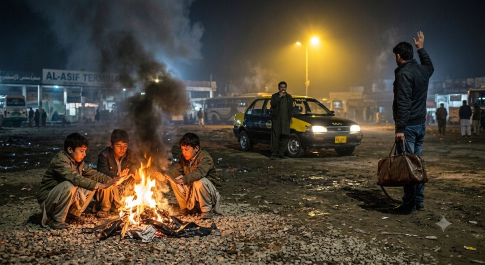
Inside the coach from Hyderabad, the glass pane stayed cold against my temple. The long evening with friends had left a quiet ache behind my eyes, a warmth that evaporated the moment my boots hit the gravel at the Al-Asif terminal. It was nine o’clock.
Near the edge of the lot, three young Afghan boys crouched around a small fire. They fed the flame with strips of black plastic, discarded cotton rags, and thick, sweet-smelling grease. The smoke rose heavy and bitter in the frost. They did not speak; they held their palms close to the chemical heat, their faces orange in the dark.
The travel bag felt heavy in my right hand. Fifty yards away, under a yellow streetlamp, a taxi sat idling. A man stood by the fender. A single wave of my hand was enough. The man flicked a half-burned cigarette into the dirt, stepped inside, and let the car roll forward until the bumper nearly touched my trousers.
“Gulshan-e-Iqbal,” I said through the lowered glass.
The driver looked through the dark of the cabin. “Two ways. We can go by the university, down past NIPA. Or we take the bypass—Jamali Pul, Sachal, then down toward the Dow Medical ground.”
“The bypass is better,” I said, lifting my bag onto the back seat. The seat was cold through the wool of my coat.
The driver put the car in gear. He held up a pack of Gold Flake. “You mind?”
I nodded.
The match flared, casting sharp shadows over a lined forehead and a graying mustache. He drew deep, then cracked his window an inch to let the gray smoke slip out into the winter night.
“In weather like this,” the driver said, his voice flat and steady like the engine, “only two things stay loyal to a man on the road. Tea and tobacco.”
The car moved onto the tarmac, the headlights cutting through the haze. The city outside was quiet, shrunk by the cold.
“Exactly where in Gulshan?” the driver asked.
“The Crescent Complex. Near the Accounts General office.”
“Are the link roads open, or is it all alleys?”
I shifted my weight. “Why do you ask?”
The driver smiled into the rearview mirror. His teeth were dark from the leaf. “The gates. Every sector has the iron barriers up now. The MQM boys close them early when the cold sets in. Speed breakers every ten yards. At this hour, if you get caught in the grid of closed gates, you do not get out unless someone finds a sector in-charge and gets permission from him to open the gate.” He glanced back to see if his words landed. I nodded. “It is a tragedy,” the driver said. “Our brothers have turned a city into a barracks.”
He laughed then, a low chuckle that ended in a cough.
“We are strange people,” the driver said. “First, we cry to the municipality. We march. We demand metaled roads. ‘Give us asphalt,’ we say. Then, the day the steamroller leaves, we gather bricks and mix cement to build speed breakers. Because the children are unsafe.”
I watched the dark shopfronts slide past. “You do not talk like a taxi driver.”
“I am a senior clerk at the Sindh Secretariat,” the man said. He did not turn his head. “The car belongs to my brother-in-law. It buys the coal and the flour.”
“You speak with sense.”
“If you have the time,” the driver said, clearing his throat, “there is an old story that resembles the people of Karachi.”
“Tell it.”
“A man lost his way in the high snows of the north,” the driver said, his hands steady on the wheel as they cleared the Jamali Bridge. “A mountain bear found him. The bear was kind and took him into his cave. Before the bear could strike a flint for the hearth, he saw the man blowing onto his hands. ‘Why do you do that?’ the bear asked. ‘My hands are frozen,’ the man said. ‘The breath warms them.'”
The driver shifted into third. The engine whined.
“Then the bear boiled a pot of wild broth. He poured it into a stone bowl and handed it over. The man took it, immediately set it on the dirt, and began blowing hard into the steam. The bear watched him. ‘Why do you blow now? Is it not hot?’ ‘It is too hot,’ the man said. ‘The breath cools it.'”
The driver let the silence hang for a moment as the headlights caught the empty grounds of the Sunday Bazaar.
“The bear stood up,” the driver said. “He told the man to leave the cave. The man wept. ‘Why do you cast me out into the frost?’ and the bear said, ‘I cannot live with a creature who acts the same way for two different things.'”
The driver loosened his grip on the wheel. “That is Karachi. We use the same breath to ask for the road and to ruin it.”
“You tell it well,” I said.
The car slowed. The dark concrete blocks of the Crescent Complex rose against the gray sky.
“What do I owe you?”
“Five hundred,” the driver said. Then he corrected himself. “Four hundred for the distance. One hundred extra for the night.”
I pulled the notes from my pocket and passed them through the gap in the seats. “The extra hundred is for the tea and the tobacco then. The loyal ones.”
The clerk smiled, his mustache twitching in the dim dashboard light. “Yes,” he said. “The ones that do not change.”
I lifted the bag from the seat. The door clicked shut, and the car moved off, its red taillights first shrinking into the cold and then disappearing.
_____________________
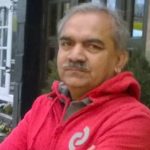 Dr. Zaffar Junejo has a Ph.D in History from the University of Malaya. His areas of interest are post-colonial history, social history and peasants’ history. He may be reached at junejozi@gmail.com