Reforming Pakistan’s University Admission Policy
From Producing Degrees to Producing National Talent

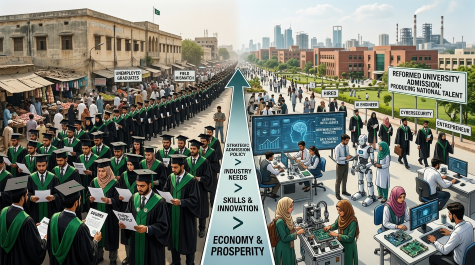
Pakistan stands at a defining moment in its educational journey. The challenges of the twenty-first century demand far more than increasing the number of university graduates. They require a workforce capable of driving innovation, solving complex national problems, and competing confidently in the global knowledge economy.
By Nuzair Ahmed Jamro
Why Pakistan Must Align Higher Education with the Needs of the Future
Every year, thousands of young Pakistanis step onto university campuses carrying dreams of a brighter future. They believe that years of hard work, academic dedication, and a university degree will open the doors to stable employment and a better quality of life. Their families often make enormous financial sacrifices in the hope that higher education will transform not only the lives of their children but also the future of entire households.
Unfortunately, for many graduates, this dream begins to fade shortly after graduation. Instead of finding meaningful employment, they are confronted with an increasingly competitive job market where opportunities are limited and their qualifications often fail to match employers’ needs. As unemployment among educated youth continues to rise, an uncomfortable but unavoidable question demands our attention: Are Pakistan’s universities preparing students for the future, or are they simply producing more degree holders than the economy can absorb?
This question is no longer confined to academic discussions. Rather, it has become a national concern that directly affects economic growth, industrial productivity, social stability, and the future aspirations of millions of young Pakistanis. Therefore, it is time to rethink not only what we teach in our universities but also who we admit and why.
An Expanding System without Strategic Direction
Over the last two decades, Pakistan has witnessed remarkable growth in higher education. New universities have been established across the country, while student enrolment has increased significantly. On the surface, this expansion appears to be a success story, reflecting greater access to education and improved educational opportunities.
However, expansion alone cannot guarantee progress. As the number of institutions has increased, long-term planning has failed to keep pace. In many universities, admission quotas continue to be determined largely by available classrooms, faculty strength, institutional infrastructure, or financial sustainability. Rarely are these decisions based on careful assessments of future workforce requirements or the evolving needs of Pakistan’s economy.
Consequently, the higher education system has gradually become supply-driven instead of demand-driven. Universities continue producing graduates in large numbers without adequately considering whether sufficient employment opportunities exist in those disciplines. While degrees continue to multiply, suitable jobs do not.
When Education and Employment Move in Different Directions, The consequences of this imbalance are becoming increasingly visible.
Read: Pakistan’s Higher Education System—What went Wrong and How to Fix it
Every year, thousands of graduates enter the labor market only to discover that their qualifications no longer correspond with available employment opportunities. Many remain unemployed for months or even years, while others reluctantly accept jobs unrelated to their field of study simply to earn a living. A significant number eventually seek opportunities abroad, contributing to Pakistan’s growing brain drain.
Ironically, while many graduates struggle to secure employment, several industries continue to report serious shortages of skilled professionals. Employers frequently highlight the shortage of experts in artificial intelligence, cybersecurity, robotics, renewable energy, biotechnology, semiconductor technology, advanced engineering, data science, automation, and digital innovation. These sectors are shaping the global economy, yet Pakistan continues to produce comparatively fewer graduates with expertise in these emerging fields.
This paradox clearly demonstrates that Pakistan does not suffer from a shortage of graduates. Rather, it suffers from a shortage of graduates equipped with the skills that modern industries actually require.
Why Admission Policies Must Be Guided by Labor Market Research
If Pakistan genuinely wishes to build a competitive economy, university admission policies can no longer rely solely on institutional capacity or historical trends. Instead, admission planning should begin with one fundamental question: What kind of workforce will Pakistan need over the next ten to twenty years?
Answering this question requires continuous labor market research, economic forecasting, and close collaboration between government, industry, universities, and professional bodies.
Such research can identify future employment trends, technological disruptions, emerging industries, regional development priorities, and critical skill shortages. Armed with this information, universities would be able to adjust admission quotas before imbalances become crises rather than reacting after graduates have already entered an oversaturated job market. In other words, admissions should not merely reflect today’s realities; they should prepare students for tomorrow’s opportunities.
Learning from Countries That Planned for the Future Around the world, many successful economies have already embraced this approach.
Germany, for example, closely integrates universities with industry through vocational education, apprenticeships, and applied research. Students graduate with practical skills that employers immediately require, making the transition from education to employment considerably smoother.
Similarly, South Korea deliberately expanded engineering and technology education during its period of rapid industrialization. That strategic investment eventually produced the highly skilled workforce behind globally recognized technology companies.
Singapore offers another excellent example. Rather than allowing universities to operate independently of economic planning, the government regularly adjusts university admissions according to national development priorities and projected workforce demands. This proactive approach enables graduates to remain competitive in a rapidly changing global economy.
Likewise, the United States and Japan continue investing heavily in research universities while strengthening partnerships among academia, industry, and government. Their experience demonstrates that higher education becomes most effective when it serves national development rather than operating in isolation.
These examples offer an important lesson for Pakistan: successful university systems do not simply educate students they strategically prepare the workforce that the future economy will require.
Pakistan’s Missing Link
Pakistan is not without capable institutions. Higher Education Commission, Pakistan (HEC) has played an important role in improving quality assurance and expanding access to higher education. Likewise, Pakistan Engineering Council (PEC) continues regulating engineering education and professional standards.
Nevertheless, one crucial gap remains.
Admission planning still lacks meaningful coordination with labor market data, industrial policy, technological forecasting, and long-term national economic planning. Universities, policymakers, employers, and regulatory bodies often work independently instead of pursuing a shared vision for workforce development.
Unless these institutions begin collaborating more effectively, Pakistan will continue producing graduates whose qualifications do not fully align with the country’s future economic needs.
Why Reform Matters
Reforming university admission policies is not simply about reducing unemployment. Its impact extends far beyond graduate employment. When universities produce graduates whose skills match market demand, industries become more productive, innovation accelerates, research improves, exports increase, and foreign investment becomes more attractive. Employers spend less time searching for qualified professionals, while graduates enjoy stronger career prospects and higher incomes.
At the same time, universities themselves benefit by improving research quality, strengthening industry partnerships, enhancing international rankings, and increasing graduate employability. Ultimately, a well-planned admission system benefits students, employers, universities, and the national economy alike.
The Way Forward
Moving towards a demand-driven higher education system requires both vision and political commitment. Pakistan should establish a National Workforce Forecasting Council responsible for analyzing future labor market trends and identifying emerging skill requirements. Labor market research should become a compulsory component of admission planning for all universities.
Furthermore, industries, employers, professional councils, and universities must jointly determine admission quotas based on projected workforce needs rather than institutional convenience alone. Academic programs should also undergo periodic review so that universities can expand enrolment in high-demand disciplines while gradually reducing admissions in fields experiencing persistent oversupply.
Finally, universities should be evaluated not merely by the number of students they enroll or degrees they award, but by the employability of their graduates, the quality of their research, their contribution to innovation, and their overall impact on national development.
Conclusion
Pakistan stands at a defining moment in its educational journey. The challenges of the twenty-first century demand far more than increasing the number of university graduates. They require a workforce capable of driving innovation, solving complex national problems, and competing confidently in the global knowledge economy.
For too long, higher education has been measured by the number of degrees awarded. It is now time to measure success by the value those graduates create for society. Universities should not merely function as institutions that distribute degrees. They should become centers of innovation, entrepreneurship, scientific discovery, technological advancement, and economic transformation.
Reforming university admission policies is therefore not simply an educational reform, it is a national economic imperative. If Pakistan succeeds in shifting its focus from producing degrees to developing skilled, innovative, and future-ready talent, it will not only empower its youth but also lay the foundation for sustainable economic growth and long-term national prosperity.
Read: Shaikh Ayaz University: Hope and Opportunity
_______________________
 Hailing from Shikarpur, Nuzair Ahmed Jamro, is a Civil Servant and Research Fellow in Public Administration. He can be reached at: najamro@gmail.com