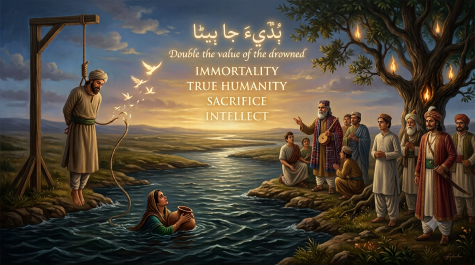
Double the value of the drowned is not just a proverb, but a philosophy of human values.
Naveed Sandeelo
The greatest question of human life is: Why are we born? Is the purpose of our existence merely to eat, drink, sleep, reproduce, and then quietly pass away? If that were the case, there would be no fundamental difference between humans and other animals. A Sindhi proverb also emphasizes true humanity: “Cattle desire satisfaction [food], but humans desire humanity.” The greatness and perseverance of a human being are not based on their property, wealth, or money, but on their consciousness, intellect, insight, wisdom, creative endeavors, revolutionary path, moral courage, self-sacrifice, encouragement, confronting falsehood, awakening others from the deep slumber of unconsciousness, and the values for which they live and, when necessary, die.
The Yogi awakened me; I was fast asleep,
Only then did I attain the vision of the Beloved while still alive.
— (Shah Abdul Latif Bhittai)
It is commonly said, “ٻُڏيءَ جا ٻيڻا” (Double the value of the drowned)—meaning that whoever sacrifices themselves for a noble cause or for their nation is remembered with immense pride. Those who do nothing and die in the comfort of their beds leave behind an existence as though they never existed at all. Latif Saien says:
“The dust settled over those who remained seated.”
The person who, in pursuit of their goal, challenges the obstacles in their path, refuses to surrender, stays ahead of the rest, adopts a courageous attitude, and drowns in the middle of the deep currents while crossing the river’s waves—their physical death attains immortality and lives on in history. Some people definitely perish physically, but their thoughts, their voices, and their principles are reborn with double the strength. They die physically, but their ideas live on from generation to generation. Such people are not defeated by death; rather, death itself becomes the source of their eternal survival.
The greatest and most just trend of modern history is that it has now forgotten kings, conquerors, and vast empires, but it forever remembers those foot-soldiers, the humble workers, the brave, the makers of history, creators, poets, artists, intellectuals, painters, and sages who suffered hardships in the path of truth but kept its banner flying high. The individuals who were labeled as criminals, rebels, or infidels in their own eras were declared benefactors of humanity by succeeding generations.
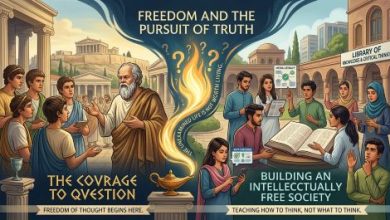
The ancient Greek philosopher Socrates is a shining example of this. Walking barefoot through the streets and marketplaces of Athens, he taught young people to question, to think logically, and to seek the truth. When he was accused of corrupting the youth, he was given several opportunities to save his life. Had he wished, he could have apologized and lived a comfortable, luxurious life in another country. Instead, he chose to drink the cup of poison rather than abandon his principles. His body died, but he lives on today in the world of philosophy. The names of those who leveled false accusations against him have been buried in the dust of history, but the name of Socrates has become a metaphor for human consciousness.
Similarly, Giordano Bruno refused to bow before the religious tyranny of his time. He was burned alive, but the fragrance of his thoughts continues to expand human knowledge. Today, those ideas are part of the journey of modern science. The fire could burn his body, but it could not singe his intellect. His scientific thinking mirrors the thought of the modern era.
The same fate befell the great scholar of Alexandria, Hypatia, who was a magnificent teacher of mathematics and astronomy. Her only crime was that she taught the books of Plato and mathematics, which were then labeled as impurity and infidelity. Furthermore, like the tradition of philosophers, she walked the path of understanding and explaining the universe through her own eyes. Consequently, religious fanatics burned down her academy, imprisoned her father, stripped her naked, tore her body into pieces, and finally threw her into a raging fire. Yet, her name stands today as a symbol of independent research and intellectual freedom.
In human history, the sacrifice of Imam Hussain and his family stands before us. Fighting for the right, he refused to allegiance to the tyrant of his time, Yazid. By giving his life along with his innocent children and his entire family before spears and swords on the battlefield of Karbala, he held the head of truth high and became immortal.
In the world of spirituality, the example of Mansur Al-Hallaj is even more astonishing. He raised the chant of “Ana al-Haq” (I am the Truth), which was not an expression of arrogance but of spiritual unity. Even when he was put on the gallows, the peace and smile never faded from his face. He knew that the body would perish, but the fire of love would never be extinguished. Because of this, despite the passage of centuries, Hallaj remains a living metaphor for Sufi love.
The land of Sindh is also not devoid of such immortal souls. When Shah Inayat Shahid raised the slogan “He who tills has the right to eat,” it was not merely a question of land distribution; it was a declaration of human justice. It was the first challenge to the yoke of tyranny and inequality, laying new foundations for social coexistence. The tyrannical Mughal rulers beheaded him, but they could not eliminate his thought. Today, in every debate on social justice, his name is taken with reverence, and the followers of his philosophy travel far to pay homage to his soil.
Jesus Christ came to this earth as a messenger of love to turn it into a paradise. He gave people the vision of wisdom and taught them to love their neighbors. When they brought a courtesan (Mary Magdalene) to be stoned to death, he told the crowd that he had come not to take life, but to give life. Because of his message of love, the contemporary clergy crucified Jesus. In every era, the Jesus of that time is crucified and stoned in exchange for love. Yet, centuries later, Jesus’s message of love and call for truth remains the heartbeat of millions. Jesus, who healed the pain of suffering humanity, was uniquely addressed in the Holy Quran as “Ibn-e-Maryam” (the Son of Mary). In the words of the great poet Mirza Ghalib:
ابن مریم ہوا کرے کوئی
میرے دکھ کی دوا کرے کوئی.
Would that someone be like the Son of Mary,
Would that someone cure my grief!
Sarmad Kashani was another dervish-souled man who refused to bow before worldly power. Even when he was brought out to be executed, words of love, not fear, were upon his lips. Such people do not die; they remain awake in the human conscience.
In the folklore of Sindh, the tale of Sohni gives a new meaning to the philosophy of immortality. Even when she discovered that her clay pot was unbaked, she did not turn back. She prioritized her love over her physical life. Eager to meet Mehar, with an anxious yet passionate heart, she waded through the whirlpools on a pitch-black, freezing winter night amidst falling dew, and was eventually swept away by the deep currents, finally uniting with her beloved, who was sweeter than honey. Bhittai Saien portrayed Sohni not just as a lover, but as a fearless, brave character who challenged every obstacle, becoming a symbol of spiritual freedom. Therefore, though Sohni drowned in the river, she became eternally alive in literature and human emotions. Shah Latif beautifully expresses this philosophy of gaining double the value through drowning in the character of Sohni:
How would she be renowned, had Sohni not entered the deep currents?
Life here was not to last forever anyway.
The cup given by the Beloved drove her ecstatic,
Sayeth Sayyid [Latif], love sacrificed Sohni,
She would have died regardless, but by drowning, her worth doubled.
In the struggle for national liberation, the example of Hemu Kalani is identical. Accepting the gallows at a young age, refusing to name his comrades, and choosing death over slavery made him a permanent part of the national consciousness. The British Empire came to an end, but Hemu Kalani’s name became immortal in the history of freedom.
Human survival is tied not only to sacrifice but also to creation. Shakespeare, Pushkin, Dostoevsky, Tolstoy, Rumi, Shah Abdul Latif Bhittai, Mirza Ghalib, Miraji, Sahir, Faiz Ahmed Faiz, and Kahlil Gibran are no longer physically with us, but their books, poetry, and thoughts continue to influence the lives of millions of people today. A creator lives more in their creation than in their physical self.
Existentialist philosophies also teach us that humans create their own existence through their choices. Freedom, responsibility, and standing firm on principles are what elevate a human being above a mere biological existence. The person who lives only for the survival of their own self is forgotten with time; but the one who lives for collective consciousness, national survival, truth, justice, love, and knowledge becomes an indelible part of history.
Ultimately, “ٻُڏيءَ جا ٻيڻا” (Double the value of the drowned) is not just a proverb, but a philosophy of human values. Driven by a fearless will and free from greed, some people—like Sohni—drown in the middle of deep waters for noble causes; some—like Jesus—adorn the cross; and some—like Mansur—ascend the gallows. But through their sacrifice and virtuous legacy, they attain immortality in history and rise with double the glory. Their bodies return to the dust, but their intellect illuminates the path of humanity for centuries. For such people, death is not an end, but the beginning of a new life. Their existence does not perish; it lives forever in history, literature, philosophy, science, and the human conscience. Their love is not that of ordinary people, but is uniquely miraculous. For such magnificent souls, the gallows feel as comfortable as a bed of roses. In the words of Shaikh Ayaz:
Love performed miracles, turning infidelity into faith for the heart,
The moment your memory arrived, my Beloved, it made the gallows look easy.
Read: Topography of Memory and Resistance
____________________
 Naveed Sandeelo is a poet, writer and critic, and Lecturer at Department of Philosophy University of Sindh Jamshoro. He is author of five books: three books are on the subject of philosophy. Doing PhD at the department of Philosophy University of Karachi.