The real question for humanity is not whether conflict exists, but whether mankind can transform the aftermath of conflict into justice, coexistence, and civilization rather than endless domination.
By Noor Muhammad Marri, Advocate | Islamabad
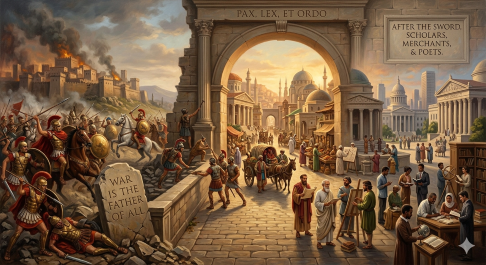
The ancient philosopher Heraclitus once said, “War is the father of all.” Centuries have passed, yet human history still appears to move under the shadow of this harsh reality. Modern morality may reject war, intellectuals may condemn violence, and religions may preach peace, but the structure of civilization itself often emerged from conflict, conquest, resistance, and consolidation.
Usually people present history in moral language, but history itself moves through power. Empires did not expand through sermons; they expanded through armies. Borders were not drawn by philosophers; they were drawn by victories and defeats. Even civilizations that later became symbols of law, culture, and refinement were born in periods of bloodshed and struggle.
In the subcontinent too, it is often argued that the philosophy of Mahatma Gandhi defeated the United Kingdom. But such explanations ignore the larger global reality. The real turning point was World War II, which exhausted Britain economically, militarily, and psychologically. The empire no longer possessed the strength to maintain direct colonial control over vast territories. Anti-colonial movements certainly played their role, but global power equations had already shifted. History often changes not only because people desire freedom, but because empires lose the capacity to continue domination.
War, however, is only the first phase. After destruction comes consolidation. After conquest comes amalgamation. Civilizations are not created merely by military victories; they are shaped when different cultures, values, traditions, and populations begin interacting under new political realities. Almost every great civilization emerged from this process.
The Mongol conquests began with extraordinary violence, yet they later connected vast regions of Asia and Europe, opening routes for trade, diplomacy, and intellectual exchange. Muslim empires in the subcontinent were not merely military occupations; over centuries they produced blended cultures, languages, architecture, customs, music, and administrative systems. Even modern European nation-states such as Germany and Italy emerged after prolonged wars and political consolidation.
If we carefully observe human history, civilization and interaction among nations often took place under the shadows of swords. The Silk Road flourished because powerful empires secured routes through military authority. Conquest was followed by trade; trade was followed by cultural exchange; and cultural exchange slowly produced new social realities. Armies opened roads, but afterward came scholars, merchants, saints, poets, and craftsmen.
Yet force alone never sustains a civilization. The sword may establish authority, but legitimacy preserves it. Every empire that relied only upon violence ultimately collapsed under its own weight. Durable civilizations emerged where power transformed itself into law, administration, economic integration, and cultural accommodation. History therefore is not merely a story of war, but of what societies build after war.
Modern states still behave according to this old logic, though they hide it beneath sophisticated language such as development, democracy, security, or globalization. Behind many political slogans remains the same struggle for power, influence, resources, and strategic control. Human civilization may speak the language of peace, yet the structure of international politics continues to move through competition and conflict.
Thus, when Heraclitus declared that war is the father of all, he was not glorifying bloodshed alone. He was pointing toward a painful truth about human history: conflict has repeatedly acted as the force that breaks old structures, creates new realities, and pushes societies into transformation. The real question for humanity is not whether conflict exists, but whether mankind can transform the aftermath of conflict into justice, coexistence, and civilization rather than endless domination.
Read: From Divine Kings to People’s Voice
__________________
 Noor Muhammad Marri Advocate & Mediator is based in Islamabad