History of Secularism and Democracy in Biblical Tradition
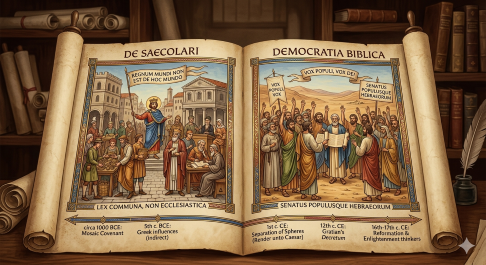
- Secularism itself emerged from within Christian and Biblical tradition. Secularism was not originally born as atheism or hatred of religion. It was the outcome of internal restructuring of authority within Christian civilization. Later, secularism gradually developed into an independent political philosophy.
Noor Muhammad Marri Advocate | Islamabad
In our society, it has become a strange fashion that whenever someone wants to appear “modern,” “progressive,” or intellectually superior, the first target becomes religion. Such people loudly claim that secularism, democracy, human rights, and modern political systems emerged through rebellion against religion, as if Europe one morning suddenly threw away the Bible, expelled the Church, and discovered civilization in empty streets. This narrative may sound attractive in drawing rooms, seminars, and donor-funded intellectual circles, but historically it is shallow, incomplete, and deeply misleading.
The reality is that secularism itself emerged from within Christian and Biblical tradition. To understand European political evolution without understanding Christianity is like trying to understand a tree while denying the existence of its roots. Secularism was not originally born as atheism or hatred of religion. In Biblical political thought, the distinction between priest and king, Church and Crown, spiritual authority and temporal authority, already existed. The Church dealt with spiritual matters while kings administered worldly affairs. When certain powers shifted from priests to monarchs or the state, those matters became “secular.” At that stage, secular simply meant worldly administration, not denial of God.
The famous Biblical phrase, “Render unto Caesar what belongs to Caesar and unto God what belongs to God,” became one of the foundations for distinguishing political and religious authority in Europe. Later, centuries of conflict between Church and monarchy produced constitutionalism, courts, parliaments, and limitations on absolute power. Had this internal struggle not existed, Europe might have remained under permanent absolute monarchies.
In reality, the modern European state was not built upon the ashes of religion but upon the evolution of religious civilization itself. Secularism did not emerge from a vacuum. It was the outcome of internal restructuring of authority within Christian civilization. Later, secularism gradually developed into an independent political philosophy, but its historical roots remained deeply embedded in Biblical tradition. Ironically, the child later began denying its own parent.
The same applies to democracy. Democracy did not descend from the skies of modernity overnight. Christianity placed enormous importance upon individual salvation. Every human being stood individually before God, responsible for his own actions and conscience. This idea slowly strengthened the concept of individual worth, individual morality, and eventually individual political rights. Once the individual gained religious significance, political significance gradually followed. Voting rights, representation, citizenship, and equality before law were not born in empty philosophical laboratories; they evolved through centuries of religious and moral transformation.
In many ways, the modern citizen is the political descendant of the Christian believer standing individually before God. If every soul possesses value before divine judgment, then eventually every citizen begins demanding value before the state as well. Thus democracy itself carries traces of theological origins, whether modern intellectuals admit it or not.
Even European kings themselves ruled through religious legitimacy. The doctrine of the “Divine Right of Kings” dominated Europe for centuries. Monarchs ruled under Biblical sanction, took oaths upon holy books, and were crowned through religious ceremonies. Even today, constitutional traditions in countries like the United Kingdom continue carrying visible Christian influence beneath their modern political structures.
Yet in our region, many self-proclaimed intellectuals reduce centuries of European history into a few fashionable slogans. According to them, religion represents backwardness while secularism appears almost like divine revelation itself. They forget that the political concepts they worship also emerged from religious history. They abuse the roots while comfortably sitting under the shade of the same tree.
The real problem is perhaps not secularism or democracy themselves, but our shallow understanding of history. We have transformed historical processes into emotional slogans. We memorize conclusions without understanding the centuries of intellectual, theological, political, and social struggles that produced them. That is why our debates generate more noise than knowledge.
Even more interesting is the fact that Europe itself never completely abandoned religion. Its legal systems, ethical values, public holidays, ceremonies, family structures, and social morality still carry deep religious foundations. Modern states merely reorganized the role of religion; they did not erase its historical influence entirely. Yet many people in our societies speak as if hatred of religion itself is the first condition of modernity.
This attitude reflects intellectual insecurity more than intellectual depth. Nations that understand their own history do not reduce civilizations into slogans. Unfortunately, we imported Western vocabulary without understanding Western historical evolution. We copied terminology but ignored the painful historical journey behind it. We borrowed conclusions while remaining ignorant of the process that produced them.
Perhaps this is why our discussions contain more emotional excitement than serious understanding. Every second person wants to appear enlightened by mocking religion, while forgetting that modern political civilization itself emerged through centuries of religious evolution, conflict, compromise, and institutional transformation.
Therefore, the issue is not religion or secularism alone. The issue is our habit of speaking about history without studying it. Societies that lose connection with their roots often fail to understand even the borrowed ideas they proudly repeat. And half knowledge, throughout history, has always been more dangerous than ignorance itself.
Read: Moral Crisis of Modern Humanity
_____________
 Noor Muhammad Marri Advocate & Mediator is based in Islamabad