A Case of Decentralized Rehabilitation, Prosthetic Access and Disability Inclusion in Rural Sindh
Sohail Ahmed
This article explores decentralized disability rehabilitation in Sindh with a focus on the Department of Empowerment of Persons with Disabilities (DEPD) and its collaboration with the Society for Research and Human Development (SRHD). Since the 18th Constitutional Amendment, DEPD has been tasked to implement the Sindh Empowerment of Persons with Disabilities Act 2018 and extend rehabilitation activities throughout the province. Decentralization was identified as an important policy measure for tackling disability inequalities, especially in rural areas where rehabilitation facilities were still concentrated in urban areas. Disability must be recognized beyond the biomedical perspective. It is also influenced by poverty, infrastructure, and the burden of caring and institutional accessibility.
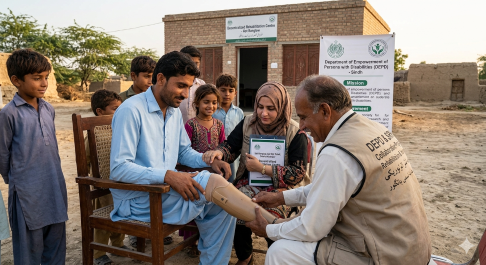
Access to rehabilitation centers and economic factors have been barriers to the seamless access to treatment and sustainable recovery in rural areas of Sindh. This meant that many families had to postpone therapies or stop getting involved in rehabilitation altogether because of the cost of transport and poor institutional outreach. In the context of this, DEPD and SRHD set up a decentralized Rehabilitation Centre in Kot Banglow, Kot Diji Tehsil, and District Khairpur. The center offers physiotherapy, speech therapy, occupational therapy and behavioral therapy. Decentralization has been observed to enhance the accessibility, minimize the cost and boost the confidence of community in rehabilitation systems. “Previously we had to travel to Karachi or Hyderabad for therapies, now the center is close to our area and our child gets his therapy regularly” said one caregiver while the other highlighted it as a “hope for the hopeless” because of the reduced transport costs and improved continuity of care. In the following narratives, it is demonstrated that decentralization is anything but an administrative reform. It also changes the way rural communities live accessibility and institutional care. But from the field, it is also noted that rehabilitation is still constrained by the absence of prostheses and orthotics. Another therapist commented: “Rehabilitation does not end with improving movement and muscle strength, but also involves orthotic devices and most families cannot access those on their own and are reliant on government funding via DEPD.” The observations suggest that functional independence cannot be achieved without interventions that support mobility when using only therapy.
The impact of this institutional deficiency can be seen in everyday life. A 26-year-old laborer who worked at a local hotel on a daily basis, earning between 600 and 700 rupees, said that five years ago he suffered a serious injury on his foot, with a road accident. Due to financial hardship, he could not continue medical treatment. This resulted in his foot being permanently misshapen and affected his movement. His injured foot is smaller now and not working properly, he explained. He is now looking for a prosthesis that will help him function and earn a living to feed his family. Right now he is looking for a prosthesis that will allow him to move about and support his family. Here is one example of how economic problems can lead to treatable injuries becoming chronic disabilities, where it is no longer possible to provide the support for rehabilitation. SRHD undertook a baseline survey to identify about 700 persons with impairments in surrounding communities and meet their rehabilitation needs. In response to this, over 91 children are currently being provided with structured rehabilitation. Approximately 200 people have been identified for interventions that will improve their posture, alignment, and functional mobility. More than 290 individuals are also being evaluated for a prosthetic intervention that will restore movement and functional independence. Additionally, 230 persons have been assisted in access to Special CNIC documents to enhance access to legal identity, social protection and state entitlements. These interventions showcase the possibilities of a decentralized rehabilitation systems that combine community-based identification, rehabilitation, mobility support and social inclusion. However, although the country has progressed in this field, the issue of prosthetic and orthotic provision is still a great challenge for rural Sindh. For most low-income households, private interventions to support mobility are still unaffordable. So, a great number of families rely on state funded rehabilitation systems. Enhancing the institutional capacity of DEPD is therefore crucial in order to bring from therapy to independence and sustainable rehabilitation. In summary, the DEPD–SRHD project has proved to be very effective in enhancing accessibility and continuity of rehabilitation and institutional trust in rural areas of Sindh. Meanwhile, the results also point to the need for rehabilitation to go beyond therapy. Through a fully effective decentralized model it is necessary to have integrated prosthetic and orthotic support systems, as well as community-based rehabilitation systems. These interventions are vital to the functional mobility, dignity and social inclusion of persons with disabilities.
Read: Our Failure To Address Autism
_____________________
The author is an M.Phil. Student at the Department of Anthropology, Quaid-i-Azam University Islamabad. His research interests include medical anthropology, disability studies, and community-based rehabilitation in Sindh, Pakistan. He currently serves as Manager at the SRHD–DEPD Rehabilitation Centre under the Society for Research and Human Development (SRHD). Contact: sohailwassan11@gmail.com