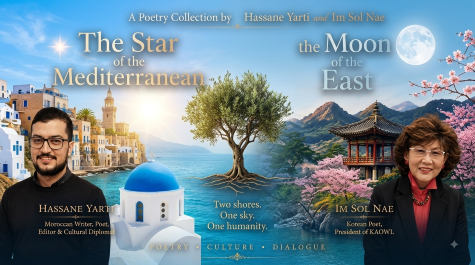
Foreword to ‘The Star of the Mediterranean and the Moon of the East’, a Poetry Collection by Hassane Yarti and Im Sol-Nae
By Dr. Barbaros İRDELMEN
Poetry is more than a way for human beings to tell the world who they are; it is an attempt to give the world new meaning. Geography changes, languages change, cultures change; yet human joy, sorrow, loneliness, longing, love, death, and the search for freedom remain unchanged. This is precisely where the true power of poetry reveals itself: an emotion born in one language can come alive again in another.
The book you hold in your hands brings together the poetic worlds of two distinguished poets from two very different parts of the world: Hassane Yarti and Im Sol Nae. Between Morocco and Korea lies not only a distance of thousands of kilometers, but also profound differences in history, culture, tradition, and aesthetics. Yet when we look closely at the poetry of these two writers, we discover that this distance disappears within the realm of poetry.
Because poetry knows no borders.
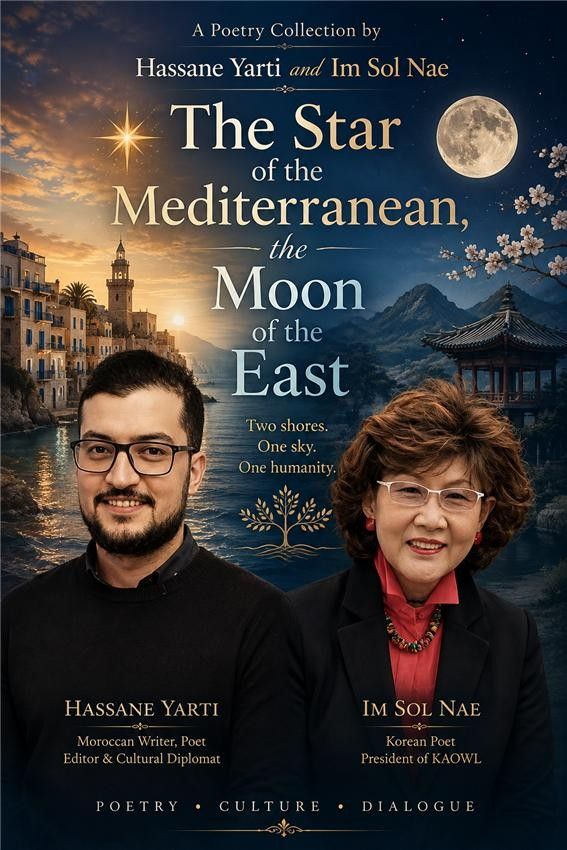 In Hassane Yarti’s poetry, the fragility of the human soul, exile, loneliness, love, longing, time, loss, and existence frequently come to the forefront. In his lines, sometimes it is the absence of a beloved that speaks; sometimes the sorrow of being far from one’s homeland; and sometimes the desolation within the human self. In poems such as “My Expatriation,” “Longing…,” “Ruins,” “A Woman of Paper,” and “And I Forgot That We Never Meet…”, longing is not merely an emotion; it becomes an inner geography in which the human being searches for the self.
In Yarti’s poetry, love does not remain a simple romantic feeling. Love becomes a test in which a person dares to reveal his or her entire being. The brief yet intense expression in “Indeed” makes this unmistakably clear: to love is to risk placing one’s whole existence on the line. At times mystical, at times philosophical, and at times charged with profound lyricism, the poet’s language moves through a rich inner landscape. In his poetic world, the human being is constantly in conversation with the self, with the past, and with all that has been lost.
Im Sol Nae’s poetic world opens another door.
Drawing upon Korea’s historical, cultural, and spiritual heritage, the poet brings together nature, death, memory, motherhood, transformation, the inner light of the human being, and the fragility of life through distinctive imagery. In her poetry, a butterfly is never merely a butterfly; it becomes a symbol of transformation, hope beyond death, and the freedom of the soul.
“Metamorphosis” (羽化) is, in this sense, one of the keys to the poet’s poetics. The ascent into the light of a creature that has lived for years in the darkness of the earth becomes a poetic counterpart to the transformation taking place within the human soul. The poet does not regard the passage from darkness into light merely as a biological change, but as a spiritual awakening.
In “Blue Butterfly,” death ceases to be an ending or annihilation and becomes a possibility of transformation and liberation. The references extending from Zhuangzi to Elisabeth Kübler-Ross also reveal the intellectual bridge the poet builds between East and West.
The figure of the mother holds a particularly powerful place in Im Sol Nae’s poetry. In poems such as “Mother Living in the Museum,” “White Butterfly Hairpin,” and “Within Me,” the mother is not merely a biological presence; she is the root of life, the home of memory, and the doorway through which the poet enters her own past. The aging and death of a mother, the scent she leaves behind, become, in the poet’s lines, part of the collective memory of all humanity.
“Sumbi Sori (Breath of the Woman Diver)” descends into another depth. Through the breath of Jeju’s women divers, the poem explores the delicate line between life and death. Here, the sea is not merely an element of nature; it is the source of life, its test, and ultimately the place where the human being returns to the self. The act of holding one’s breath in order to survive becomes a paradoxical statement of existence: Sometimes, in order to live, we must hold our breath.
What brings these two poets together is not merely their poetic achievement. There is a deeper bond between them: The human being.
In Yarti’s poetry, the human being is one who longs, loses, waits, and tries to love again. In Im Sol Nae’s poetry, the human being is one who transforms, remembers, and reconnects with the mother, the earth, the sea, and the sky.
One shows us the geography of longing; the other, the geography of transformation.
One searches for exile within words; the other discovers light within darkness.
One speaks to the wounds of the past; the other opens a path of transformation from the past toward the future.
Yet both ultimately arrive at the same destination: The human heart.
Another striking feature of this collection is the profound relationship these poems establish with nature. The sea, the sky, trees, flowers, butterflies, fireflies, the moon, the stars, and the wind all become mirrors of the human soul in the poetry of both writers. Nature is not merely the setting of the poem; it is a speaking character within the poem.
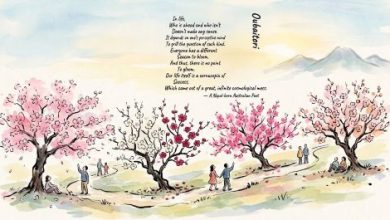
The date palm tree in Im Sol Nae’s “The Scarlet Light Universe,” the river and the sea in “Becoming the Sea,” the plum blossoms in “The Plum Blossom Path,” and the stars in “Aura Physics” invite us to reconsider the human being within the wholeness of the universe.
In Hassane Yarti’s poetry, the sea, night, harbor, ash, rose, thorn, and sky become reflections of the fractures and upheavals within the human inner world.
For this reason, this book should not be read merely as a collection of poems by two poets.
It is an encounter between two cultures through poetry.
This poetic journey stretching from Morocco to Korea, from Africa to Asia, reminds us once again why literature is universal. The true boundary of poetry is not language. The true boundary of poetry is not geography. The boundary of poetry lies only in whether a human being can recognize the self in another person’s sorrow and joy.
And before great poetry, we recognize ourselves.
We may find our own longing in another person’s longing, our own loss in the death of a mother, our own transformation in the metamorphosis of a butterfly, and our own infinity on the shore of a sea.
Perhaps this is why poetry books are not merely read; they build invisible bridges between people.
This book, bringing together the poetry of Hassane Yarti and Im Sol Nae, is such a bridge. Two poets, two languages, two cultures, and two distinct life experiences…
Yet beneath the same sky;
the same loneliness,
the same hope,
the same love,
the same death,
the same life,
and the same humanity.
Perhaps this is one of the most beautiful things poetry can tell us:
People who seem so distant from one another in this world are never truly far apart within poetry.
Believing in the border-crossing voice of poetry, I sincerely hope that this valuable work will become a source of new literary encounters—not only between Moroccan and Korean poetry, but also between East and West, between different languages, and between different cultures.
Read: Living like a flame
____________________
 Dr. Barbaros İrdelmen is a Turkish poet, writer, translator, and retired physician. He is the author of nineteen poetry collections, with works published in numerous national and international anthologies, literary journals, and poetry festivals. A member of the Turkish Writers’ Syndicate, he translates world poetry from English into Turkish and contributes to the Turkish edition of Poetry Without Borders. He is also affiliated with the poetry translators’ community of the ITHACA Foundation (Spain), promoting literary dialogue across cultures through poetry and translation.