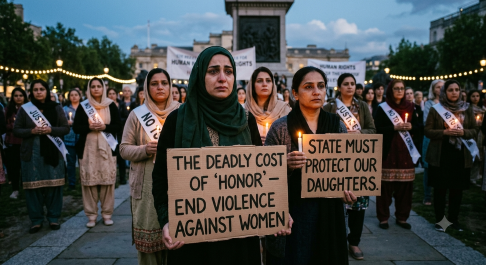
The crimes against our innocent daughters are hair-raising and shameful. The state should fulfil its responsibility to provide security to its citizens.
Ambassador M. Alam Brohi
Karo Kari reflects a deep-rooted tribal system where honour-based violence, weak legal enforcement, and social norms override women’s rights, leading to systemic injustice and insecurity for women in society
The Sindhi words ‘Karo Kari’ literally mean blackened, stained, disgraced, and are used to describe a man (Karo) and woman (Kari) involved in courtship, sexual relationship, elopement, and even free-will marriage or matrimony without the consent of parents. Such a daring act by a woman triggers enmity. The girl’s family solicits the help of the police and judiciary, claiming inducement, kidnap, or forcible marriage, or disputing her age. They also seek the intercession of the influential persons of the tribe of the man involved for the return of the girl so that they have the convenience to marry her off in a far-flung region or to kill her.
The Hindus of Sindh dispute the age of their girls who convert to Islam and contract marriage with Muslim men. A Sindhi spiritual and political leader, Mian Mithoo from Ghotki Tehsil, has rightly or wrongly earned notoriety for such marriages. Hindu girls often convert to Islam at the Dargah. Mian Mithoo has represented his area in the National Assembly as an MNA of the Pakistan People’s Party for a couple of terms when the party was led by Mohtarma Benazir Bhutto, and he was not so controversial. After the frequency of such conversions of Hindu girls increased, the current PPP leaders kept Mian Mithoo at bay.
The tribal traditions, which unfortunately take precedence over religious edicts and civil and criminal laws, recognize any of the above social indiscretions as a disgraceful breach of the honour of the family of the woman, and an unforgivable crime. In the tribal way of life, this so-called crime renders her and her partner liable for elimination to vindicate the honor of the family. The man is equally punishable for his audacious indulgence in tarnishing the honor of the family of his female partner. These murders are appreciated as part of an honorable way of living in the tribe.
The Karo Kari or Honor Killing is not a new phenomenon. This inhuman tribal practice has been in existence for centuries and is traced back to the outmoded patriarchal societies, which considered women as living objects to satisfy the sexual needs of their husbands, bear children, and look after the house. They were traded in exchange for money, land or animals or in retribution to settle an old enmity. They were not allowed to have social, economic and legal rights as known in modern constitutional, democratic and liberal societies. They had no say in their matrimonial matches, no legal right to inheritance, and no social status.
Islam has placed greater emphasis on the rights of women. It made the consent of the woman mandatory for marriage, entitled her to dowry, and a fixed share of inheritance from her parents’ movable and immovable properties, and made her the sole heir to her husband’s possessions. These Islamic edicts raised the status of women in society. However, tribal traditions survived the changes that the religious beliefs, moral philosophies, and modern civil and criminal laws sought to enforce gender parity and human rights.
The flourishing of tribal societies owes a great deal to factors such as the lack of education; social and economic reforms; the concentration of agricultural lands in few hands; the economic dependency of women; the joint family system; the influence of tribal chiefs given their social, economic and political power; the corruption within the police, and faulty investigation; the exploitation of the loopholes in our prosecution system to manage relatively lighter punishments for the perpetrators of the crime; the Jirga intercessions, and above all, the absence of legal and constitutional awareness in society, and the weak civil societies; the heightened sense of vanity and honour of fathers, brothers, uncles in outdated tribal societies to punish a female member who dares to defy their authority.
This egotistical pride is sometimes accentuated by taunts of relatives, neighbours, and tribal fellows after the elopement of a girl. Human beings are inhuman by nature. All religious edicts and moral philosophies tend to tame human arrogance, pride, ego, vanity, their sense of vengeance, and vindictiveness. In developed societies, these base human traits have been tamed by the dissemination of education, the promotion of social norms, and consciousness about women’s legal and constitutional rights through constitutional and democratic governance.
In those societies, the prosecution and judiciary work hand in hand to deliver cheap and quick justice against any excess. Sometimes, human jealousies triggered by the unfaithfulness of women do result in heinous crimes. But these crimes are not as frequent and extensive as in our society. Our girls really live under insecurity and fear. The Western state takes it as its responsibility to provide social and economic security to its citizens. These societies do not know of tribes herded by tribal chiefs, Jirga courts manned by mini tribal chiefs, or area landlords to give arbitrary decisions which solely depend on the willingness or the goodwill of the parties involved for implementation.
The tribal intercession or Jirga decisions sometimes result in equally condemnable acts of criminality, such as the sanctioning, in retribution, of the marriage of minor girls to men from the so-called aggrieved party, or ordering rape or disgrace of the women of aggressors in full view of the crowd gathered there. These decisions leave a festering wound in the families, instigating them to seek vengeance.
A professor with a PhD in Computer Science from France, Ajmal Sawand, originally from Kandhkot, leaves his well-paid job in Paris and returns to IBA Sukkur to teach the children of his land, Sindh. He is ruthlessly killed by members of the rival tribe to avenge an old murder committed by the people of the Sawand tribe, with whom this educationist had no connection. His crime was to be from the Sawand tribe.
The crimes against our innocent daughters are hair-raising and shameful. Some years back, probably in 2011–2012, four girls of a tribe in Nasirabad district were buried alive. We heard the echo of this inhuman act in the National Assembly also. In those years, another event in Khairpur district was more heart-rending. Ferocious hounds were set after a girl who was running and beseeching for her life. She was caught and torn into pieces by the hounds.
Recently, two girls from the Chandio tribe were killed and buried in shallow graves. Disgraceful and shameful, really. The state should fulfil its responsibility to provide security to its citizens.
Read: Karachi: Federalization Is No Solution
_____________________
 Based in Karachi, the author is a former member of the Foreign Service of Pakistan and has served as Ambassador for seven years
First published in The Friday Times Lahore