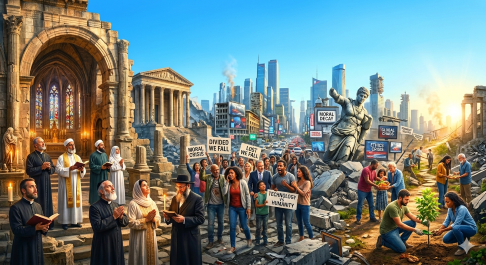
Humanity does not suffer merely from a lack of technology or power. The real crisis is the absence of moral balance.
- History repeatedly shows that civilizations collapse not because they lacked intelligence, but because power exceeded wisdom and capability moved beyond conscience.
By Noor Muhammad Marri Advocate | Islamabad
Today, many societies suffer from problems rooted in state structures and state policies, such as injustice, corruption, economic inequality, misuse of authority, and political repression. Yet instead of directly criticizing these fundamental issues, criticism is often redirected toward religion itself. In many intellectual and political circles, criticizing religion is considered easier and safer than challenging state institutions, global economic systems, or ruling elites.
As a result, religion is frequently portrayed as the main obstacle to progress, while the real causes of social crises are ignored. Wars, exploitation, poverty, environmental destruction, and authoritarian systems are often produced by political interests, state policies, geopolitical rivalries, and economic greed, yet the blame is conveniently shifted toward religion and tradition.
In developing societies, another factor also exists: the desire to please international donors, foreign institutions, or dominant global ideological trends. Certain local elites and intellectuals sometimes adopt anti-religious rhetoric not entirely out of intellectual conviction, but because it aligns with the expectations of powerful international circles that financially or politically influence local discourse. In such an environment, criticizing religion is presented as “progressive,” while criticizing global power structures, military alliances, corporate exploitation, or unjust state systems becomes difficult or risky.
This does not mean religion should be beyond criticism. Every institution, ideology, or tradition can be questioned, especially when it is misused for power, intolerance, or oppression. However, intellectual honesty requires balance. If religion is criticized for its failures, then secular states, political systems, colonial history, capitalist exploitation, and modern military powers must also be examined with equal seriousness.
Modern humanity often condemns religious extremism while remaining silent about economic imperialism, the arms industry, proxy wars, environmental destruction, and the suffering caused by global power politics. Such selective criticism creates intellectual imbalance. No society can solve its problems merely by weakening faith if the deeper problems lie in injustice, corruption, inequality, and misuse of state power.
Read: Collapse of Capitalism and the Moral Crisis of Modern Humanity
Despite human misuse, religion has historically provided ethics, charity, social cohesion, and moral restraint upon power. The real challenge for modern civilization is therefore not simply religion versus secularism, but how to create a society where morality, justice, knowledge, and political accountability coexist together.
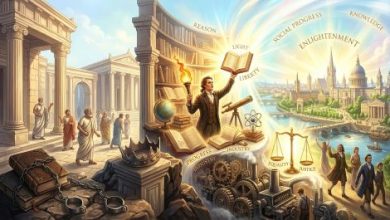
Religion was the first great order of human society. Long before modern states, constitutions, nationalism, capitalism, socialism, or secular ideologies emerged, religion provided humanity with law, morality, identity, and social discipline. It transformed scattered tribes into organized civilizations and offered human beings a shared ethical framework through which justice, responsibility, and collective life could be understood.
Religion was never merely a matter of worship, rituals, or spiritual ceremonies. It was civilization itself. Temples, mosques, churches, monasteries, and shrines were not only places of worship but also centers of education, philosophy, literature, science, culture, and social welfare. In ancient and medieval societies, religion shaped architecture, poetry, customs, inheritance laws, and systems of justice. It gave meaning to life and stability to society at times when political systems were weak or incomplete.
Most importantly, religion acted as an umbrella for the weak and vulnerable. The poor, orphans, widows, travelers, and oppressed found protection within religious morality. Long before modern welfare states, concepts such as charity, alms, zakat, generosity, and social responsibility emerged from religious teachings. Religion reminded rulers that power was not absolute and that there existed a higher moral authority above kings and empires.
It is often argued that religion has been the primary cause of wars and violence, but history presents a far more complex reality. World War I and World War II were caused mainly by imperial ambitions, nationalism, colonial rivalries, economic interests, military alliances, and geopolitical struggles for dominance. Tens of millions died in these wars, yet they were fought largely by modern secular nation-states rather than theocratic governments.
Likewise, the first use of nuclear weapons was not carried out by a religious empire. The Atomic bombings of Hiroshima and Nagasaki were executed by a modern secular state during a global war. This historical fact challenges the simplistic assumption that religion alone produces violence while secular modernity guarantees peace. Modern history demonstrates that secular ideologies, fascism, nationalism, racial supremacy theories, and political ambitions have also produced destruction on an unprecedented scale.
European history is also often interpreted in a narrow manner. Many of the conflicts between the Church and feudal rulers during the medieval period were not merely theological disputes. In several cases, the Orthodox Church intervened against the misuse of power by feudal elites and monarchs. The Church frequently acted as a moral authority capable of challenging arbitrary rule and reminding rulers that power itself required ethical limitations. These struggles were therefore also conflicts over justice, legitimacy, and moral limits upon authority.
Modern civilization entered a new phase when science and technology became dominant forces in society. Science liberated humanity from many forms of ignorance, disease, and material hardship. It transformed medicine, communication, transportation, and industry. Yet science itself possesses no inherent morality. It is ethically neutral. It can save humanity, but it can also destroy humanity.
The real crisis of modern civilization is therefore not science itself, but science detached from ethics and moral responsibility. Earlier civilizations attempted to balance power with morality through religion, philosophy, and cultural traditions. Modern systems increasingly prioritize efficiency, profit, military superiority, technological expansion, and economic competition, while ethical restraints continue to weaken.
As a result, humanity today possesses immense material power but uncertain moral direction. Nuclear weapons, chemical warfare, biological manipulation, surveillance systems, unregulated artificial intelligence, and environmental destruction are all products of scientific achievement combined with human greed and political ambition. Science gave humanity power, but not wisdom.
In the end, humanity does not suffer merely from a lack of technology or power. The real crisis is the absence of moral balance. History repeatedly shows that civilizations collapse not because they lacked intelligence, but because power exceeded wisdom and capability moved beyond conscience.
Read: Hidden hands steer the ship’s wheel
___________________
 Noor Muhammad Marri Advocate & Mediator is based in Islamabad