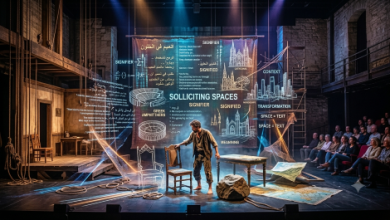
The theatrical discourse is a semiotic act to the utmost degree, in which everything on stage appears as a meaningful sign
Souad Khalil | Libya
The semiotic and semiological approach is considered one of the richest modern critical approaches in the study of theatrical discourse, since it concerns itself with creative works as systems of signs and signals, analyzing them according to concepts and procedural methods derived from its theoretical propositions. If we realize that theatrical discourse is a semiotic act to the utmost degree, in which everything on stage appears as a meaningful sign, and that its reliance on codes and symbolic systems constitutes one of its essential foundations, it becomes easy for us to understand the necessity of this approach in studying and analyzing the theatrical phenomenon.
During the last ten years, a considerable number of books dealing with this approach have been translated into Arabic. These works formed an essential reference in enriching the culture of Arab theatre critics, developing their critical tools, and changing their vision of theatrical experience.
In a review by Awad Ali on Theatre and Signs entitled “Semiotics Has Its Enemies,” he points out that one of the most recent books is Theatre and Signs by critics Elaine Aston and George Savona, published in New York in 1995. The authors indicate that they wrote the book in response to the clear hostility toward semiotics — the preferred development of semiology in America — expressed by several participants at the Theatre Conference held at Crows and Sorcerers College in 1983. The book was intended as a guide to some of the limited but significant results produced by theatre semiotics.
The book deals with two principal fields in theatre: the text and the performance, based on the view that semiotics has clear implications for the study of both dramatic discourse and theatrical discourse. Dramatic discourse allows for a structural examination of the dramatic text, while theatrical discourse provides us with an artificial language participating in the analysis of the vocal, bodily, and visual language of theatre.
 The early chapters, from the second to the fifth, define the theatrical text from a semiotic perspective, focusing on its essential elements and defining its characteristics: form, character, dialogue styles, and stage directions. Chapter Two examines the different approaches to analyzing dramatic structure and tests dramatic genres on the basis of the formal perception of the transformation of story into plot. The story constitutes the basic narrative framework, whereas the plot is the means through which narrative events are constructed, organized, and presented.
For example, the story of Oedipus, as narrated in its linear form, consists of successive general events happening to Oedipus, beginning with the prophecy preceding his birth, through which Laius and Jocasta learn that their son will kill his father and marry his mother. The story then records the successive events in the order in which they occurred. Sophocles’ tragedy, however, dramatizes the end of the myth. Instead of the linear nature of the story, it constructs a plot that organizes events spanning many years within twenty-four hours, rearranging Oedipus’ historical experiences according to the requirements of dramatic form, with its continuous flow of events and detective-like structure that shapes the tragic plot. In this way, the story is retold and reorganized, and the original text becomes a narrative of argumentative form enacted through the exchanges between actors and chorus during the theatrical performance.
The authors argue that transforming a story into a dramatic plot requires reflection on the way drama is constructed and on the conditions through which meaning and significance are produced within the dramatic text. Thus, they examine how the plot is organized through divisions into acts and scenes, as well as conventions of opening and closure, in order to demonstrate how drama achieves distinctive stylistic structures.
Chapter Three presents the concept of character as a function within the framework of the plot. The authors employ the functional and actantial models of Propp and Greimas as the basis for their approach. Propp’s model proposes a classification of thirty-one functions of the folktale, many of which are logically connected to form particular spheres embodied by performers or characters: the villain, the donor, the helper, the princess or her father, the dispatcher, the hero, and the false hero.
Regarding the way characters perform these actions, the character may correspond entirely to the action, or its function may change through involvement in several spheres of action, or several characters may share a single sphere. Greimas’ model, on the other hand, includes six roles or functions: sender, receiver, subject, object, opponent, and helper. The sender represents a force or being influencing the subject to initiate the search for the object in the interest of the receiver, whom the subject seeks to reach.
In the case of the quest for love, for example, the subject (the hero) seeks the object (the heroine), motivated by Eros (love), and is typically aided by confidants or servants, while opposed by paternal forces. In this model, the subject is also the receiver, since the hero, driven by love, acts for his own benefit.
This model is applied to Ibsen’s Hedda Gabler, where the actantial model illustrates the opposing binary forces upon which the tragedy is founded. Hedda’s isolation is clarified by the crowded category of opponents and the complete absence of helpers. Because of this absence, Hedda’s struggle acquires meaning. If the critic charts the sequence in which the interests of this group of opponents operate as actants, it becomes evident that their trajectory or objective constitutes an obstruction to Hedda because of the interests of the bourgeois society they represent.
Society itself becomes the force that suppresses individual will, functioning as a systematic structure of patriarchal repression that ultimately destroys the female subject. The authors also discuss the application of the model by Anne Ubersfeld to Racine’s Phaedra, through which she offers a method for clarifying the underlying structure of the play in order to deepen the reader’s understanding of the text. She observes that the models reveal, for example, the following:
The relation of action (Hippolytus’ desire) opens the play, and the dialogue between Theramenes and Hippolytus reveals the latent structure.
Hippolytus appears at one time as subject and at another as object, sometimes as subject and twice as opponent.
Hippolytus as object is opposed by his father in both schemes.
The structures of love reveal the political powers hidden beneath the emotions of individuals.
Theseus, the king-father, appears in all three models as an opponent, indicating the failure of all love schemes. He possesses no traits of the subject and desires nothing until the end of the play.
Chapter Four examines the different styles of dialogue operating within the dramatic text. Through this chapter, the authors aim to present a systematic account of the distinctive variations among the different kinds of dialogue styles: poetry and prose, classical dialogue in tragedy and bourgeois comedy, dramatic dialogue, and radical dialogue. They emphasize that the role of dialogue in dramatic texts generally is to define character, place, and action.
What allows dialogue to create reciprocal interaction within the time and place of discourse is deixis, the means through which exchanges between “I” and “you,” and between the conditions of “here” and “now,” are constructed. Through this deictic exchange, drama achieves its three-dimensional quality, clothing bare bones with flesh.
 The authors maintain that poetic dialogue is characterized by the presence of artistic language employing metaphor, simile, and rhythm. Although dramatic discourse may accommodate either poetry or prose, the choice of style has a tangible effect on the processes of meaning production.
Historically, poetry was associated with tragedy, while prose was linked with comedy. Just as theoretical assumptions concerning ideal form influenced dramatic structures, methods of dramatic expression were also connected to assumptions regarding suitable style. Classical tragedy constructs a dramatic world inhabited by royal figures whose dialogue must possess dignity and sublimity appropriate to their status. Aristotle observed that the clearest style consists of ordinary words, but such a style is vulgar, whereas the style using unfamiliar words possesses dignity and elevation beyond everyday usage.
In Chapter Five, the authors study stage directions, beginning with a comprehensive overview of directions both within and outside dialogue. They classify the functions of stage directions related to the vocal and physical definition of character, as well as those connected to design and technical elements. They focus on demonstrating how particular patterns of stage directions are associated with specific theatrical and dramatic forms, linking them to dialogue.
The authors regard stage directions, according to Ingarden’s parallel terminology, as complementary systems of signification dependent upon one another. They frame dialogue literally in the typographical layout of the page and theatrically in that they endow the printed text with the quality of a draft for stage production. The production team is presented with a series of signs indicating the playwright’s theatrical intentions. The reader is thus given the opportunity to read the act of performance through the text, and consequently to stage the play imaginatively within the theatre of the mind.
The authors present two views of stage directions. The first belongs to the critic Veltrusky, who distinguishes between genuine stage directions and what he considers the dramatic equivalent of the authorial met text or narrative voice in nineteenth-century realist fiction. The second belongs to the critic Seger, who, unlike Veltrusky, treats stage directions that constitute texts for wordless scenes as literary devices in themselves, exercising a poetic function exemplified in the theatre of Beckett and Stoppard. Furthermore, stage directions always complete the operations of dialogue, as they may be read as manifestations of the potential slippage between primary and secondary texts.
The final chapters, from Six to Nine, deal with the elements of performance. Chapter Six lays the groundwork for establishing a language through which the authors discuss the text in performance. They consider the attempts made to classify theatre as a system of signs and examine the changing systems of signs and the methods of decoding employed by the spectator.
While semiotics offered a way of viewing the dramatic text that deepened understanding of how the text is constructed, it also provided a key to liberating theatre from literature, or from imprisoning theatre within the text. However, once the dramatic text is freed from the constraints of traditional literary criticism and viewed within its theatrical context, the difficulties of interpretation increase because of what Roland Barthes called the “thickness” of theatre — its capacity to attract numerous systems of signs that do not function linearly but rather within an instantaneous, simultaneous, and complex network unfolding in time and space.
Everything presented to the spectator in theatrical performance is a sign, as recognized by the Prague School before anyone else. The process of signification is directed and controlled; even if something accidental slips into the performance, it is nevertheless read as meaningful.
Chapter Seven returns to the subject of stage directions in order to evaluate their implications for theatrical practice. Chapter Eight concerns the reading of the image and considers the ways in which systems of staging — such as lighting, scenery, and acting conventions — cooperate in constructing the theatrical image. The authors indicate in this chapter the strategies through which these images may be decoded, and they reflect on the development of the theatrical image into a visual metaphor that either contradicts the dialogue or highlights ideological content.
They also examine the implications of the written text for performance style. The spectator’s reception of the visual dimension may be regarded as the final stage of a project involving four phases:
The playwright encodes the text according to an awareness of its function as an initial blueprint for theatrical production.
The director decodes the text, beginning the process of leadership or collaboration with the production team and arriving at a mise-en-scène.
The designer re-encodes the text in developing the design concepts, evaluating them within known financial and spatial limitations that are open to interpretation.
The spectator decodes the performance, and a reciprocal interaction occurs between the spectator and the visual dimension as a complementary factor in reception.
Chapter Nine presents a synthesis between approaches to text and performance, combining theory and application through comparative readings of two filmed versions of Samuel Beckett’s Krapp’s Last Tape, a one-act play and another example of Beckett’s reduced representation of the human condition. In this theatrical world, existence is reduced to an exhausted old man — Krapp — and a tape recorder, while the action consists solely of listening to tape-recorded memories Krapp made approximately thirty years earlier.
The first production discussed is Patrick Magee’s performance for the Royal Court Theatre, while the second is the cinematic interpretation by Jack MacGowran, presented during the Beckett memorial in 1990.
Read: Theatre between Poetry and Poeticity
____________________
 Souad Khalil, hailing from Benghazi Libya, is a writer, poet, and translator. She has been writing on culture, literature and other general topics.