The screenplay has proven to be one of the most influential artistic forms in shaping modern poetic expression.
Souad Khalil | Libya
In the second part of this study, we will examine additional cinematic techniques employed in modern Arabic poetry, focusing on interior shots and the interwoven screenplay structure through selected poetic models.
Second: The Use of Interior Shots
In contrast to the exterior daytime scenes employed by Mohammed Al-Zahir, other poets utilize screenplay structures built upon scenes occurring within enclosed spaces. Such poems rely on visual description accompanied by sounds, movements, and carefully observed details.
An example appears in Kamal Nash’at’s poem “A Boy on a Holiday.”
Third Shot
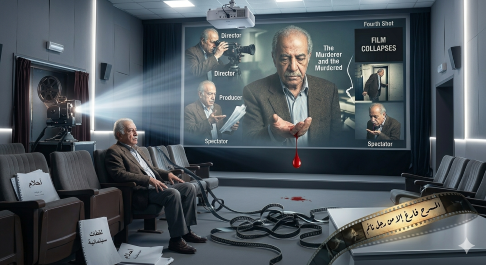
The director: you … me … them.
The producer: you … me … them.
The spectator: you … me … them.
The screen: a space of dreams.
The murderer and the murdered: myself.
Nothing exists except me—
A meaning
Stirring within a drop of blood.
Fourth Shot (Exterior View)
The film collapses.
The director escapes through a back door.
The spectator spits into his palm.
The film collapses—
Four shots drowned in a drop of blood.
Yet I, the director,
the producer,
and the spectator,
possess nothing in this world except
a space for dreams.
I possess no home for my longing,
no breast to shelter me.
I possess no refuge.
I know no café,
no amusement,
no brothel that would receive me.
Nor any woman in a tavern.
I shall remain here,
awaiting the second performance.
The theatre is empty except for a sleeping man.
The poet attempts to alleviate his loneliness through dreams embodied in the form of films projected within his imagination. He assumes every role in the cinematic experience: he is simultaneously the producer, the director, the spectator, and the actors who perform the drama. He is both the murderer and the victim.
Nor does he stop there. He also portrays the cinema hall itself from a distant perspective, employing a broad exterior shot. Significantly, he explicitly labels this scene “Exterior View,” precisely as a screenwriter would indicate an exterior location in a screenplay.
The events that follow the collapse of the film are rendered through a succession of rapid visual images: the director’s escape, the spectator’s gesture of contempt, and the repeated announcement that the film has failed. The recurring image of blood functions as a symbolic reference to the death of the experience itself, perhaps even the death of art, or the failure of society to acknowledge the artist’s efforts and suffering.
From this point, the poem transforms into an intimate monologue. Through it, the poet reveals his emotional wounds and explains the psychological necessity of the dreams he creates. He owns nothing capable of alleviating his loneliness except these imagined worlds. This explains the repeated use of the phrase “I possess no…”, which appears several times throughout the closing section and reinforces the sense of deprivation and existential isolation.
The final note attached to the poem resembles a cinematic caption appearing after the conclusion of a film:
“The theatre is empty except for a sleeping man.”
This statement serves as a powerful metaphor suggesting that no one truly watches the poet’s films, listens to his complaints, or shares in his suffering.
This absurdist fantasy derives its poetic force not merely from its existential implications concerning individual and human responsibility, nor from the familiar mystical notion of the unity of murderer and victim. Rather, its poeticity emerges specifically from its language, which interacts creatively with the vocabulary and techniques of cinema.
The poem employs visualization, magnification, montage, surprise, abrupt cutting, observation, commentary, and even the narrative frame that follows the extinguishing of the cinematic image. In doing so, it transforms cinematic devices into poetic instruments.
At this point, the poet’s refined sensibility becomes evident. The flexibility of his expressive language enables him to establish a profound aesthetic connection with the reader. Through this emotional and communicative relationship, the reader is invited to participate in the poet’s suffering, aspirations, disappointments, and hopes.
Conclusion
The screenplay has proven to be one of the most influential artistic forms in shaping modern poetic expression. Contemporary poets have not merely borrowed cinematic terminology; rather, they have absorbed the screenplay’s methods of visual construction, scene composition, montage, movement, and the interplay between image and sound.
Through these techniques, the poem has expanded beyond its traditional lyrical framework to become a dynamic visual and auditory experience. The poet increasingly resembles a filmmaker who arranges shots, controls perspective, directs movement, and constructs dramatic tension within the textual space.
The examples examined in this study demonstrate that the relationship between poetry and cinema is not one of imitation but of creative interaction. The screenplay provides poetry with new expressive possibilities, while poetry enriches cinematic techniques with symbolic depth, emotional resonance, and imaginative power.
Thus, the integration of screenplay techniques into poetic construction represents one of the most significant manifestations of artistic experimentation in modern Arabic poetry, reflecting its continuous search for innovative forms capable of expressing contemporary human experience.
Read: Poetic Structure in the Cinematic Screenplay-1
_____________________
 Souad Khalil, hailing from Benghazi Libya, is a writer, poet, and translator. She has been writing on culture, literature and other general topics.