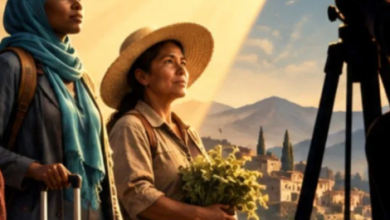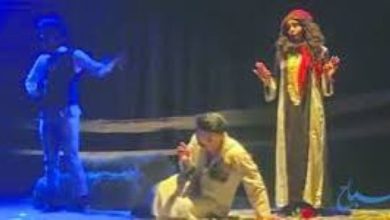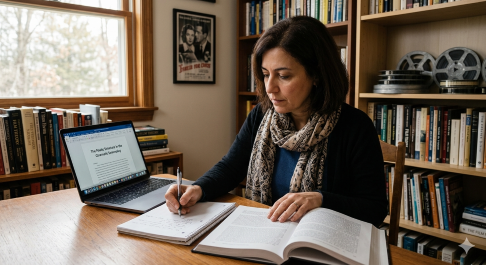
A screenplay may be defined as a film written on paper in visual form, awaiting realization through cinematic cameras and the various techniques of filmmaking.
It is the film of the future, the first stage in the construction of a motion picture, and a network of human relationships upon which cinematic conflict is built.
Souad Khalil | Libya
Before embarking on this study of the cinematic screenplay and its functional relationship to poetic construction, it is important to note that cinema is a highly comprehensive term encompassing numerous relationships, trends, theories, and technical practices. Here, however, I do not intend to discuss the cinematic film itself, as that subject may be addressed in future articles. Rather, I seek to clarify the concept of the screenplay, which constitutes one of the most fundamental elements of filmmaking.
In an important study containing valuable insights and information, Dr. Mohammed Ajour explains the concept of the screenplay as follows:
 The Concept of the Screenplay
The term screenplay was not originally associated with cinematic art, since it existed before the emergence of cinema itself, that is, prior to 1894. The word derives from the Greek term scene, meaning a visual setting or stage view. During the nineteenth century, the term spread into various European languages, where it referred to the dramatic text of a play accompanied by the director’s technical instructions regarding scenery, lighting, movement, and performance.
With the emergence of cinematic storytelling, the term came to signify the written text of a film, developed through visual descriptive writing and presentation. In other words, it became the complete blueprint of a film, including its dialogue.
The renowned screenwriting theorist Sid Field raises several questions concerning the screenplay:
Is it the guidebook of the film or merely its outline? Is it a sequence of scenes expressed through dialogue, or a description of those scenes? Is it a collection of ideas, or a dream embodied within an integrated framework?
Field ultimately concludes that the screenplay is all of these elements simultaneously, woven together in a coherent and logical harmony.
Accordingly, a screenplay may be defined as a film written on paper in visual form, awaiting realization through cinematic cameras and the various techniques of filmmaking. It is the film of the future, the first stage in the construction of a motion picture, and a network of human relationships upon which cinematic conflict is built.
It is an organized scenic design of a cinematic narrative, writing events on paper through shadows and colors. It attends to every detail of the filmic structure and prepares it for the camera, which moves under the guidance of the cinematographer and director to bring these described scenes to life, complete with their backgrounds, locations, and evolving dialogue according to the original sequence of events.
It begins as a flexible project open to revision, through which the screenwriter presents a vision of the principal events, the central conflict highlighted by the narrative, and the development of that conflict. At the same time, the writer outlines the biological, intellectual, and psychological dimensions of the characters. In short, the screenplay is a detailed narration of a film’s scenes through the combined language of sound and image, the two essential elements of screenwriting.
The screenplay transforms the locations described in a novel into tangible settings that serve as containers within which the characters move. It also transforms those characters from mere names on a page into living human beings whom we see eating, drinking, loving, and struggling. Likewise, it converts time—expressed in literature through verbs and narrative structures—into a living reality in which events unfold according to a logical sequence. In this sense, the screenplay breathes life into a literary work that originally depended entirely upon the reader’s imagination and turns it into a visible and concrete reality.
Methods of Writing a Screenplay
As previously noted, the screenplay is written in a presentational form that describes every dimension of the event. Each scene is written separately and sequentially, while shots are divided and numbered according to the circumstances and requirements of the story.
Screenplays are generally written in two formats:
The Parallel Format
In this format, the page is divided vertically into two columns. The right-hand column contains the visual details, while the left-hand column contains dialogue and sound. The scene number is written at the top right of the page. The setting or filming location is indicated in the center, while the far left specifies the time of the scene and whether the location is interior or exterior.
The Interwoven Format
In this format, image and sound are written in a continuous, interwoven sequence without separation. It also includes references to detailed movements accompanying the dialogue. Dialogue and accompanying sounds are usually written in the middle third of the page. Although this format creates a stronger integration between image and sound, it lacks some of the practical advantages of the parallel format during production.
Accordingly, the cinematic screenplay is not intended for literary reading in the same way that a written play is. It functions as a fragmented descriptive framework for the film and can only be fully appreciated after it has been assembled through editing and visual realization.
When reading a screenplay, one encounters a text that does not lend itself easily to conventional narrative enjoyment. The narrative aspect appears incomplete, literary expression remains subordinate, and events and characters are presented and defined through methods different from those used in traditional literary writing. Furthermore, screenplay pages are filled with technical terminology related to camera movement, camera paths, musical cues, shot descriptions, and shot types. These cinematic devices work together to unify the filmic work.
This does not diminish the value of the screenplay. On the contrary, it remains a literary creation in its own right.
The Influence of the Screenplay on Modern Poetry
Modern poets recognized in screenplay construction a creative element capable of enriching poetic form and expanding methods of poetic composition. Consequently, some poets began incorporating screenplay techniques into contemporary poetry.
Techniques for Employing the Screenplay in Poetic Construction
Modern poets were influenced by the cinematic screenplay both formally and thematically. However, they did not strictly adhere to the conventional screenplay formats discussed above. Instead, they adapted cinematic techniques to serve the requirements of their poetic experiences.
Structuring the Poem According to the Parallel Format
First: Exterior Daytime Shots
A poet may employ exterior shots depicting roads, seas, deserts, streets, and other open spaces. Such scenes are generally filmed in daylight and do not rely upon enclosed settings, artificial lighting, or constructed backgrounds.
An example can be found in Mohammed Al-Zahir’s poem “The Massacre Moon: The Dove of the Homeland.”
Scene 1
(The camera moves in a panoramic shot. A poorly dressed child runs, stumbles, and then resumes running. The camera follows him throughout. Suddenly he stops at a crossroads. The camera executes a rapid zoom-in toward two directional signs at the intersection: Sabra – Shatila.)
The poet employs screenplay techniques both structurally and conceptually. He combines elements of the parallel and interwoven formats, assigning a scene number, describing camera movement, and carefully portraying the confusion and vulnerability of the child who functions as the protagonist of the narrative.
He also makes use of what cinematography calls the bird’s-eye view shot, where the camera looks downward upon the subject. Such a perspective intensifies the viewer’s sense of disorientation and helplessness. This technique is frequently used in films concerned with fate and inevitability because it emphasizes the insignificance and fragility of the characters while placing the viewer in a position of visual dominance.
Through these techniques, the poet prepares the reader-viewer to experience the child’s weakness and inability to confront the harsh circumstances surrounding him, both physically and psychologically.
The poet then follows this preparation with a sudden cut to an extremely rapid close-up of a non-illuminated road sign pointing in two directions. Each direction bears the name of one of the massacres suffered by the Palestinian people. This visual strategy deepens the emotional impact of the image upon the reader of this poetic-filmic text.
The poet does not limit himself to a realistic depiction of events; rather, he relies heavily on emotional intensity, generating profound sympathy for the young child born amid massacres and displacement. Furthermore, the absence of punctuation in the prose-like introduction contributes to a sense of speed, instability, and terror, reflecting the atmosphere dominating the poem-screenplay.
The poet-screenwriter continues to design his shots through what may be called intercutting, alternating between the directional signs and the terrified face of the child. He carefully portrays the expressions of fear, bewilderment, and vulnerability visible on the boy’s face. By juxtaposing the road signs with the child’s features, he creates what might be described as an emotionally charged visual metaphor. Through this technique, he evokes the collective memory of Palestinians who constantly anticipate violence and see traces of bloodshed everywhere around them.
This movement between the child’s face and the signs creates a tragic fusion between the brutality of reality and the innocence of childhood, presenting the boy as lost between two massacres at a crossroads.
The poet then introduces another cinematic transition through a title sequence resembling what appears on a film screen. This title invokes the name of one of the most significant symbols of Palestinian resistance poetry, Mahmoud Darwish. The reference to Sidon simultaneously expands the scene to include the suffering of southern Lebanon. The image of the poet’s body becomes a symbolic space through which fragmentation, pain, and collective memory are expressed.
Having established the visual background, the poet proceeds to construct an auditory background in the form of collective chanting resembling the chorus of classical drama. This demonstrates that the poet can draw simultaneously upon both cinematic and theatrical techniques.
 The collective song unfolds through a series of short, rhythmically balanced lines resembling revolutionary slogans. Although lyrical in character, the passage is dominated by present-tense verbs, a feature that corresponds both to the immediacy of the screenplay and to the ongoing nature of the events being portrayed. These events remain alive in Arab memory, particularly in the consciousness of the Palestinian people who have endured the consequences of such massacres for decades.
Likewise, the actions associated with the cinematic description are almost entirely expressed through present-tense verbs: runs, stumbles, resumes, follows, stops, fixes. At the same time, numerous nominal structures reinforce the sense of permanence and continuity that pervades the poem.
This immersion in visual immediacy becomes so overwhelming that the poet appears unconcerned with traditional poetic meter and rhyme. The pressure of experience compels him to focus instead upon the movement of the camera and the unfolding of dramatic action. The poem begins as a prose passage resembling an excerpt from a screenplay notebook. Only when the collective song emerges do rhythm and rhyme gradually re-enter the text.
The critic whose analysis is being discussed here emphasizes that these examples derive from real events in occupied Palestine and that the child functions as the central protagonist of the experience.
He further argues that one of the poem’s cinematic achievements lies in its opening with a wide-angle shot. The contrast between the vastness of the crossroads and the frailty of the child intensifies the emotional effect. This is reinforced by an exterior scene depicting bullets racing through the streets in search of hearts to penetrate after riddling walls with holes.
The poet juxtaposes the image of relentless gunfire with that of the frightened child running desperately through the streets. The bullets seem almost alive, pursuing him and searching for his small heart in order to extinguish its flame before it can ignite. Yet within the brightness of his forehead resides the anticipated sun of resistance.
The poet succeeds in constructing an innovative poetic screenplay. He links the opening shot to the concluding one, integrates auditory and visual backgrounds, and places the brutality of violence alongside the vulnerability of childhood. The result is a unique poetic architecture that distinguishes itself from much resistance poetry, which often relies primarily upon elegy, lamentation, or rhetorical enthusiasm, despite the fact that many examples of resistance poetry also contain strong dramatic elements derived from theatrical and cinematic techniques. (Continues)
Read: The Human Being, Before the Artist
_____________________
 Souad Khalil, hailing from Benghazi Libya, is a writer, poet, and translator. She has been writing on culture, literature and other general topics.