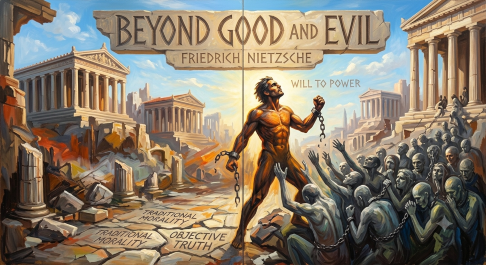
Friedrich Nietzsche’s 1886 masterpiece, Beyond Good and Evil, fundamentally disrupts centuries of philosophical tradition by exposing how personal bias and power dynamics shape human truth and ethics. Rather than offering a comfortable moral code, it challenges readers to abandon herd conformity and courageously forge their own path.
By Noor Muhammad Marri Advocate | Islamabad
Friedrich Nietzsche’s book Beyond Good and Evil, published in 1886, stands as one of those works in the history of Western philosophy that thoroughly shakes a person to their core. Nietzsche wrote this book during an era when Europe was actively searching for new moral systems to replace traditional religion amid the rise of science and progress. Yet, rather than offering a ready-made, convenient system, he delivered a striking blow to the very foundations of traditional philosophy, ethics, and values.
 Reading Friedrich Nietzsche’s *Beyond Good and Evil* for the first time forces a person to stop and think, fundamentally disrupting long-held, established assumptions. He emerged at a moment when Europe was taking immense pride in science, materialism, and rationalism, and while traditional religious constraints were gradually loosening. But instead of handing humanity a neat, beautiful new moral framework, Nietzsche used a hammer to shatter the philosophical foundation on which centuries of thought had been built. The text does not read like a conventional book with neatly structured chapters; rather, it feels like a raw, intense collection of sharp insights where he engages in a direct showdown with almost every major thinker who came before him.
What immediately catches your attention is Nietzsche’s deep distrust of those philosophers who claimed to be completely neutral and devoted solely to the pursuit of “objective truth.” Thinkers like Kant and Plato always framed their theories as the product of pure reason and logic, but Nietzsche strips away that illusion. In his view, no mind is truly neutral. Whatever a philosopher writes is ultimately a hidden confession of their own personality, inner anxieties, personal prejudices, and psychological inclinations. We do not observe the world as it actually is; we see it entirely through our own perspective. This means that “absolute truth” is merely a mirage—a comforting illusion humans chase to feel secure.
When he turns his attention to morality, the reflection becomes even more complex and thought-provoking. Looking back through history, he argues that we have confused and blended two completely distinct types of moral thinking. On one side stands what he calls Master Morality. This developed within ancient, aristocratic, and powerful societies where people valued physical strength, self-reliance, nobility, and distinction. For them, being “good” simply meant being strong, capable, and vibrant, whereas being “bad” meant being weak, passive, or pitiable—there was no concept of sin attached to it, just an unimpressive state of being.
In stark contrast, Slave Morality emerged as a byproduct of the oppressed and the subjugated. Because they lacked the means to challenge the powerful directly, a quiet, simmering bitterness and resentment (ressentiment) took root within them. Driven by this resentment, they flipped the entire scale of values upside down. They rebranded the traits of the strong—such as pride, ambition, and the drive for dominance—as inherently “evil.” Simultaneously, they transformed their own weaknesses—such as humility, passivity, and patience—into supreme moral virtues, labeling them as “good.” Nietzsche views this as a masterclass in psychological inversion that ultimately conquered Western civilization, teaching people to prioritize comfort, safety, and conformity over genuine human greatness.
This perspective naturally pushes us to question why we do anything at all. Nietzsche posits that at the core of every living organism lies a fundamental driving force: the **Will to Power**. This is not merely a drive to survive or a simple desire to be happy; it is a relentless, restless impulse to expand, overcome obstacles, and imprint one’s presence upon reality. Even when people preach humility or erect vast legal and moral structures, they are still, in their own subtle way, attempting to exercise influence over the world and those around them.
Where does this leave an individual navigating the modern world? Honestly, it can feel deeply disorienting. Once you trace these ideas to their roots, you realize that many of our deeply held beliefs are not truly our own—we simply absorbed them passively from our surroundings without much thought. Here, Nietzsche introduces the concept of Free Spirits—individuals who possess the quiet strength to sit with uncertainty and solitude without panicking or fleeing back to the safety of the herd. This does not mean becoming cruel or abandoning the distinction between right and wrong; rather, it demands the courage to define your own path and cultivate your own values without succumbing to societal pressure.
Living this way requires far more self-discipline than blindly following a set of pre-packaged rules, because when you stumble, you cannot shift the blame onto anyone else. Society naturally prefers people to be predictable and uniform to maintain order, but true human evolution only occurs when someone dares to challenge the existing framework. Ultimately, reading this book does not offer neat answers or a clear roadmap for life; instead, it leaves you face-to-face with uncomfortable questions that force you to re-examine the very foundations of what you believe.
Read: Tracing the Arc of Cosmic Existence
____________________
 Noor Muhammad, Advocate and Mediator, Islamabad