Thick layer of crude oil likely spilled from tankers hit by American, Iranian strikes in, around Strait of Hormuz, has covered vast stretch of southwestern Gwadar coast
- Westerly winds, coupled with sea currents, have pushed spilled oil toward Pakistan, says expert
- Cleanup operation underway to clear shoreline; oil accumulation could have long-term effects on marine life, experts warn
Aamir Latif
Karachi, Sindh
What began as a distant war between the US and Iran in the waters of the Strait of Hormuz is now visibly reaching South Asia, spilling onto Pakistan’s doorstep.
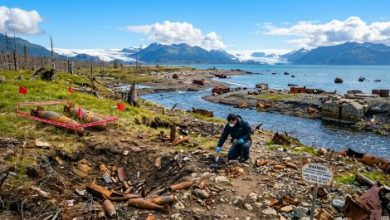
In the southwestern city of Gwadar, a thick layer of crude oil — likely spilled from tankers hit by the US and Iranian strikes in and around the Strait of Hormuz — has covered a vast stretch of the coast, posing a serious threat to marine life and the local fishing communities.
The government authorities and marine biologists are still trying to find out the exact cause and origin of the oil spill, focusing on three possibilities – all linked to the US-Iran war.
According to Abdul Rahim, a marine scientist associated with the Gwadar Development Authority, the spilled oil may have reached Gwadar’s coast via a key Arabian Sea shipping route about 200 nautical miles off Pakistan’s shoreline, which is linked to the Strait of Hormuz.
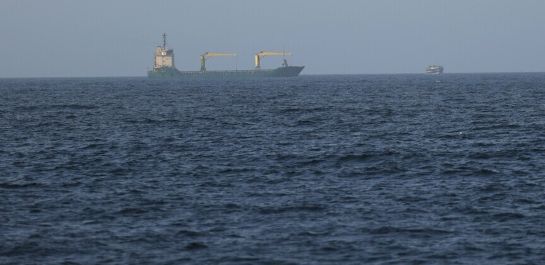
The second possibility, he told Anadolu, could be the leakage from oil tankers, which tried to cross the Strait of Hormuz and were targeted by the US or Iranian forces.
The third origin, he told Anadolu, could be Kharg Island – Iran’s primary oil export hub – which was bombed by the US and Israel.
Investigation continues
“We have collected water and sand samples to trace the possible source of oil spill and its impact on marine environment through carbon monitoring and remote sensing,” Rahim said, adding that the oil layer has covered a 20-kilometer stretch of Gwadar’s west coast. The results are expected this week.
According to him, westerly winds, coupled with sea currents, have pushed the spilled oil toward Gwadar’s coast.
Sharing a similar view, Muhammad Asghar, a senior official of Balochistan’s Environment and Climate Change Department said that investigation is underway to find out the real source of the oil spill, without ruling out the possibility of its linkage with the latest hostilities in the Strait of Hormuz.
“We are not ruling out the possibility of any factor. It could be the US-Iran war or an informal oil trade with Iran,” he said, referring to the illegal smuggling of petroleum products from Iran into Balochistan that has been taking place for decades.
The Strait of Hormuz has been reopened to commercial shipping after being effectively restricted for several weeks amid the US-Iran conflict. The narrow waterway — through which around one-fifth of global oil and LNG trade normally flows — had seen severe disruptions to maritime traffic during the escalation.
The demand for cheaper smuggled Iranian oil has surged in recent months as a result of disruption of oil flows after the US-Israeli war against Iran.
Gwadar is a key route of the multi-billion-dollar Belt and Road Initiative, which aims to connect China to Central Asia and Europe through a network of roads, railways, and pipelines for cargo, oil, and gas transportation.
With its 600-kilometer (373-mile) coastline, Gwadar is an important deep seaport currently operated by China.
Silent price of war
Rahim said a cleanup operation is underway to clear the shoreline, but warned that the oil accumulation could leave long-term impacts on marine life.
“In fact the impact is already there,” he said, adding that authorities have so far found at least four dead green sea turtles, an endangered species.
Endorsing the view, Rafi-ul-Haq, a Karachi-based ecologist, said that the oil slick, which is the beginning of a “transboundary ecological crisis,” is extremely harmful to marine life and acts as a poison for the marine ecosystem.
Speaking to Anadolu, he said that the slick might increase marine mortality rates, especially for hatchlings, struggling to reach the sea and regulate their body temperature.
“While the immediate ecological damage of the war that has already disrupted the global oil supplies, is localized around the Persian Gulf, its long-term impacts ripple outward through shared ocean currents, atmospheric pathways, and climate systems,” Haq said.
Pakistan will continue to pay the silent ecological price of a war it is not fighting as environmental security in the North Arabian Sea is inextricably linked to geopolitical stability in the Persian Gulf, he said
He recalled that southwestern Makran coast, which includes Gwadar, had faced a similar crisis during the 1990 Gulf war.
“The environmental devastation caused by burning and dumping of millions of barrels of oil into the Persian Gulf, did not remain contained, and drifted eastward, severely impacting the Makran coast,” he said.
The International Maritime Organization (IMO) warned that attacks on ships could cause large-scale marine pollution such as oil, hazardous and noxious substances and hazardous residues arising from missiles, drones, fires and explosions.
“We are aware of the reports …(but) … cannot confirm the source of the pollution at this time, and whether it is linked to incidents in and around the Strait of Hormuz,” an IMO spokesperson told Anadolu.
Read: Trout under pressure from man and nature
_____________________
Aamir Latif is a Karachi-based senior journalist. He represents Anadolu, a Turkish news agency.
Courtesy: Anadolu Agency