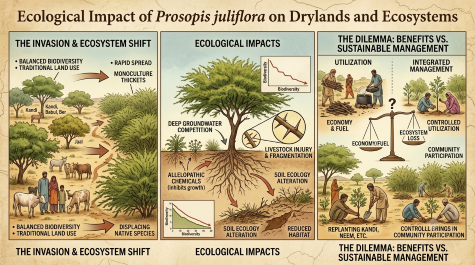
One of the most significant impacts of Prosopis juliflora is the loss of biodiversity. The tree grows rapidly and forms dense, thorny thickets that can dominate large areas of land.
Ali Nawaz Rahimoo
Across the dry lands of Pakistan, few plant species have generated as much environmental debate as Prosopis juliflora, commonly known as the Devi tree. Originally introduced to combat desertification, stabilize sand dunes, and provide fuel wood in arid regions, the tree has spread extensively across Sindh, Balochistan, and southern Punjab. While it has provided certain economic benefits, its rapid and uncontrolled expansion has created significant ecological challenges. Today, environmental scientists and conservationists increasingly regard Prosopis juliflora as one of the most invasive plant species threatening Pakistan’s fragile dry land ecosystems.
Dry lands cover a large portion of Pakistan and support millions of people who depend on agriculture, livestock, and natural resources for their livelihoods. These ecosystems are characterized by low rainfall, high temperatures, sparse vegetation, and delicate ecological balances. Native plants and animals have evolved over centuries to survive under harsh climatic conditions. However, the spread of invasive species such as Prosopis juliflora is disrupting these natural systems and altering the ecological landscape in profound ways.
One of the most significant impacts of Prosopis juliflora is the loss of biodiversity. The tree grows rapidly and forms dense, thorny thickets that can dominate large areas of land. Unlike native vegetation, which exists in a balanced mixture of grasses, shrubs, and trees, Prosopis juliflora often creates monocultures where a single species occupies vast stretches of land. As these thickets expand, native plants struggle to compete for sunlight, water, and nutrients. Over time, indigenous species gradually disappear, reducing plant diversity and weakening ecosystem resilience.
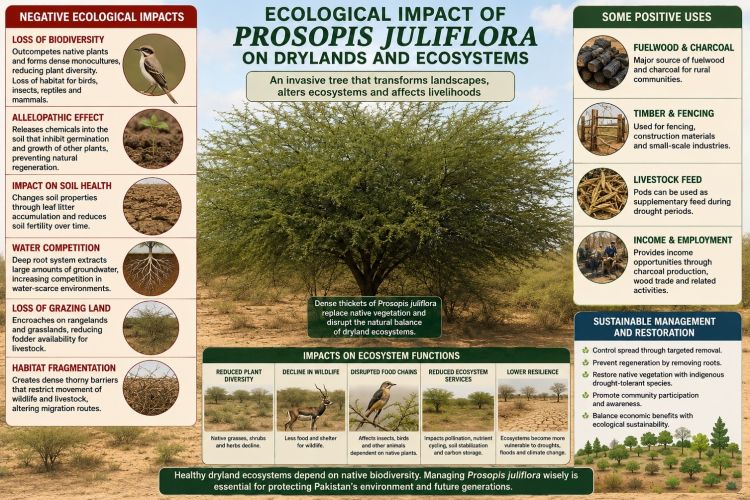 The decline of native vegetation has serious consequences for wildlife. Many birds, insects, reptiles, and mammals depend on local plant species for food, nesting sites, and shelter. Indigenous trees such as Kandi (Prosopis cineraria), Babul (Acacia nilotica), Ber (Ziziphus mauritiana), and Jaal (Salvadora persica) play important ecological roles in supporting biodiversity. When these species are replaced by Prosopis juliflora, wildlife habitats are altered or destroyed. As a result, populations of native animals may decline, disrupting ecological relationships that have developed over centuries.
Another major concern is the tree’s effect on soil ecology. While Prosopis juliflora can reduce soil erosion and stabilize sandy landscapes, its long-term dominance may negatively affect soil health. The tree sheds large amounts of leaves, pods, and organic matter, altering the physical and chemical properties of the soil. More importantly, it releases chemical compounds through a process known as allelopathy. These compounds inhibit the germination and growth of neighboring plant species, making it difficult for native vegetation to regenerate. Even after invasive trees are removed, these chemical effects may persist, slowing ecological recovery and restoration efforts.
The impact on water resources is another issue receiving increasing attention. Prosopis juliflora possesses an extensive root system capable of reaching deep underground water reserves. This characteristic allows the tree to survive prolonged droughts that would kill many native species. However, in water-scarce environments, dense infestations can increase competition for groundwater. In regions already facing declining water availability due to climate change and overextraction, the spread of deep-rooted invasive species may place additional pressure on limited water resources. Although the exact extent of this impact varies according to local conditions, many researchers consider groundwater competition a significant ecological concern.
The invasion of Prosopis juliflora also affects rangelands, which are essential for livestock production in Pakistan’s dry regions. Natural grasslands provide forage for sheep, goats, cattle, camels, and other livestock. These grazing systems support thousands of rural households, particularly in districts such as Tharparkar, Umerkot, Sanghar, and Badin. As Prosopis juliflora spreads, productive grazing areas become covered by dense thorny vegetation. Native grasses decline, reducing the availability of nutritious fodder. This not only affects livestock productivity but also places economic pressure on pastoral communities that depend on healthy rangelands for their survival.
The sharp thorns of Prosopis juliflora create additional ecological and economic problems. Livestock and wildlife moving through dense infestations frequently suffer injuries to their mouths, eyes, feet, and skin. Such injuries can lead to infections, reduced mobility, and lower productivity. The dense vegetation can also obstruct traditional movement routes used by both animals and local communities, creating barriers within the landscape and contributing to habitat fragmentation.
Ecosystem services provided by native vegetation are also affected by the spread of the invasive tree. Healthy dry land ecosystems perform numerous ecological functions, including soil stabilization, nutrient cycling, pollination, water regulation, and carbon storage. Native grasses and shrubs help maintain soil fertility and support diverse insect populations that are essential for pollination. As biodiversity declines and ecosystems become dominated by a single invasive species, these ecological services may become less effective. Reduced ecosystem functionality can increase vulnerability to droughts, floods, and other environmental stresses.
Climate change further complicates the situation. Pakistan’s dry lands are already experiencing rising temperatures, irregular rainfall patterns, and increasing drought frequency. While Prosopis juliflora is highly resilient to these conditions, its dominance may reduce the adaptive capacity of ecosystems. Ecological resilience depends on diversity. Ecosystems containing a variety of plant species are generally better able to withstand environmental disturbances and recover from extreme events. Monocultures created by invasive species are often less resilient and more susceptible to ecological instability over time.
Despite these environmental concerns, Prosopis juliflora cannot be viewed solely as a harmful species. The tree provides fuel wood, charcoal, fencing materials, and income opportunities for many rural communities. During drought periods, its pods may serve as emergency livestock feed. These benefits explain why opinions regarding the tree remain divided. For some communities, it represents an important economic resource; for others, it symbolizes environmental degradation and loss of productive land.
The challenge, therefore, is not simply whether Prosopis juliflora should be removed, but how it should be managed. Complete eradication is often impractical due to the tree’s extensive distribution and ability to regenerate after cutting. Instead, experts recommend integrated management approaches that combine targeted removal, utilization of harvested biomass, restoration of native vegetation, and community participation. Replanting indigenous species such as Kandi, Neem, Babul, Ber, Lasora, Jaal, and Kair can help restore ecological balance while supporting local livelihoods.
Prosopis juliflora represents one of the most complex ecological challenges facing Pakistan’s dry land environments. Although introduced with the intention of combating desertification and providing economic benefits, its invasive nature has resulted in biodiversity loss, habitat degradation, reduced grazing resources, soil and water impacts, and disruption of ecosystem functions. Balancing its economic value with environmental sustainability requires science-based management strategies that protect native ecosystems while addressing the needs of local communities. The future health of Pakistan’s dry lands will depend on finding this balance and restoring the ecological integrity of these fragile landscapes.
Read: Windmills: Energy without Smoke
________________
 Ali Nawaz Rahimoo, based in Umerkot, Sindh is a social development professional. He can be contacted on anrahimoo@gmail.com