The Nature and the Human Relationship
In defense of Nature: Restoring humans’ relationship

Our true home is nature. We must reclaim this permanent address, prove our bond, and rediscover our real identity. If we forget the way to nature we risk becoming another dinosaur of history.
Rupsingh Bhandari, PhD | Nepal
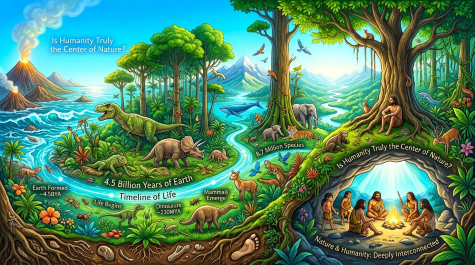
The relationship between nature and humans is profoundly mysterious and deeply interconnected. Humanity is a late participant in this vast and complex system. Long before humans appeared, countless other forms of life and matter had already shaped the Earth. The planet Earth was born approximately 4.5 billion years ago, while human ancestors, modern human (Homo sapiens), emerged only about 300,000 years ago. Agriculture began roughly 10,000 years ago, and scientific development has accelerated only in the past few centuries. Humans are just beginning to unfold the fragments of the immense mysteries of nature and the universe. Whereas, the earth itself is home to nearly 8.7 million species of animals and about 390,000 species of plants. We are all interconnected, sharing this common home. Yet, an important question arises: is humanity truly the center of nature?
Nature is a complex web of both living and non-living participants, intricately bound together. The absence of even one participant directly or indirectly affects the entire system. For instance, if bees were to vanish, nearly 80% of flowering plants including apples would disappear. Some creatures often labeled harmful by humans also play vital roles in maintaining ecological equilibrium. For example: sharks sustain marine ecosystems, bats pollinate fruits, mosquito larvae provide food for aquatic life, tigers regulate forest populations, earthworms enrich soil, birds disperse seeds, snakes control small animal populations, frogs manage insect numbers, and insects themselves maintain soil health. Even air, water, minerals, and other non-living participants of nature hold indispensable roles. The loss of any one element disrupts the whole. But humans are often considered the most powerful and intelligence beings in nature. Yet, when compared to other creatures, humans’ abilities seem limited. For example, African elephants, dogs, bears, and sharks surpass us in smell. Eagles can see eight times farther than humans. Bats hear ten times better. Cheetahs run two and a half times faster. Several animals sense earthquakes before humans do. Butterflies anticipate monsoons, salmon detect ocean currents, and migratory birds navigate with natural radars stronger than humans’ technology. Clearly, nature’s uniqueness is astonishing. But here lies the central argument: does human intelligence truly contribute to the health of nature, or does it undermine it?
Moreover, humans’ dominance has led to both progress and destruction. While we proud humans’ intelligence our exploitation of ecosystems raises doubts about whether this intelligence is fostering nature’s well-being. If every participant in nature plays a crucial role for ecological balance, then humanity must recognize itself not as the master, but as one among many contributors. The survival of our species depends on respecting this balance. Thus, the argument stands: humanity must abandon the illusion of being the center of nature and instead embrace their role as a responsible participant in the grand ecological equilibrium.
Similarly, human beings must have a profound and deep connection with nature, for nature possesses immense powers that not all humans have been able to grasp. Nature is the center of all civilizations and religions. The great spiritual teachers: they attained wisdom and enlightenment in the presence of nature. The Buddha, for instance, achieved enlightenment beneath a tree. Thousands of other gurus, sages, and figures of Eastern philosophy transformed themselves in forests, mountains, and along riverbanks. This is not limited to spiritual leaders. Renowned scientists, philosophers, writers, and artists have also drawn inspiration directly from nature. Leonardo da Vinci observed the flight of birds and conceived of flying machines. Nikola Tesla, watching lightning flash across the sky, discovered principles of electromagnetism. Isaac Newton, sitting beneath a tree, formulated the idea of gravity. The famous writer Henry David Thoreau lived for two years in a small cabin near Walden Pond, away from modern city life, and wrote his celebrated book Walden. Philosopher Rousseau argued that in nature, humans were free and beautiful, but society corrupted their minds. He insisted that without returning to nature, there can be no true well-being. Therefore, the significance of humans and nature interconnectedness is more than humans’ imagination, renewing humans’ organic relationship with nature is important.
Unfortunately, by viewing nature only through a human-centered perspective, we have caused immense destruction. In the past five hundred years alone, nearly one thousand species of animals and seven hundred species of plants have vanished from Earth. Climate change now threatens the extinction of about forty thousand plant species and nearly eight thousand animal species. This devastation is not accidental it stems from excessive consumerism, rapid urbanization, reckless development, industrialization, and the profit-driven motives of capitalism. As a result, environmental crises are multiplying: climate change, loss of biodiversity, deforestation, pollution, water scarcity, ocean acidification, and declining soil fertility. Humanity cannot survive without nature, but nature can survive without humanity. Yet it is precisely human activity that is making the Earth sick. And when the Earth is unhealthy, we too are unhealthy. If the planet continues to deteriorate, what use will human pride and achievements be? Imagine barren black rocks stripped of snow, how ugly they would appear. Forests without greenery, how lifeless they would be. Rivers without water how shameful they would seem. Birds will vanish, songs will vanish, creativity will vanish.
Furthermore, in destroying nature, humans may also be destroying the nature within themselves. With artificial intelligence, humanity is rushing into the Fourth Industrial Revolution. Yet alongside rapid urbanization and technological advancement, people are competing for happiness while growing depression, anxiety and meaninglessness. Suicide rates are highest in the most developed nations Russia, Belgium, Japan. Even in deeply religious countries like Lithuania and Brazil, depression and suicide are rising. Politically advanced and free nations such as the United States face the same crisis. Mental illnesses are spreading worldwide. By contrast, in less developed nations closer to nature such as Bhutan people remain happier. Indigenous communities living in forests appear healthier than modern humans living in palaces. Why have modern religions, ideologies, and science failed to solve this problem? Perhaps because true well-being lies not in endless development, but in restoring our bond with nature.
Perhaps because humans have failed to establish their true relationship with nature, countless changes are now occurring due to human influence. In some places, there is excessive rainfall; in others, drought. Humanity has altered the very systems of nature. What happened to those nameless birds, or the forest bird that sang endlessly did it forget its melody, or has it disappeared? Who stole, all at once, the taste of vegetables and fruits, the snow of the Himalayas, the rush of rivers, and the original laughter of humankind?
Thus, modernity has rendered humanity mechanical, devoid of creativity and sensitivity. In city apartments, people cry out like caged birds. Humanity has not only disconnected its physical connection with nature but also its psychological and spiritual ties. In this self-destructive competition, whom are humans trying to defeat? By dismantling our own home, what are we attempting to prove?
We are in fact nature: our birth and death follow nature’s laws. Nature has water, so we have thirst. It has wondrous sights, so we have eyes. It has music, so we have ears. It has food, so we have hunger. Without fragrance, what use would our noses be? Do our eyes see only by themselves, or do light, invisible rays, and the objects themselves also play a role? Do we walk only with our feet, or does gravity also participate? Why can we not walk on the Moon as we do on Earth? Every existence depends on relationships with other existences. Therefore, we are deeply interconnected with nature. Nature holds countless invisible mysteries we have yet to understand. Humanity survives because of innumerable unseen reasons provided by nature. Yet humans are attempting to replace all of this with modernity creating artificial rain, manufacturing ready-made and synthetic substitutes. In doing so, humanity is not conquering nature but constructing an unimaginable, terrifying future, inviting countless crises upon itself. So, one must ask: for what purpose did nature grant humanity this great potentiality?
The more humans pursue scientific discoveries, the more complex mysteries of nature stand before us. Quantum mechanics, for instance, reveals the dual nature of subatomic particles and waves, showing that quantum measurement can change the behavior of subatomic particle. How can one particle influence another across vast distances? If so, how many particles are we constantly entangled with? Such questions challenge even the foundations of physics, reminding us that countless mysteries remain unresolved. Being the part of nature humanity has not yet understood its true role in nature. Can we justify destroying nature through our narrow, human-centered perspective without comprehending its deeper connection? What consequences will this bring for future generations, other species, and ecosystems? These unanswered questions are humanity’s ultimate test.
Meanwhile, capitalist society and globalization, driven by profit have led multinational corporations to exploit nature for material gain. By selling nature, we are becoming increasingly unnatural. The very fact that we now pay for what nature once gave freely such as clean water and food shows how distorted our perspective has become. One day, will we even be forced to pay bills for oxygen?
Political ideologies and systems which have been developed until now also have placed humans at the center focusing on justice, health, rights, freedom, and material progress. But in nations where these goals have already been achieved, what purpose does politics serve now? Is nature meant only for humans? Who gave humanity the right to exterminate creatures it finds troublesome, or sterilize them for convenience?
Humans are the only species that have killed millions and fought countless wars in the name of religions, nations, money, and rights but at the same time nature has been destroyed alongside human beings. What has humanity truly gained from all this? Imagine if birds divided the sky into nations, if fish partitioned the oceans, if trees taxed oxygen what chaos would ensue? Albert Einstein once said: “Look deep into nature, and you will understand everything better.” Perhaps that is where our answers lie.
Thus, humanity must renew its relationship with nature, seeing it not through human-centered eyes but through nature’s perspective. Humans are not the center of nature; Earth is the shared home of millions of livings and non-living participants. Humanity is merely one participant, not the master. Today’s environmental crises morphed from human-centered selfishness. A fundamental shift in our thinking is essential. Deep ecologist such as Arne Næss argues that only nature-centered philosophy can solve these problems. Without changing our worldview, we cannot save our sick home, Earth.
Humans have gone through revolutions for freedom, equality, justice, and against poverty, these all happened for human-centered purposes. Now, one final revolution is needed: a nature-centered revolution, an ecological awakening. This revolution must ensure that no participant in nature is exploited beyond necessity. Unless all participants are safe, none of us are safe. We must recognize that we are all in the same boat.
Humans’ creativity and intelligence, gifts of nature, have been misused selfishly to dominate sky, land, water, and even space. But if this sick Earth slips into a coma, what meaning will our achievements hold? Recent scientific research shows that plants can communicate, and protect smaller beings through their roots; dolphins communicate with one another; elephants perform rituals for their dead. These discoveries prove that every participant in nature has equal value. Humanity must learn to respect them. Our abilities must be used for the enrichment of nature itself.
Therefore, we must once again write stories of nature, paint its colors, compose its music. Through these expressions, culture and civilization will flourish. Such culture will give rise to leaders who stand for nature. Humanity must rediscover its original bond with nature, recognize its responsibilities, and call back its sensitivity and true happiness.
We must make deep interconnectedness with nature. From walking alone in nature, we learned to live in society, and thus we called ourselves social beings. But this is not our complete identity and potentiality. Our true home is nature. We must reclaim this permanent address, prove our bond, and rediscover our real identity. If we forget the way to nature we risk becoming another dinosaur of history.
Read: The Final Selo: Manifesto of Love, Life and Mankind
________________
 Dr. Rupsingh Bhandari is a poet, short story writer, social activist, critic, and translator from the Karnali province of Nepal. He writes in English, Nepali, and Hindi. Rupsingh has published several poems, articles, and short stories, as well as translated poems and stories. He is the author of the Conscience’s Quantum poetry book. He served as editor of the International Anthology of Pandemic Poetry 2020. His creations are worldwide anthologized and published.