Wind power offers a practical, affordable and environmentally responsible pathway toward sustainable development.
Ali Nawaz Rahimoo
Have you ever endured the intense heat of a Pakistani summer while waiting helplessly for electricity to return? For millions of people across the country, frequent power outages and prolonged load-shedding have become an unfortunate part of daily life. Meanwhile, many developed nations enjoy uninterrupted electricity that powers homes, industries, schools and hospitals around the clock. This contrast raises an important question: why does Pakistan continue to struggle with energy shortages, and what solutions can secure a brighter future?
The answer lies in the widening gap between electricity demand and supply. Pakistan’s population continues to grow rapidly, urban centers are expanding, and industries require increasing amounts of power to sustain economic activity. Although generators, UPS systems and rooftop solar panels provide temporary relief to some households, they cannot solve the country’s broader energy crisis. Pakistan urgently needs sustainable, affordable and long-term solutions capable of meeting national energy needs.
Traditionally, Pakistan has relied on hydroelectric dams and thermal power plants fuelled by oil, gas and coal to generate electricity. While these sources have supported economic development for decades, they come with serious drawbacks. Fossil-fuel-based power generation contributes significantly to greenhouse gas emissions, air pollution and climate change. Rising fuel prices also place enormous pressure on the national economy through expensive imports.
As concerns about global warming intensify, countries around the world are increasingly investing in renewable energy sources. Among these, wind energy has emerged as one of the most promising options. The same powerful winds that often inconvenience us during storms can become a valuable source of clean electricity. According to global energy statistics, wind power contributed more than seven percent of the world’s electricity generation in recent years, and its share continues to grow steadily.
The idea of harnessing the wind is not new. Human beings have used wind power for centuries. Ancient sailors depended on wind-filled sails to cross oceans and connect civilizations through trade. Farmers and rural communities used windmills to grind grain into flour and pump water from wells. Today’s modern wind turbines are sophisticated descendants of these early inventions.
Historians trace the earliest practical windmills to Western Asia more than a thousand years ago. During the seventh to ninth centuries, regions that now form parts of Iran, Afghanistan and Pakistan developed vertical-axis windmills known as “Asbads.” These ingenious structures used strong seasonal winds to grind grain and irrigate farmland in dry environments. Their success eventually inspired similar technologies in India, China and Europe.
In Europe, windmills became symbols of innovation and prosperity. The Netherlands, in particular, perfected their use. Thousands of Dutch windmills were built during the Middle-Ages to grind grain, process raw materials and, most importantly, pump water from low-lying areas. Through this technology, the Dutch reclaimed land from the sea and transformed their landscape into productive agricultural land. Even today, these historic windmills remain icons of Dutch engineering and cultural heritage.
During the nineteenth century, wind-powered water pumps spread across the United States and Australia. Farmers and ranchers relied on multi-bladed windmills to extract groundwater for livestock, irrigation and domestic use. These devices became indispensable in remote rural regions where access to conventional power sources was limited.
Wind energy entered a new era in 1890 when Danish scientist and inventor Poul la Cour developed one of the first wind-powered electricity generators. His pioneering work laid the foundation for modern wind technology. Interest in wind-generated electricity increased dramatically during the energy crises of the 1970s, encouraging nations to seek alternatives to imported oil. Since then, advances in engineering and technology have transformed wind power into one of the fastest-growing renewable energy sources in the world.
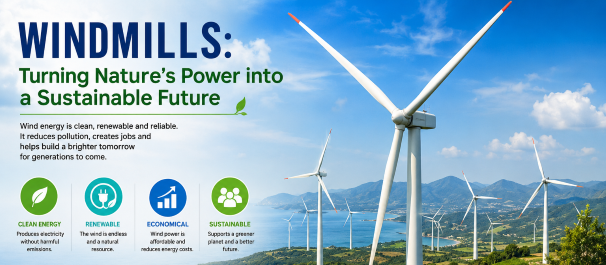
Modern wind turbines operate through a remarkably simple principle. The movement of air turns large blades mounted on tall towers. The rotating blades spin a shaft connected to a generator, which converts kinetic energy into electricity. Unlike fossil-fuel power stations, wind turbines require no fuel and produce no harmful emissions during operation. As a result, they represent one of the cleanest methods of electricity generation available today.
There are two primary types of wind turbines. Horizontal-axis turbines are the most common and recognizable. Typically featuring three large blades, they stand between 60 and 90 meters high and rotate while facing directly into the wind. Their generators are positioned near the top of the tower. Vertical-axis turbines, by contrast, rotate around a vertical shaft and often have generators located near the ground, making maintenance easier and less expensive. Their smaller size also allows installation in urban environments and on rooftops.
When multiple turbines operate together, they form a wind farm. These facilities can contain dozens or even hundreds of turbines connected through a power collection system to the national grid. Wind farms may be established on land or offshore, depending on local wind conditions. Advances in technology and declining installation costs have made wind energy one of the most cost-effective sources of electricity worldwide.
Countries such as China, the United States, Germany, India, Spain, the United Kingdom and Denmark have become global leaders in wind energy production. China possesses the largest installed wind power capacity, while Denmark generates a substantial share of its electricity from wind and is widely regarded as a pioneer in renewable energy innovation.
For Pakistan, the potential of wind energy remains largely untapped. The country’s geographical conditions are highly favorable for wind power generation. Under its renewable energy ambitions, Pakistan has identified several regions suitable for wind development, particularly in Sindh, Balochistan and Khyber Pakhtunkhwa.
The coastal belt between Karachi and Hyderabad contains one of South Asia’s most promising wind corridors. Stretching approximately 180 kilometers in length and 60 kilometers in width, this region alone possesses the potential to generate nearly 50,000 megawatts of electricity. The Gharo-Jhimpir corridor in Sindh is especially significant, with an estimated capacity of around 43,000 megawatts.
Pakistan has already taken encouraging steps. The Jhimpir Wind Power Plant began commercial operations and demonstrated that large-scale wind projects can contribute effectively to the national grid. Today, multiple private-sector wind projects collectively generate substantial amounts of electricity, while additional projects continue to be developed.
Expanding these initiatives could help Pakistan reduce dependence on imported fuels, strengthen energy security, create employment opportunities and significantly decrease the burden of load-shedding. Investments in manufacturing, maintenance, engineering and technical training associated with the wind sector would further stimulate economic growth.
As the world confronts climate change and rising energy demands, renewable energy is no longer a luxury; it is a necessity. Wind power offers a practical, affordable and environmentally responsible pathway toward sustainable development.
The winds that sweep across Pakistan’s plains, coastlines and mountains are more than natural phenomena. They represent an abundant natural resource waiting to be harnessed. By embracing wind energy, Pakistan can transform its energy landscape and ensure that future generations inherit a country powered not by scarcity and darkness, but by innovation, prosperity and uninterrupted light.
Read: The Sanitation Crises in Sindh
________________________
 Ali Nawaz Rahimoo, based in Umerkot, Sindh is a social development professional. He can be contacted on anrahimoo@gmail.com