The tales of Hira Mandi, Pimp, Kite-Flying and the Rooftop Romance
- Author Pran Nevile, who was born in Lahore and spent his youth there until Partition came into being, narrates his memories and observations. His style of expression is remarkably unbiased and filled with affection. He refrains from preaching moral lectures anywhere, presenting the social realities of that era exactly as they were. This book offers a vivid glimpse into the colorful and cultural past of pre-Partition Lahore.
By Nasir Aijaz
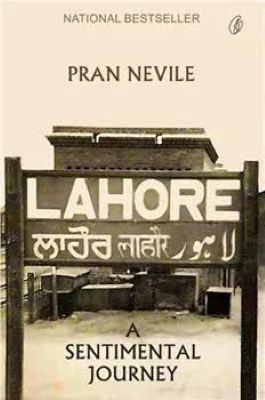
Pran Nevile, the author of the book Lahore: A Sentimental Journey, writes in his preface that the idea for this book about Lahore first struck him in November 1968, in a lonely dining room at Hotel Astoria in Geneva.
”I was having breakfast when I heard someone calling out to me in Punjabi: ‘Motien aalyo, Hindustan de o ke Pakistan de?’ (‘O pearl-adorned one, are you from India or Pakistan?’). I immediately replied: ‘Badshaho aao veho, main Lahore da han’ (‘O King, come take a seat, I am from Lahore’). That person turned out to be a Pakistani belonging to Lahore. Soon, a deep, friendly bond developed between us.”
 “That conversation unleashed a massive storm of memories, etching the lingering recollections of that magnificent city back into our minds. I have attempted to systematically put those very memories onto paper.”
”Rather than writing a personal autobiography, I have penned my personal observations of Lahore, which are extraordinary. I have reflected upon all those experiences of my life that left a deep, lifelong impact on me. I have recorded my memories and observations of those years, in which I also documented the changing conditions of my birthplace, Lahore. I have tried to revive that atmosphere which existed in the first half of this century—that deeply beloved and historic city whose thoughts and lifestyle have now vanished.”
Pran writes that a city is not merely defined by its markets and buildings, but rather by its atmosphere, joys, sorrows, passion, nostalgia, entertainment, and above all, its people, who collectively form the very soul of that city. He tried to feel that essence and soul once again. He consciously avoided commenting on the political and economic events of the city, even though he made sure to mention that era of Lahore’s past which was brought to an end by the 1947 Partition of Punjab.
Pran Nevile’s acclaimed book, Lahore: A Sentimental Journey, first published in 1993 by Penguin India, stands as an exquisitely beautiful, emotional, and indelible document of the memories, culture, and vibrant life of pre-Partition Lahore. Nevile, who was separated from his homeland by the historic Partition of 1947, took a reverent journey back into his past through this book decades later.
This book is by no means a dry historical record; rather, it is a magical map of 1930s and 1940s Lahore, where Hindus, Muslims, and Sikhs lived together as part of a shared, secular Ganga-Jamuni civilization. Shopping in Anarkali Bazaar, horse-drawn tanga rides on The Mall Road (Thandi Sarak), the festivities of Basant, and romances blossoming from rooftop balconies—it encompasses all of this.
However, two of the most fascinating and unique chapters in the book illuminate Lahore’s historic and controversial red-light district along with its distinct characters. Other chapters explore Lahore’s cinemas and various other themes, including flying kites on rooftops and falling in love.
Fazal – The Ace Pimp of Lahore
This chapter is an engaging and witty profile that offers a close look into the inner workings of Lahore’s underworld and red-light district of that time. The central figure of this whole trade is a pimp named Fazal.
Fazal was a peculiar character. He held the status of a master in his profession, and his method of attracting clients was highly dramatic. To draw the attention of innocent and adventurous young students from Government College, he would roam the alleys shouting his own name out loud, ensuring everyone knew that the “expert” had arrived.
Pran Nevile himself had an encounter with this pimp. Pran relates an anecdote from his youth when he was studying with his friends. One evening, Fazal spotted them and called out in his signature style: “Bau ji! If you come with me, I will make this evening unforgettable for you forever.”
For social historians, this chapter is particularly significant because Nevile documents in detail the language and code words used by Fazal. Fazal ran his trade like a well-organized business. He used terms like “goods” (maal) or “pieces” to refer to women, and he adapted his pricing and tone based on the depth of the customer’s pockets or their innocence.
For the author and his friends, that walk with Fazal was a mixed experience of fear and excitement. Fazal led them to those forbidden alleys where they merely observed the environment. Nevile writes that owing to their innocent age, they did not let things progress any further and, after taking in the sight, quickly returned to their hostel.
The Splendours of Hira Mandi or Tibbi
In this chapter, rather than focusing on a single person, the author presents a broad cultural and geographical analysis of this historic entertainment area of Lahore. Nevile clarifies an important distinction here that outsiders often fail to understand: the difference between Hira Mandi and Tibbi.
Hira Mandi: The Hub of Culture and Art
Pran Nevile writes that pre-Partition Hira Mandi was not merely a den of vice; it was an exalted center of classical music, dance, poetry, and refined etiquette (tehzeeb). Here, elite courtesans (tawaifs) ran their kothas (salons). During the 1930s and 1940s, the city’s wealthy elites, literary figures, poets, and artists gathered here. The air resonated with poetry, ghazals, and classical ragas.
During that era, it was a tradition for affluent families to send their young sons to the kothas of these cultured courtesans so they could learn conversation etiquette, refined manners, and the proper pronunciation of both Urdu and Punjabi.
Nevile paints an enchanting picture of the evenings, where dancers adorned in jewelry glimpsed through windows, and the rhythmic sound of ghungroos (ankle bells) cast a mesmerizing spell over passersby.
Tibbi: The Stark Commercial Reality
In stark contrast to Hira Mandi, the adjacent streets of “Tibbi” were a purely commercial red-light area. This was a section where art, poetry, or classical music had no place. It was purely a trade of the body, devoid of any moral or cultural pretense. It was a place where physical desire was sold without the resonance of ghungroos or ghazals.
 Kite Flying on Rooftops and Falling in Love
Pran writes that during the winter season, as soon as boys returned home from college, they would head straight to the rooftops to fly kites. The atmosphere surrounding kite flying was captivating and full of enthusiasm, with shouts of “Bo-Kata!” echoing through the air. As evening fell, the boys would head downstairs, and when silence settled after dusk, the time for young lovers would begin. Young men and women would steal away to the rooftops out of their parents’ sight to whisper words of love.
In the summer, due to the intense midday heat, activities shifted to the evening when the elders of the house would also carry their hookahs up to the roof. Occasionally, musical gatherings would take place on a neighbor’s rooftop.
Pran recalls an incident toward the end of June when he went up to the roof at dusk to retrieve a pillow and heard soft whispering. Peeking quietly, he saw his neighbor Heera whispering words of love to Ram Pyari, the young wife of another neighbor. Just a short while earlier, she had been sitting downstairs chatting with other women before stealthily slipping away to the roof.
Other chapters of the book are equally compelling, touching upon live dance performances, indigenous aphrodisiacs, and traditional medicines.
Pran Nevile’s tone remains remarkably balanced and warm throughout. He never pauses to deliver moral commentary, choosing instead to present the social reality of the time as it was. Through this book, we get a poignant glimpse into Lahore’s shared, colorful, and rich cultural past—one that was forever lost to the Partition of 1947 and the political and religious shifts that followed. This book is not merely a memory of Lahore; it is an elegy for a lost civilization.
Read: Two Shores of the Same River
______________
 Nasir Aijaz is a journalist, based in Karachi