A Solo Journey through Marseille, Provence, the French Riviera, and Monaco
Suddenly, thousands of kilometers from Sindh, the familiar greeting of “Sain! Sain!” filled the air.
By Abdullah Usman Morai | Sweden
Day Three – Marseille through Many Eyes Where Every Street Tells a Story
12 October 2025
Every city has its own personality.
Some cities reveal themselves through grand monuments, others through museums or famous landmarks. Marseille, however, reveals itself through its people. It is a city where Europe, Africa, the Middle East, and the Mediterranean have been meeting for more than twenty-six centuries. As France’s oldest city and one of its busiest seaports, Marseille has welcomed traders, sailors, artists, immigrants, students, and dreamers from every corner of the world. Walking through its streets feels less like visiting a city and more like walking through a living history book.
I had intentionally reserved my third day entirely for Marseille.
After enjoying a delicious French continental breakfast at my hotel, fresh bread, buttery croissants, fruit, juice, coffee, and pastries, I stepped outside into another beautiful Mediterranean morning.
The weather was comfortably warm, the sky was brilliantly blue, and modern trams quietly glided through the city’s wide streets. Being Sunday, the city already had a lively atmosphere.
As I walked towards the Old Port (Vieux-Port), I noticed hundreds of runners participating in what reminded me of the “Lopp” races so common in Sweden. The streets were full of enthusiastic runners, cheering spectators, and volunteers, giving the city an energetic weekend spirit.
Not far away, another scene captured my attention.
A large open-air seafood market had taken over part of the harbour.
Freshly caught fish, shellfish, octopus, prawns, and countless other treasures from the Mediterranean lay beautifully displayed on ice while residents carefully selected their weekly purchases. The market reflected Marseille’s centuries-old relationship with the sea.
Everything looked remarkably fresh, clean, and well organized.
With some time remaining before my scheduled walking tour, I wandered around the Old Port.
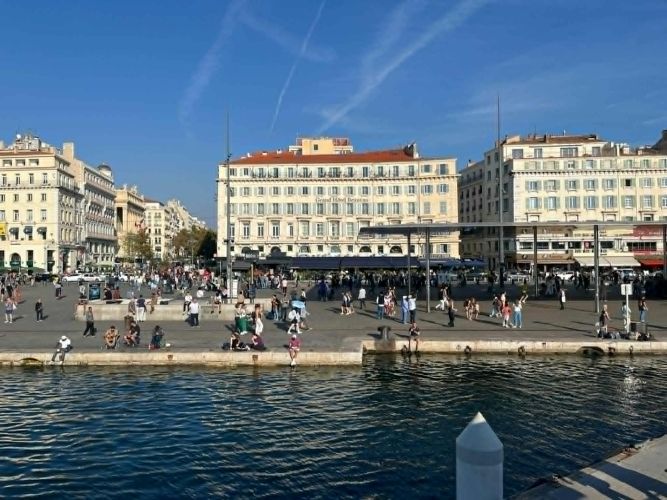
Elegant yachts floated peacefully beside traditional fishing boats, while street musicians entertained visitors with guitars, violins, accordions, and soulful singing. Their music echoed gently across the harbour, creating a soundtrack that perfectly suited the relaxed Mediterranean atmosphere.
Watching the boats, listening to music, and simply observing people became an experience in itself.
Sometimes travelling means doing absolutely nothing except noticing life around you.
Shortly before eleven o’clock, I received a WhatsApp message from our guide, Ezequiel.
Originally from Latin America, he explained that he would be waiting outside the Old Port Metro Station, holding a blue umbrella so everyone could recognize him.
When I arrived, several travelers were already gathered there.
Within a few minutes, our group had grown to around twenty-five participants, most of them from Canada and the United States, with a few others from different parts of the world.
One of the reasons I enjoy joining free walking tours whenever I travel is that they combine local knowledge with genuine human interaction. Unlike traditional guided tours, these tours usually operate on a tip-based system, allowing visitors to decide the value of the experience themselves. Over the past decade, they have become increasingly popular across Europe because they make history, architecture, culture, and local stories accessible to every traveler regardless of budget.
Soon, our walking tour began.
Ezequiel proved to be an excellent storyteller.
Rather than overwhelming us with dates and historical facts, he connected Marseille’s history with everyday life, making every stop meaningful.
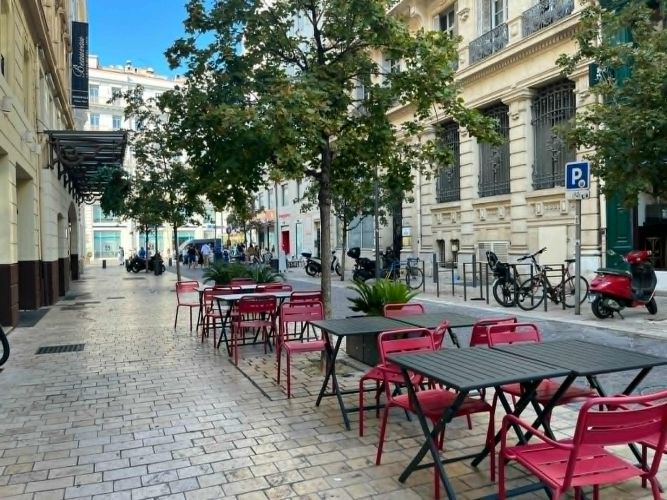
We explored the remains of the ancient Greek and Roman settlements preserved around the Marseille History Museum, where archaeological ruins reveal the city’s remarkable past. We wandered through the charming streets of Le Panier, Marseille’s oldest neighbourhood, famous for its colourful street art, murals, narrow alleyways, artists’ studios, cafés, and centuries-old buildings.
Every corner seemed to tell a different story.
Some walls displayed contemporary artwork while others carried reminders of Marseille’s multicultural identity.
We also admired the magnificent Cathedral of La Major, whose Byzantine-inspired architecture dominates the waterfront. Along the way, Ezequiel pointed towards his very first accommodation after arriving in Marseille, reminding us that guides also have personal journeys intertwined with the cities they introduce to others.
Throughout the walk, he explained why Marseille’s Old Port became one of the Mediterranean’s most significant trading centers, connecting Europe with Africa, the Middle East, and Asia for thousands of years.
Our tour eventually concluded between two of Marseille’s most impressive landmarks.
The first was the Museum of European and Mediterranean Civilizations (MuCEM), one of France’s most innovative museums. Opened in 2013, MuCEM celebrates the shared history, traditions, cultures, and civilizations surrounding the Mediterranean Sea. Its striking contemporary architecture, covered with intricate concrete latticework, contrasts beautifully with the ancient surroundings while symbolizing the connection between past and present.
Standing beside it was the historic Fort Saint-Jean, originally constructed in the seventeenth century under King Louis XIV to guard Marseille’s harbour. Today, visitors can stroll through its ancient walls and gardens while enjoying spectacular panoramic views of the sea and the city.
Before saying goodbye, Ezequiel pointed towards the hill overlooking Marseille.
“There,” he smiled, “is Notre-Dame de la Garde. If you have time, don’t leave Marseille without visiting it.”
Everyone thanked him according to their own means, rewarding both his knowledge and his enthusiasm.
When Marseille Suddenly Spoke Sindhi
The historical tour ended.
Another journey was about to begin.
This time, it was a Sindhi journey.
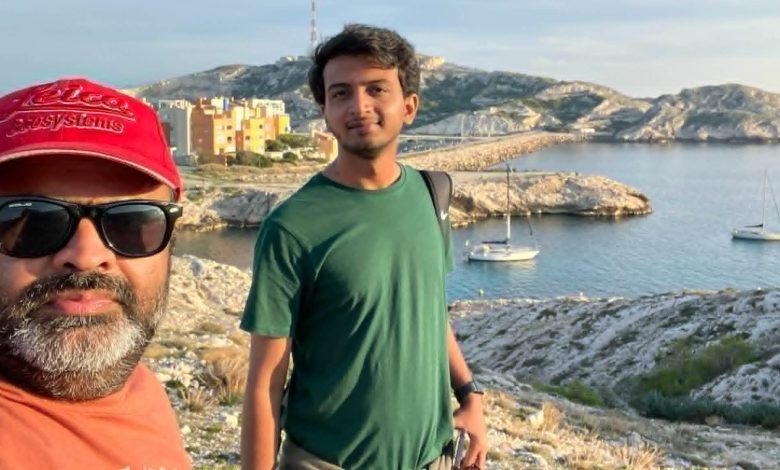
Waiting for me was Tanveer Ahmed Sangrasi, originally from Janghi village of Chachro, Tharparkar, Sindh.
Tanveer had graduated from IBA Sukkur and was then studying in Italy while spending time in Aix-en-Provence as an exchange student.
The moment we met, the atmosphere changed completely.
Suddenly, thousands of kilometers from Sindh, the familiar greeting of “Sain! Sain!” filled the air.
We both smiled instantly.
There is something uniquely comforting about hearing your own language in a foreign country. For a moment, Marseille felt just a little closer to home.
The afternoon had become quite warm, so I changed into the extra shirt I had wisely packed in my backpack that morning.
Together, we revisited MuCEM and Fort Saint-Jean, taking our time to appreciate details that are often missed during organized tours.
The contrast between centuries-old fortifications and bold modern architecture was fascinating.
Standing on the terraces overlooking the Mediterranean, we admired the endless combination of blue sky, blue sea, and warm sunshine while talking about life, studies, travel, and Sindh.
Above the City
From the Old Port, we boarded a local bus towards Notre-Dame de la Garde, Marseille’s most recognizable landmark.
The journey uphill took around thirty minutes.
The basilica stands on the city’s highest natural point, watching over Marseille like a guardian.
For generations, fishermen and sailors have prayed here before setting sail, believing the Virgin Mary would protect them during dangerous voyages across the Mediterranean.
From the terrace, Marseille unfolded beneath us.
The Old Port, the endless coastline, the surrounding hills, the distant islands, every rooftop, every church, every ship.
It truly felt like seeing the city through the eyes of a bird.
People from all over the world quietly admired the same breathtaking panorama.
Sometimes words become unnecessary.
Chasing the Sunset on the Frioul Islands
Returning to the harbour, we decided that the day still had another adventure waiting.
We purchased ferry tickets for the Frioul Archipelago, consisting mainly of Île Ratonneau and Île Pomègues, together with the nearby island made famous by Château d’If, the fortress immortalized in Alexandre Dumas’ novel The Count of Monte Cristo.
Before boarding, we still had a little time.
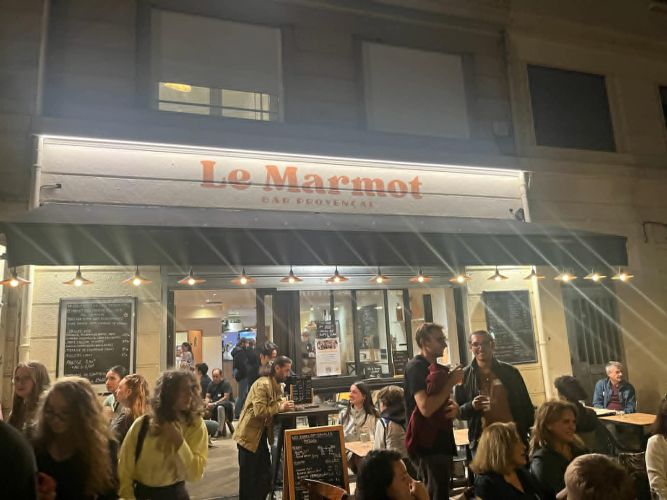
We wandered around the harbour before stopping at Risette Torréfacteur, a cosy coffee shop filled with students reading books, working on laptops, chatting with friends, and enjoying Sunday afternoon coffee.
We ordered tea, coffee, and cake while watching everyday Marseille continue outside.
Soon our ferry departed.
Within half an hour, the busy city disappeared behind us.
The Frioul Islands are unlike the elegant Riviera towns.
Rocky, windswept, and beautifully rugged, they offer hiking trails, hidden coves, crystal-clear water, and extraordinary panoramic views. The islands are connected by walkways, making it possible to explore them on foot while constantly surrounded by the Mediterranean.
There were no crowds, no traffic, only nature. The scenery felt almost untouched.
Small private boats anchored in secluded bays where families and friends enjoyed quiet picnics. Every turn revealed another postcard-worthy landscape.
We walked for hours. The deeper we explored, the quieter everything became.
Eventually, we reached Île Pomègues, one of the best places around Marseille to watch the sunset.
As the sun slowly approached the horizon, the Mediterranean transformed into shades of gold, orange, pink, and deep blue.
Nearby, a group of young Arab girls sat peacefully in a row, silently watching the sunset. Nobody seemed interested in speaking. The view itself was enough.
Eventually, we realised it was time to hurry back.
Missing the last ferry would have meant spending a very unexpected night on the islands.
Fortunately, we reached the harbour just in time. The island residents and workers boarded first, followed by everyone else. Soon the ferry began its return journey. As Marseille gradually appeared on the horizon, the city resembled a constellation of stars rising from the sea.
The illuminated Old Port sparkled beautifully, while reflections from boats, buildings, and streetlights danced across the calm water.
It was one of the most beautiful night arrivals I have experienced.
A Sindhi Evening in Marseille
Back in the city, Tanveer and I continued walking through the lively harbour before choosing a Tunisian restaurant called Le Palmier for dinner.
We preferred sitting outside. The evening was pleasantly warm, and the surrounding streets remained full of life. Dinner became much more than simply eating.
Tanveer shared stories from his childhood in rural Thar, his student life at IBA Sukkur, his experiences studying in Italy, and his exchange program in France.
Listening to young Sindhis building successful futures abroad filled me with genuine happiness. Around 9:30 p.m., we finally said goodbye. Tanveer needed to return to Aix-en-Provence. I began my walk back to the hotel.
Meeting him had become one of the most memorable moments of the entire journey.
It reminded me that no matter where Sindhis travel, to Europe, North America, Asia, or elsewhere, they somehow find one another.
And wherever they meet, conversations immediately feel like home.
To the young people of Sindh who dream of studying or working abroad, I would simply say this: Do not let geography limit your ambitions. The world is far larger than we often imagine.
Every country offers opportunities for those willing to learn, work hard, respect other cultures, and remain proud of their own roots.
Reflections: Beyond the French Riviera
Back at my hotel around ten o’clock, I packed my rucksack for the next morning’s flight. As I folded my clothes, I realized I was also packing memories.
In just three days, I had experienced France through remarkably different perspectives. I had shared tea with an old French friend whose friendship has lasted twenty-five years. I had laughed with people from France, Tunisia, Syria, Pakistan, Canada, and the United States.
I had travelled through glamorous Riviera towns where luxury yachts floated beside historic harbours. I stood inside medieval villages scented with perfume. I had finally fulfilled a long-held dream of visiting Monaco.
I had wandered through Marseille’s multicultural streets where African, Arab, European, and Mediterranean cultures blend naturally into everyday life.
Most importantly, I had shared meaningful moments with a fellow Sindhi thousands of kilometers from home. Travelling alone never truly means being alone. Every destination introduces new companions.
Some remain friends for a day, some become lifelong friends, some remind you of where you came from, others inspire you to imagine where you might go next.
France offered me magnificent landscapes, remarkable history, unforgettable cuisine, beautiful architecture, and breathtaking coastlines.
But the greatest souvenir was something no shop could sell: it was the kindness of people, the conversations over coffee, the reunions, the music that crossed languages, the sunsets shared with strangers, the laughter that needed no translation.
As my journey came to an end, I realized that the French Riviera is far more than a collection of famous destinations.
It is a place where history meets the sea, where cultures meet one another, and where every traveler discovers a slightly different version of themselves.
The next morning, I would fly back to Stockholm. But a small part of my heart would remain somewhere between the Old Port of Marseille, the lavender-scented hills of Provence, the glamorous French Riviera, and the peaceful sunset over the Frioul Islands.
Some journeys end when the airplane takes off. The best ones continue travelling with us long after we return home. (Concludes)
_______________________
Abdullah Soomro, penname Abdullah Usman Morai, hailing from Moro town of Sindh, province of Pakistan, is based in Stockholm Sweden. Currently he is working as Groundwater Engineer in Stockholm Sweden. He did BE (Agriculture) from Sindh Agriculture University Tando Jam and MSc water systems technology from KTH Stockholm Sweden as well as MSc Management from Stockholm University. Beside this he also did masters in journalism and economics from Shah Abdul Latif University Khairpur Mirs, Sindh. He is author of a travelogue book named ‘Musafatoon’. His second book is in process. He writes articles from time to time. A frequent traveler, he also does podcast on YouTube with channel name: VASJE Podcast.