Sand Mining Drains the Lifeblood River. Protect Khirthar Before Nothing Remains
Farooq Sargani
A.W. Hughes was a British civil servant and writer who authored several detailed accounts of Sindh and Balochistan. Having traveled extensively across the region, he compiled the comprehensive Gazetteer of the Province of Sind, published in London by George Bell and Sons in 1876.
This review offers a critical assessment of the Karachi Taluka (sub-district) section of Hughes’ work, while also exploring the palaces, historical sites, rivers, and mountains of the region—many of which have vanished due to urban development erasing the hills of Kohistan.
Administrative Geography and the Local Irrigation System
When Hughes arrived in Sindh, Karachi was classified as a Taluka containing just two Dehs (administrative units): Malir and Hub. At the time, the urban population of Karachi town was only about 800 people.
Hughes described the region as a vast area bounded by the lofty Khirthar Mountains in the north and the Hub River in the west. He noted that whenever it rained, the arid landscape transformed into a lush, green, and fertile region:
“There are no canals here, only the lofty, beautiful peaks of the mountains; from these, several rivers originate, such as the Malir and Lyari.”
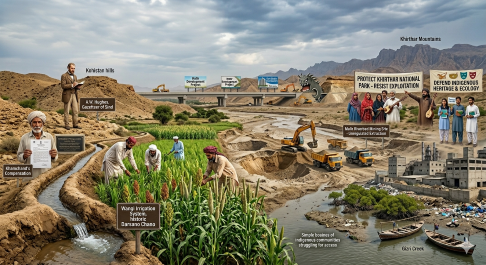
However, Hughes was unaware of the “Wangi,” the indigenous local irrigation channel system used by native inhabitants.
Contrary to Hughes’ observations, British archival records—specifically the “Settlement Report of Malir Tapa Karachi, 1889″—confirm the existence of 37 irrigation channels locally known as Wangis. These channels successfully diverted water from the rivers to irrigate the agricultural lands of Malir.
The Famous Khamchand Wangi Case
A notable historical example of this indigenous system is the Khamchand Wangi case. A Wangi originating from the Malir River diverted water to cultivate agricultural fields in the Darsano Chhano area. However, when the Karachi Municipality subsequently diverted the river’s water for urban use, Khamchand’s lands turned barren.
He took the matter to court, and in 1936, the judicial authorities awarded him 110,000 rupees in compensation. Today, the site of the former Khamchand Wangi falls within Education City and has been allocated to Sir Syed University of Engineering and Technology.
Environmental Degradation of the Malir River
The Malir River originates in the Khirthar Mountains and is known by various names along its course. For most of the year, it remains a dry, seasonal riverbed. Historically, local farmers excavated the riverbed to tap into subsurface water for their crops. Eventually, the river empties into the Arabian Sea through the Gizri Creek.
Historically, this confluence formed a rich delta with dense mangrove forests. However, rapid and unregulated urban development has acted like a monster, destroying the Malir River creeks.
The establishment of industrial factories, excessive sand and gravel mining (Reti-Bajri extraction), and the deforestation of mangroves have severely degraded the ecosystem and displaced indigenous fishing communities.
Exploring Manghopir and the Gadap Valley
Hughes also explored Manghopir, referring to the broader surrounding region as the Gadap Valley, located approximately 16 kilometers north of Karachi town.
To him, Manghopir was a fascinating place. Situated 6 to 7 miles north of Karachi, the area was characterized by dry, low-lying hills. Hughes was astonished to observe the local crocodiles (alligators) living in peaceful coexistence with other animals, such as bathing water buffaloes.
When Hughes attempted to approach the crocodiles for a closer look, the local Baloch residents stopped him, warning that it was dangerous. Additionally, Hughes noted that despite its distance from the main Karachi town, Manghopir was incredibly beautiful and featured natural hot springs. The rich myths and folklore surrounding these crocodiles were later detailed by Gul Hassan Kalmati in his seminal book, Karachi: The Glory of the East.
Climate, Wildlife, and Agriculture
Hughes observed that due to its proximity to the Arabian Sea, the climate of the Karachi Taluka was pleasant and attractive.
The region originally boasted a diverse array of wildlife, including leopards, hyenas, wolves, jackals, foxes, and bears, alongside numerous bird species. Unfortunately, unchecked urban expansion and a hunting culture eventually displaced or decimated these populations.
In terms of agriculture, Hughes highlighted the high productivity of Malir, where large quantities of sorghum (Jowar), pearl millet (Bajri), barley, and sugarcane were grown.
The region was also famous for producing highly flavorful vegetables. However, agricultural conditions in Malir have deteriorated significantly since then.
The Rise and Fall of Cotton Farming
An interesting historical footnote is the cultivation of cotton in Malir. In 1861, a farmer named Mr. Jacob Bethcom established a 22-acre cotton farm. He successfully cultivated premium American and Egyptian cotton varieties, earning a 500-rupee prize from the Bombay Government.
Despite the high fertility of the soil, the cotton industry in Malir ultimately declined. Frequent, destructive flash floods in the Malir River repeatedly wiped out the crops, discouraging farmers from pursuing large-scale agriculture out of fear of recurring losses.
Modern Challenges and the Call to Action
Today, roughly 80 percent of Malir’s agricultural land has been destroyed. The seasonal Malir River and its tributaries have been heavily damaged by sand mining and land reclamation. The remaining fertile lands have been seized by capitalists, feudal lords, and real estate developers.
In the name of “development,” invaluable historical sites and natural hills have been erased. It is now critical to protect the remaining ecology, agriculture, and environment of Malir and the Khirthar region.
Powerful developers, local chieftains (Sardars), and capitalists have now turned their sights toward Khirthar National Park. If left unchecked, they will do to Khirthar what they have already done to Malir. With political backing, there is an ongoing exploitation of both the indigenous people and their ancestral lands.
To counter this destruction, we must resist. We must use our voices—through art, literature, and regional theater—to expose the exploitation taking place in Malir and Khirthar. It is vital for the educated middle class and progressive activists to stand in solidarity with the indigenous communities to protect their heritage and environment.
Read: Malir: Farmlands, Heritage at risk
_____________________
 The author is freelance writer. He has graduated from Karachi University