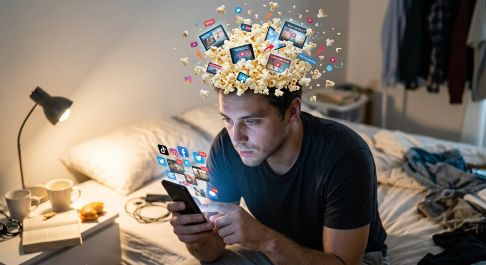
Popcorn Brain: Is Your Smartphone Training Your Mind to Lose Focus?
- How constant scrolling, notifications and instant entertainment may be turning our attention into a restless search for “What’s next?”
By: Ramesh Raja
Popcorn Brain is a simple term for a mind that constantly jumps from one thing to another because of continuous digital stimulation. The term was popularized by David M. Levy of the University of Washington in 2011 to describe how electronic multitasking can make slower, offline activities feel difficult or boring. It is not a medical diagnosis, but a useful metaphor for a modern attention problem.
The topic is highly relevant today because smartphones, short videos, social media and instant notifications have made constant stimulation part of everyday life. Popcorn Brain asks a simple but important question: are we using technology, or is technology gradually training us to lose the ability to concentrate?
Popcorn Brain: When the Mind Starts Jumping
You sit down to read an article, but after a few minutes you check WhatsApp. A notification appears, you open it, reply to a message, glance at social media, watch a short video, check the news and then return to the article, only to realize that you have forgotten what you were reading. You are not necessarily lazy, nor does this automatically mean that you are addicted to your phone. You may simply be experiencing what is popularly called “Popcorn Brain”, an informal expression used to describe a mind that has become accustomed to rapid digital stimulation and constantly jumps from one piece of information to another, much like popcorn kernels suddenly popping in different directions. The term is not a medical diagnosis and was popularized by University of Washington researcher David M. Levy, who used it to describe a state in which people become so accustomed to electronic multitasking that slower, offline experiences can begin to feel strangely dull. The idea is particularly relevant today because smartphones have placed an almost endless stream of information, entertainment and communication directly into our hands. There is always another message, another headline, another video, another recommendation or another notification waiting to capture our attention. One interruption may seem harmless, but when this pattern is repeated throughout the day, the mind can become increasingly comfortable with switching rather than staying. Reading a book requires sustained attention, writing requires concentration, listening to another person requires patience and deep thinking requires uninterrupted mental space, while much of the digital environment encourages us to move quickly from one stimulus to another.
How the Digital World Is Training Us to Keep Looking
The development of Popcorn Brain is not something that happens overnight. It can gradually emerge from everyday digital habits. We check our phones while eating, look at messages while watching television, scroll through social media while travelling, read headlines while working and reach for the phone whenever there is even a moment of boredom. Social-media platforms and digital services are designed around constant engagement, with notifications, recommendations, short videos, continuously refreshed feeds and personalized content providing an almost endless supply of new stimulation. The mind begins to anticipate something new every few seconds, and the simple act of checking the phone can become automatic. This creates a cycle in which curiosity leads to checking, checking produces new information or entertainment, and the experience encourages another check later. Research into media multitasking has found associations between heavier multitasking and aspects of attention and cognitive control, although researchers caution that such findings do not prove that digital multitasking alone causes these difficulties. The more important point for ordinary users is that attention is partly shaped by habit. When we repeatedly practice rapid switching, sustained concentration may begin to feel less natural. This helps explain why someone can spend an hour scrolling through hundreds of short pieces of content but struggle to spend twenty minutes reading a serious article or book. The problem may not be a complete loss of attention, but a growing preference for rapid stimulation over slow and demanding thought.
What Are We Gaining, and What Are We Losing?
Digital technology has brought enormous benefits, and it would be unfair to portray every form of rapid information processing as harmful. Modern technology allows people to communicate instantly, access knowledge within seconds, monitor several sources of information and respond quickly to changing circumstances. In professions such as emergency management, journalism, engineering, business and many other fields, the ability to notice and respond to new information can be extremely useful. The problem arises when the ability to switch attention becomes an inability to maintain attention. The cost can be particularly serious because deep thinking rarely happens in the few seconds between notifications. Students need sustained concentration to understand difficult subjects; engineers need uninterrupted thought to solve complex problems; writers need mental space to develop ideas; researchers need patience to examine evidence; and ordinary people need attention to listen properly to another person. Constant interruption can encourage superficial reading, fragmented thinking, weaker engagement with difficult subjects and a tendency to seek novelty whenever something becomes slow or demanding. Perhaps the most revealing consequence is the growing difficulty many people experience with silence and boredom. Sitting quietly without a phone, waiting without scrolling, drinking tea without checking messages, walking without headphones or simply looking out of a window can begin to feel strangely uncomfortable. We may start to believe that something must always be happening. In this way, the greatest danger may not be that technology makes us unintelligent, but that it gradually makes us impatient with the conditions in which intelligence develops: silence, concentration, reflection and time.
The Cure Is Not to Abandon Technology, but to Regain Control
The good news is that Popcorn Brain is an informal description of a behavioural pattern, not a recognized medical diagnosis, and habits of attention can be changed. The answer is not to throw away the smartphone or reject modern technology. Smartphones can be libraries, classrooms, offices, maps, communication tools and gateways to knowledge. The real challenge is to make technology serve us rather than allowing it to control our attention. A useful first step is to turn off unnecessary notifications so that the phone does not constantly demand attention. During reading, writing, studying or important conversations, the device can be kept physically away rather than merely placed beside us. Single-tasking can also be deliberately practiced by completing one meaningful activity before moving to another. The ability to concentrate can be rebuilt gradually, just as physical strength is developed through exercise. Someone who struggles to read for thirty minutes can begin with fifteen minutes of uninterrupted reading and slowly increase the period. Small periods of digital silence can also be introduced into everyday life by eating without a phone, walking without constant scrolling, drinking tea without checking messages or spending a short period each day simply sitting quietly. These practices may appear insignificant, but they teach the mind an important lesson: not every notification deserves a response, not every moment of boredom needs entertainment and not every piece of information deserves our attention. The objective is not to use technology less simply for the sake of using it less. The objective is to become capable of choosing when to use it and when to put it aside.
The Most Valuable Freedom in the Digital Age
Perhaps the deepest lesson of Popcorn Brain is that attention is not merely a mental function; it is one of the most valuable resources we possess. What receives our attention shapes what we learn, what we remember, what we create, how we communicate and ultimately how we experience our lives. A notification chooses something for us. An endless feed chooses something for us. An algorithm recommends what we should see next. If we constantly follow these prompts, we may gradually stop deciding where our attention should go. That is why the real issue is not simply screen time. It is control over attention. Technology should be our servant, not the manager of our minds. A useful test is to put the phone away for thirty minutes and spend that time reading something substantial, talking to someone, walking, thinking or simply doing nothing. If thirty minutes of silence feels unusually difficult, it may be a sign that our minds have become accustomed to constant stimulation. The solution is not fear of technology but deliberate practice of attention. In a world where companies compete relentlessly for our eyes, clicks and seconds, the ability to ignore, wait, concentrate and think deeply may become one of the most valuable human skills. A healthy mind should be able to move quickly when circumstances demand it, but it should also be able to slow down, remain quiet and stay with one important thought. The greatest danger is not that the smartphone is becoming smarter; it is that we may gradually forget how to control our own minds. Popcorn Brain is therefore more than a catchy expression. It is a warning about a world in which our attention has become a commodity, and a reminder that one of the most important freedoms we can protect is the freedom to decide what deserves our attention.
Instant Suggestion: Observe DDD or DDDT
DDD, Digital Detox Day, can be observed once every month by deliberately staying away from unnecessary digital devices for a full day, while DDDT, Daily Digital Detox Time, means setting aside at least 30 to 60 minutes every day without smartphones, social media or unnecessary screen use. DDD gives the mind an occasional complete break, while DDDT makes digital discipline a daily habit. The purpose is not to reject technology, but to regain control over our attention and create time for reading, conversation, nature, reflection and real-life experiences. DDD gives the mind a day to breathe; DDDT gives it a daily breath.
Read: When Pollution Is Painted Green
______________________
 The author of this article, Engr. Ramesh Raja, is a Civil Engineer, visionary planner, PMP certified and literary enthusiast with a passion for art and recreation. He can be reached at engineer.raja@gmail.com