Balochistan’s political landscape has undergone a profound transformation since 1948, shifting from traditional parliamentary efforts to a middle-class, urban-centered armed resistance driven by fractured political accords and systemic alienation.
By Noor Muhammad Marri Advocate | Islamabad
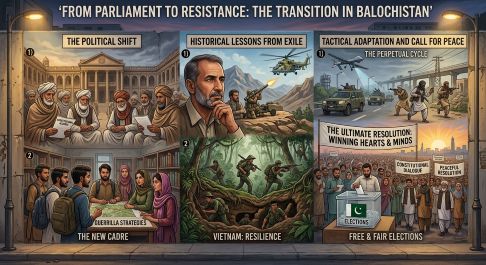
Since 1948, the political question of Balochistan has remained a central subject of discussion among its political leadership. Over these decades, two distinct strategic paths emerged: the constitutional and parliamentary route, and the path of armed resistance. As political accords repeatedly fractured and democratic avenues narrowed, the momentum gradually tilted toward armed struggle. Consequently, traditional Sardars and Nawabs who adhered to constitutional politics found themselves politically sidelined or confined to their homes.
This shift marked a profound transition in Balochistan’s political landscape, giving rise to an educated, middle-class cadre of young men and women. Reliable accounts confirm that the ideological, political, and tactical foundations of this new generation were cultivated by senior leaders returning from Afghan exile—including Abdul Nabi and his contemporaries.
Their primary role lay in transforming an irregular, chieftain-led tribal lashkar model into a disciplined, cadre-based movement on modern guerrilla warfare principles. They systematically engaged educated students, university youths, and women, equipping them with political consciousness, ideological discipline, and updated tactical methods. They demonstrated that contemporary resistance relies far less on static mountain hideouts and far more on urban networks, intellectual clarity, and strategic agility.
In shaping this new structure, these veteran figures drew directly from their observations during years of exile in Afghanistan. Globally, irregular warfare has evolved continuously. During the Vietnam War (1955–1975), conventional forces deployed overwhelming firepower, yet unguided munitions and traditional systems repeatedly failed against dense canopy cover and subterranean networks like the Củ Chi tunnels. This operational limitation forced a technological revolution, driving the development of microprocessors, semiconductors, and precision-guided munitions. Yet, Vietnamese fighters proved a timeless truth: terrain mastery, political patience, and strategic endurance can outlast superior industrial power.
The Soviet-Afghan War (1979–1989) elevated asymmetric conflict into a high-tech arena. The Red Army utilized armored formations and Mi-24 Hind gunships to command the rugged terrain of the Hindu Kush. However, the introduction of shoulder-fired, heat-seeking FIM-92 Stinger missiles fundamentally disrupted Soviet low-altitude air dominance, neutralizing their primary tactical advantage.
During their time in Afghanistan, these exile commanders closely analyzed these developments—observing how small, highly mobile units leveraging sovereign sanctuaries, flexible logistics, and advanced portable technology could paralyze a global superpower. These operational insights were subsequently imported into Balochistan and embedded within the new, educated cadre.
Over the years, as the state continuously upgraded its surveillance capabilities, intelligence apparatus, unmanned aerial vehicles, and rapid-response force structures, the guerrillas adapted in parallel. Moving away from traditional tribal formations, they adopted decentralized, autonomous cells capable of executing urban hit-and-run operations and targeting key infrastructure. Yet history confirms that as state security apparatuses refine their methods, guerrilla tactics evolve in tandem—creating an endless cycle of escalation.
This perpetual cycle underscores an undeniable reality: technical and military measures alone cannot resolve a deeply rooted political conflict. The time has come for a fundamental shift in state policy—moving away from kinetic force toward winning the hearts and minds of the people.
The ultimate resolution lies in restoring faith in the democratic process through completely free, fair, and unhindered elections. When political setups are perceived as managed or engineered, local leadership loses credibility, deepening public alienation and pushing youth toward extra-constitutional paths. Ensuring authentic, transparent elections guarantees that true representatives—chosen directly by the people—take their seats in provincial and national assemblies. Truly elected leaders possess the legitimate mandate required to address core grievances, negotiate provincial autonomy and resource distribution, and serve as credible mediators to bring alienated youth back into the national mainstream through peaceful constitutional dialogue.
Read: Kissinger’s View on World Order
__________________
 Noor Muhammad, Advocate and Mediator, Islamabad