If societies genuinely wish to unlock their human potential, structural change is essential.
By: Raphic Burdo
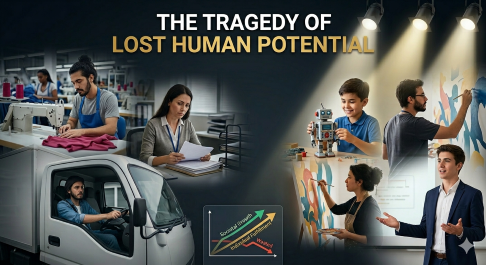
What is the greatest waste in modern civilization? Not oil. Not capital. Not natural resources. Human potential. Surprising as it might seem, there may be no greater waste in modern civilization than the waste of human potential. Across cities, villages, factories, workshops, farms, transport stations, crowded neighborhoods, and forgotten towns, millions of highly talented individuals live unseen lives disconnected from their deepest abilities. A gifted singer spends decades driving passengers through traffic. A naturally brilliant visual artist works in a garment factory. A mechanically intuitive mind performs repetitive labor without ever becoming an engineer or inventor. A poet becomes trapped in clerical routines. A born teacher never enters a classroom. A future designer, filmmaker, philosopher, architect, or innovator disappears quietly into survival. This is not rare. It is one of the defining characteristics of human society. And yet the issue remains dangerously under examined.
Governments discuss inflation, unemployment, exports, infrastructure, digitization, and industrial growth. Economists analyze fiscal deficits and productivity. Educational systems focus on examination performance and credentialing. Corporations compete for market share and quarterly returns. Meanwhile, beneath these visible systems lies a vast invisible crisis: the systematic failure of societies to identify, nurture, and deploy human capability. The tragedy is not merely personal. It is economic. It is cultural, psychological, societal and above all civilizational. Because the nations do not become great solely through roads, ports, factories, or financial systems. They become great when human beings are allowed to fully develop their abilities and meaningfully contribute them to society.
The true wealth of nations lies not merely underground or inside banks, but inside human beings themselves. Unfortunately, much of that wealth remains buried. There is this myth that talent naturally finds its way. It will not be an overstatement to say that one of the most dangerous myths modern societies believe is that genuine talent inevitably rises. Popular culture repeatedly reinforces this comforting narrative. The brilliant child is eventually discovered. The unknown artist finally gets recognition. Exceptional individuals somehow overcome circumstance through sheer ability. Reality, actually, is far less romantic.
History remembers the few who escaped obscurity. It forgets the millions who did not. Talent alone is rarely enough. We must remember that human capability requires ecosystems consisting of mentorship, exposure, emotional encouragement, financial stability, infrastructure, networks, institutions, and, most importantly, opportunity. Without these conditions, even extraordinary individuals remain trapped inside environments designed primarily around survival rather than expression. A child born into privilege can experiment with uncertainty. Failure becomes recoverable. Time exists for exploration. But for the poor, failure carries heavier consequences. Creativity becomes risky. Stability becomes moralized. Practicality becomes survival logic. Over time, entire societies begin teaching young people not to discover themselves, but to protect themselves. This creates populations that are economically functional yet psychologically diminished. People learn how to earn a living, but never fully learn how to become themselves.
It is a fact that poverty does not only limit income, it limits possibility. The deepest damage caused by poverty is not merely material deprivation. It is the compression of human possibility. When survival dominates daily life, long-term creative development appears irrational. Families understandably encourage secure professions because instability threatens dignity, food security, education, and social survival. The result is a tragic pattern repeated across generations. Sadly, enough a gifted child is told music is not practical, painting cannot sustain a family, writing is unsafe, performance is unstable, and creativity is a luxury. These warnings are often rooted in care rather than cruelty. But their cumulative social effect is immense. Millions gradually disconnect from their natural inclinations and adapt themselves to systems of economic necessity. The consequences are enormous yet mostly invisible. Entire societies become populated with underutilized intelligence, suppressed creativity, unrealized innovation, and emotionally disengaged populations. This represents not only a moral loss but a developmental failure. Because economies increasingly depend upon exactly the qualities many societies suppress imagination, creativity, originality, communication, storytelling, design, emotional intelligence, and innovation. It is germane to say, a nation that suppresses these capacities weakens its own future competitiveness.
This is also a fact of the matter that educational systems often reward compliance more than genius. Historical records exhibit that most education systems were designed during industrial and bureaucratic eras when societies required standardization, administrative efficiency, and predictable workforce preparation. As a result, schools became highly effective at measuring: memorization, repetition, procedural accuracy and examination performance. Thus they became far less effective at detecting unconventional intelligence. This is one of the greatest structural blind spots in modern civilization. Many transformative abilities like artistic intuition, visionary thinking, entrepreneurial instinct, aesthetic sensitivity, emotional depth, storytelling capacity, philosophical imagination, design intelligence and the like cannot be easily standardized. A student who struggles academically may nevertheless possess extraordinary creativity or inventive capability. Yet systems organized around narrow definitions of merit frequently classify such individuals as average, weak, or problematic. Societies then make a devastating mistake when they confuse measurable intelligence with total intelligence. The consequences extend far beyond classrooms.
When educational systems repeatedly fail to identify diverse forms of capability, societies lose future creators, innovators, entrepreneurs, and cultural leaders before they are even recognized. This becomes particularly dangerous in the twenty-first century. The industrial economy rewarded standardization. The future economy increasingly rewards originality.
There are also serious psychological consequences of suppressed potential. One of the least discussed dimensions of unrealized talent is its psychological impact. Human beings possess a profound need not merely to survive, but to express. People seek alignment between inner capability, outer contribution and personal meaning. When this alignment never occurs, a subtle form of suffering emerges. This is not necessarily a dramatic suffering but for sure a quiet suffering. A kind of chronic feeling of incompleteness. Thus many individuals live with the persistent sense that some essential dimension of themselves remained undeveloped. They fulfill responsibilities, earn incomes, and maintain appearances, yet internally experience emotional fatigue, disengagement, or quiet dissatisfaction. This is not simply ambition frustrated. It is identity suppressed.
This tragic that civilizations underestimate how psychologically damaging it is for populations to remain disconnected from meaningful contribution. People do not require dignity only through consumption. They require dignity through significance. A society that provides survival but not self-expression eventually produces emotionally exhausted citizens. We must know that exhausted societies become socially, culturally, politically, and economically vulnerable.
The Economic cost of wasted human talent is huge. The suppression of human capability is often treated as an emotional or cultural issue. In reality, it is also an enormous economic issue. Every undiscovered innovator weakens future productivity. Every unsupported creator weakens future cultural industries. Every neglected entrepreneur weakens future enterprise formation. Every buried inventor weakens future competitiveness. The modern global economy increasingly rewards creativity, design, digital content, entertainment, branding, innovation, storytelling, software, aesthetics, and intellectual property. The countries dominating global influence today are not merely industrial powers. They are creators of ideas, narratives, experiences, technologies, and culture. South Korea transformed music and entertainment into strategic national assets. The United States built global influence not only through military or economic strength, but through cinema, music, literature, software, and design. Japan transformed aesthetics and storytelling into economic ecosystems. The future belongs increasingly to societies capable of converting human imagination into scalable value. Countries that fail to harness creativity risk becoming consumers of other societies’ innovation and cultural influence.
Civilizations do not decline only economically. They decline imaginatively too. Cultural decline begins with the neglect of human expression. A society that neglects creators gradually loses emotional depth, originality, cultural confidence, philosophical richness and symbolic power.
When artistic and intellectual life weakens, societies become culturally dependent. They import narratives, aesthetics, aspirations, and identities from elsewhere. This produces a subtle but important form of civilizational weakening in the form of erosion of cultural self-definition. Creators do not merely entertain societies. They help societies understand themselves. Writers articulate collective anxieties. Musicians preserve emotional memory. Artists shape imagination. Storytellers transmit values. Philosophers interrogate meaning. Designers influence how people experience the world. Without such figures, societies become materially active yet spiritually shallow.
For most of history, talent depended heavily upon geography, class, and institutional access. Today, this equation is changing since technology has created a historic opportunity. Digital platforms, remote learning, artificial intelligence, creator economies, and global connectivity have dramatically lowered barriers to participation. A musician in a remote village can distribute songs globally. A digital artist can build international audiences. A self-taught programmer can access world-class knowledge online. A craftsperson can market products internationally through digital platforms. This transformation is historically significant. For the first time, millions of individuals possess direct access to tools that once belonged only to elites or institutions. However, technology alone is insufficient. Potential still requires mentorship, guidance, infrastructure, emotional support, financing and discovery systems. Technology creates possibility. Societies determine whether possibility becomes reality.
The central challenge of the industrial era was productivity. The defining challenge of the coming era may be human potential optimization. Artificial intelligence and automation will increasingly perform repetitive cognitive and mechanical tasks. As this happens, uniquely human capacities like creativity, imagination, emotional intelligence, storytelling, design, ethical reasoning, innovation and cultural interpretation become more valuable. This changes everything. Nations that cultivate these capacities systematically will shape the future economy. Those that continue producing conformity while neglecting creativity will struggle to compete. The question facing societies is no longer whether human creativity matters. The question is whether institutions can evolve quickly enough to recognize and nurture human depth before it is lost beneath economic pressure and social conformity.
What Do We Need To Do?
If societies genuinely wish to unlock their human potential, structural change is essential.
First, education must be redesigned. Schools should move beyond narrow memorization-based systems and recognize multiple forms of intelligence. Creativity, design thinking, storytelling, artistic expression, entrepreneurship, and interdisciplinary learning must become central rather than peripheral.
Secondly, talent discovery systems must emerge. Governments, communities, and private institutions should actively identify hidden capability through competitions, digital platforms, fellowships, local showcases, arts programs and mentorship networks. Human potential should not depend entirely upon accident.
Thirdly, societies must build creative infrastructure. Libraries, studios, maker spaces, cultural centers, public performance venues, digital labs, and artistic communities are not luxuries. They are developmental infrastructure.
Fourthly, financial systems must support creative risk. Many talented individuals do not require charity. They require runway in the form of small grants, affordable tools, creator financing, incubation systems, and market access.
Fifthly, societies ought to change culturally. Creative professions must stop being treated as secondary or irresponsible. The future economy increasingly rewards originality and symbolic value creation. Nations that continue dismissing creativity as nonessential misunderstand the direction of history by leap years.
Ultimately, this issue extends beyond economics and policy. It concerns the moral purpose of civilization itself. What is development truly for? Is the purpose of society merely to produce functioning economies and administratively stable populations? Or is it to create conditions in which human beings can meaningfully unfold their capacities? This may become one of the defining philosophical questions of our century. Because somewhere tonight, there is a child with extraordinary ability whose future depends entirely on whether someone notices in time. Somewhere, a future inventor is trapped inside repetitive labor. Somewhere, a remarkable voice remains unheard. Somewhere, a brilliant mind slowly abandons its ambitions because survival leaves no room for possibility. Somewhere else, entire civilizations continue searching for wealth while overlooking the greatest wealth they already possess in the shape of human beings themselves. The societies that will shape the future are not necessarily those with the largest armies or tallest buildings. They will be the societies that learn how to recognize hidden greatness before it disappears.
Read: Lives on Autopilot — the unlived self
____________________
Raphic Burdo is student of psychology, entrepreneurship and innovation. He believes, the actual role of public policy is to create enabling conditions for citizens so that they are able to achieve their true potential aligned with their genius.