Re-evaluating the Purpose of State Institutions
- When we see institutions failing to facilitate public life, we are seeing the resurgence of their ancient, conflict-oriented DNA. Understanding this doesn’t solve the problem, but it brings clarity to the conflict.
By: Noor Muhammad Marri Advocate | Islamabad
We are conditioned to view the state as a benevolent custodian. From the library on the corner to the healthcare system that treats our ailments, we perceive the apparatus of government as a social contract brought to life—a mechanism established, first and foremost, to facilitate the public good. We view taxation as a membership fee for civilization and the civil service as the stewards of our collective prosperity. However, a deeper, more analytical look at the historical trajectory of human governance reveals a far more jarring reality. The modern state was not born in the town square; it was forged on the battlefield. To understand why institutions often feel unresponsive, bloated, or self-serving, we must accept a difficult premise: the modern state apparatus was essentially established as a logistical support network for armies, not for the flourishing of the individual.
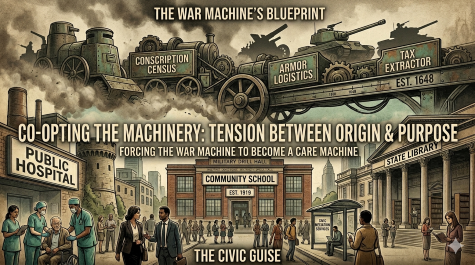
The political sociologist Charles Tilly famously observed that “war made the state, and the state made war.” This is not merely a historical footnote; it is the foundational blueprint of modern governance. Before the rise of the nation-state, power was fragmented among feudal lords who possessed neither the resources nor the motivation to build deep, pervasive administrative systems. When warfare transitioned from the sporadic clashes of knights to the protracted, expensive, and gunpowder-heavy conflicts of the early modern period, the requirements of survival changed. A ruler could no longer rely on sporadic fealty. To survive, they needed a standing army. To maintain a standing army, they needed massive, consistent funding. To get that funding, they needed to reach into every pocket of the realm with precision. Thus, the institutions we recognize today were invented to solve the problem of mass mobilization. The first modern bureaucracies were not created to manage schools or parks; they were created to manage the extraction of wealth and the inventory of human life. The central bank, the national treasury, and the census bureau were the early progenitors of the state, serving as the connective tissue that allowed a monarch to turn the grain of a peasant into the cannons of a battalion.
This military-centric logic explains why the state’s infrastructure looks the way it does. We often romanticize public works as evidence of the state’s commitment to citizen mobility and connectivity. Yet, analytically, the primary utility of these systems was the rapid deployment of force. The Roman roads—the archetype of state-built infrastructure—were famously designed for the legions, not the merchant. In the modern era, this pattern held firm. The U.S. Interstate Highway System, often cited as a marvel of domestic convenience, was officially codified as the “National System of Interstate and Defense Highways.” Its primary strategic purpose was the rapid movement of personnel and materiel across the continent in the event of a foreign invasion. Similarly, the evolution of the modern “social” state—what we now call the welfare state—was significantly accelerated by military necessity. In the late 19th century, Otto von Bismarck’s Germany pioneered national healthcare and pension systems. While these policies served the public, they were not purely altruistic. They were strategic investments in manpower. A state that wanted to field a mass conscript army needed that army to be literate, healthy, and disciplined. Universal education was adopted not just to enlighten the citizenry, but to instill national identity, punctuality, and the ability to follow complex orders—the essential characteristics of both the factory worker and the infantryman.
If institutions are fundamentally built for the state’s preservation, we arrive at the central tension of modern life: the divergence between the institution’s “factory settings” and the public’s aspirations. Sociologist Max Weber argued that bureaucracies tend to become “iron cages.” Once an institution is created to solve a military-logistical problem, it develops a life of its own. It acquires a budget, a hierarchy, and a staff whose primary interest is the maintenance and expansion of that institution. Even when the original war ends or the threat dissipates, the institution does not dissolve. It pivots. It begins to view its own survival as synonymous with the public interest. This is why, in many countries, state institutions feel like a monolith designed to protect the “state” from the “public.” When a government agency prioritizes its own procedural continuity, security clearance, or funding stability over the actual needs of the people it serves, it is merely defaulting to its original purpose. It is acting as a protector of the apparatus, not a servant of the citizen.
This reality is subjective, yet profoundly felt. When a citizen interacts with a tax authority, a border agency, or a department of defense, they are engaging with the “hard power” roots of the state. These interactions are often cold, transactional, and top-down because the institutions are essentially doing exactly what they were designed to do: identifying, counting, and controlling. The public, however, has increasingly attempted to hijack these institutions for humanistic ends. We have successfully co-opted the state’s vast administrative machinery to provide schools, hospitals, social security, and environmental protections. This is the great irony: the public has taken a war machine and demanded it become a care machine.
The friction we perceive between state and citizen is not an accident; it is the natural byproduct of an evolutionary mismatch. We live in a world where the apparatus of government is fundamentally wired for control and mobilization, yet the people living under it demand freedom and support. To critique the state is not New Year’s idealism, but an acknowledgment of the shadow cast by its origins. As legal professionals and mediators, our role is to navigate this inherent friction. When we see institutions failing to facilitate public life, we are seeing the resurgence of their ancient, conflict-oriented DNA. Understanding this doesn’t solve the problem, but it brings clarity to the conflict. The state may have been built for the army, but it is now the only vessel we have to build a lawful, balanced society. The task of the modern citizen and the legal advocate, therefore, is to continue the difficult work of alternative dispute resolution and constitutional enforcement, forcing the state to serve a purpose for which it was never originally designed: the actual well-being, justice, and peace of the human beings it governs.
Read: Order Without Liberty Becomes Tyranny
______________
 Noor Muhammad Marri Advocate & Mediator is based in Islamabad