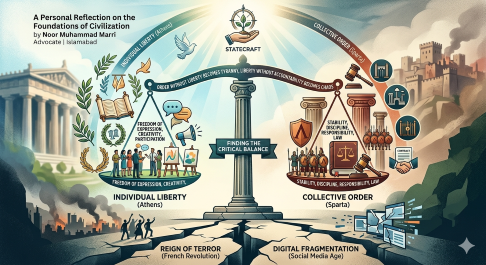
Individual Liberty and Collective Order: A Personal Reflection on the Foundations of Civilization
- A society that worships order while suppressing freedom may preserve stability but lose its soul. The wisdom of statesmanship lies in maintaining a balance between these competing forces. That balance may differ from one society to another society.
By Noor Muhammad Marri Advocate |Islamabad
As I observe contemporary political debates, I often feel that humanity is engaged in a strange and unfinished conversation. Everywhere we hear the language of liberty, rights, democracy, equality, empowerment, and freedom of expression. Yet far less attention is given to the institutions, responsibilities, and collective discipline that make these ideals sustainable. It is as if modern societies have become fascinated with the fruits while forgetting the roots that nourish the tree. This imbalance compels us to return again and again to one of the oldest and most difficult questions in political philosophy: what is the relationship between individual liberty and collective order?
In my view, this question cannot even be properly addressed without first understanding the nature of the state itself. The state is not merely an apparatus of power; it is one of humanity’s most significant collective achievements. It emerged not because human beings naturally desired authority over one another, but because they recognized that survival, security, and social cooperation required organization. From early tribal formations to modern nation-states, the evolution of political authority reflects a continuous attempt to manage conflict, regulate behavior, and create conditions in which human life can be sustained with dignity.
Every state, regardless of its ideological orientation, carries certain fundamental responsibilities. It must ensure security, administer justice, protect property, regulate conflict, build infrastructure, and maintain public order. These are not abstract functions; they are practical necessities without which societies quickly descend into disorder. In this sense, rights are not floating concepts existing independently of institutions. They are dependent upon a functioning state capable of enforcing them. Liberty, therefore, is not the absence of structure but its careful design.
Different societies have developed different political systems to achieve these goals. Geography, history, culture, economic conditions, and social organization shape the nature of governance. A small city-state does not face the same challenges as a large continental empire; a tribal society does not require the same institutional complexity as a modern industrial nation. This is why political systems vary across civilizations. There is no universal model that can be applied without adaptation. The effectiveness of any system depends upon its compatibility with the society it governs.
This is precisely why political philosophy has never produced a single consensus on the ideal form of government. The debate is not simply between liberty and order, but between different interpretations of how they should be balanced.
Socrates, for instance, was deeply skeptical of democratic governance in Athens. He questioned whether political authority should be based on popular opinion rather than knowledge and competence. His famous analogy of the ship suggests that governing a state requires expertise, just as navigation requires a skilled captain. In his view, political leadership should not be left to chance or popularity, but to wisdom.
Plato expanded this critique in The Republic, where he expressed concern that democracy, if left unchecked, could descend into disorder. He believed that excessive freedom might weaken authority and open the door to demagoguery. His proposed solution—the rule of philosopher-kings—was an attempt to anchor political power in reason and virtue rather than mass opinion.
Aristotle offered a more balanced perspective. He recognized that both tyranny and mob rule were dangerous extremes. His ideal constitution was a mixed system combining elements of monarchy, aristocracy, and democracy. For Aristotle, the purpose of politics was not to maximize liberty in isolation, but to achieve stability, justice, and the common good through moderation.
The ancient Greek world provides a striking illustration of these competing principles. Athens is often celebrated as the cradle of democracy, philosophy, and intellectual freedom. It encouraged debate, participation, and artistic expression. Yet it was also politically unstable, frequently influenced by shifting public opinion and factional conflict. The same democratic system that celebrated freedom ultimately condemned Socrates to death, revealing the tension between liberty and collective judgment.
Sparta, by contrast, represented a society structured around discipline, order, and collective responsibility. Its political system was designed to preserve cohesion and military strength. Interestingly, Spartan women enjoyed comparatively greater rights than their Athenian counterparts, including property ownership and physical education. Sparta achieved remarkable internal stability and military dominance, yet it did so at the cost of intellectual diversity and cultural development. Athens produced philosophers and artists; Sparta produced soldiers. Each reflected a different prioritization of values.
History provides further evidence of how liberty, when detached from institutional balance, can produce instability. The French Revolution began with powerful ideals: liberty, equality, and fraternity. It sought to dismantle monarchy and privilege and establish a new political order based on popular sovereignty. Yet as revolutionary fervor intensified, internal divisions deepened. The Reign of Terror witnessed mass executions and political purges carried out in the name of protecting liberty itself. What began as a movement for freedom gradually transformed into a system of fear and coercion. Ultimately, the instability contributed to the rise of Napoleon Bonaparte, whose centralized authority restored order but limited many of the revolution’s original freedoms.
This historical pattern suggests a recurring truth: societies rarely collapse because they have too much liberty or too much order alone. They collapse when the balance between the two is destroyed.
In the modern era, this tension has taken new forms. Concepts such as democracy, human rights, equality, and women’s empowerment have become central to global political discourse. These ideas have undoubtedly expanded human dignity and challenged historical injustices. Yet they are often treated as universal abstractions, detached from the cultural and institutional realities of individual societies. I do not question their value, but I do question the assumption that they can function effectively without considering social context and collective stability.
Nowhere is this tension more visible than in the age of social media. What was once celebrated as a tool for communication and education has increasingly become a space of fragmentation and volatility. I often reflect on how quickly a single irresponsible message can spread across societies, inflaming emotions, deepening divisions, and sometimes triggering real-world crises. In deeply divided environments, digital platforms can amplify hatred more effectively than they spread understanding.
Yet whenever the question of regulation arises, it is often immediately framed as an attack on liberty. This creates a dangerous binary: either absolute freedom of expression or alleged censorship. In reality, no society can survive without some form of responsibility in communication. Freedom of expression cannot logically include the unrestricted right to spread deliberate falsehoods or incite violence without consequences. Liberty without accountability becomes self-destructive.
A similar complexity exists within civil society and non-governmental organizations. Civil society plays an essential role in holding governments accountable and protecting vulnerable communities. However, it is also true that not all organizations necessarily operate in the interest of social harmony. Some may promote divisive narratives, ideological agendas, or external interests that contribute to polarization. When states attempt to regulate or investigate such activities, the response is often immediate and organized protest, framed as resistance against authoritarianism. Yet the deeper question remains whether accountability itself is being misinterpreted as repression.
This brings us back to a fundamental philosophical question: can liberty exist without obligation? Every right carries a corresponding duty. Freedom of speech requires truthfulness and restraint. Freedom of association requires respect for social peace. Political participation requires commitment to institutional stability. When rights are separated from responsibilities, they risk undermining the very structure that makes them possible.
Thinkers such as Edmund Burke emphasized that society is not merely a collection of individuals but a partnership between generations. It is sustained by traditions, institutions, and shared moral understandings. Similarly, many communitarian philosophers argue that excessive focus on individual autonomy can weaken the bonds that hold society together. Without shared values, liberty becomes fragmented into competing personal interests rather than a collective achievement.
Ultimately, I am increasingly convinced that the success of any political system depends less on its formal structure and more on its compatibility with the society it governs. Democracy, monarchy, or any other system cannot be evaluated in isolation. Each society must find the form of governance that reflects its history, culture, geography, and social cohesion. Political systems are not universal prescriptions; they are social adaptations.
As I reflect upon history—from Athens and Sparta to the French Revolution and the digital age—I am increasingly persuaded that the survival of civilization depends not upon choosing between liberty and order but upon reconciling them. A society that worships liberty while neglecting responsibility may eventually lose both. A society that worships order while suppressing freedom may preserve stability but lose its soul. The wisdom of statesmanship lies in maintaining a balance between these competing forces. That balance may differ from one society to another society.
Read: Plato on Change and the Stability
___________________
 Noor Muhammad Marri Advocate & Mediator is based in Islamabad