Many lives today are lived on autopilot. People wake at predetermined hours, perform predetermined routines, pursue inherited definitions of success, consume prescribed forms of entertainment, and gradually move toward old age without sustained reflection upon what they actually desired from existence
By Raphic Burdo
Yesterday, in the quiet routine of government offices and bureaucratic corridors, I encountered something unexpectedly profound: evidence that many human beings are living lives insufficiently examined.
I met two officers. One was a poet hidden within the machinery of administration; the other a thoughtful civil servant carrying within herself a subdued intellectual restlessness. Both conversations, though ordinary in setting, gradually became existential in character. We spoke not merely about careers or official work, but about literature, meaning, mindfulness, death, human potential, and the strange phenomenon of passing through life without ever fully arriving into oneself.
At one point, the lady officer confessed that she had never truly audited her life. She could not clearly articulate her deepest passion or highest goal. Important aspirations had remained indefinitely postponed on the back burner of existence. As we spoke about living consciously rather than mechanically, she remarked with unusual sincerity that she felt I had appeared in her life providentially. Earlier, another officer had expressed a similar sentiment, saying that after a long time he had met someone whose company genuinely gave him pleasure and intellectual nourishment.
Their words flattered me, certainly, but they also unsettled me. Why should thoughtful conversation feel so rare? Why should discussions about purpose, consciousness, mortality, and inner life affect people so deeply? Why do so many intelligent and capable individuals appear vaguely estranged from themselves?
These encounters forced me again toward one of the oldest philosophical statements in human civilization: “The unexamined life is not worth living.” When Socrates uttered those words before the Athenian court, he was not arguing that every human being must become a philosopher in the formal sense. He was making a deeper claim: that a human life acquires dignity only when it becomes conscious of itself. To examine one’s life is to ask difficult questions. Who am I beneath my social role? What is the highest use of my abilities? What fears govern me? What possibilities within me remain unlived? What kind of person am I becoming through my daily habits? Am I truly living, or merely functioning?
Modern civilization, despite its astonishing technological sophistication, often discourages such questions. We educate people extensively, but mostly for utility. We train them to perform, compete, earn, manage, adapt, and survive. Institutions produce efficient professionals, competent administrators, and productive workers, yet they rarely produce inwardly awake human beings. A person may accumulate degrees, promotions, property, status, and social approval while remaining fundamentally unacquainted with himself.
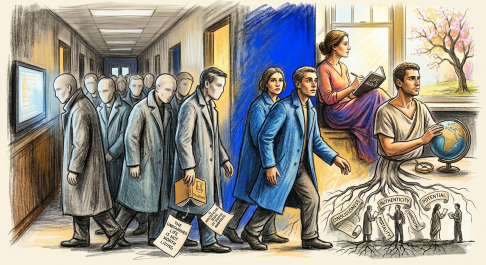
Many lives today are lived on autopilot. People wake at predetermined hours, perform predetermined routines, pursue inherited definitions of success, consume prescribed forms of entertainment, and gradually move toward old age without sustained reflection upon what they actually desired from existence. Their schedules are full, yet their inner life remains underdeveloped. They mistake movement for meaning.
This condition does not arise because people are unintelligent. On the contrary, some of the most inwardly disconnected individuals are externally successful. The tragedy of modern life is not necessarily poverty of capability but poverty of consciousness.
Why, then, do people avoid self-examination? Partly because genuine introspection is uncomfortable. To examine one’s life honestly is to risk discovering painful truths: years wasted in fear, talents neglected through laziness, ambitions abandoned through conformity, relationships maintained without love, careers pursued without vocation, convictions compromised for convenience. Many people instinctively avoid silence because silence permits such realizations to emerge.
Moreover, conscious living imposes responsibility. Once a person clearly sees his deeper potential, he can no longer entirely hide behind excuses. Clarity creates moral burden. There is also the immense pressure of modern systems. Economic anxieties, bureaucratic structures, social expectations, digital distraction, and perpetual busyness consume reflective energy. Human beings today are surrounded by information yet deprived of contemplation. They communicate constantly yet rarely converse deeply. They are connected to everyone except themselves.
Perhaps this is why meaningful conversations now feel almost sacred. When people encounter someone who speaks openly about mortality, destiny, literature, philosophy, or the inner architecture of life, they often react with disproportionate intensity. Something dormant within them awakens temporarily. Beneath their professional identities and social performances lies an unaddressed hunger: the desire to live more consciously.
The great psychologists and spiritual thinkers repeatedly warned humanity about this danger of unconscious living. Carl Jung observed that what remains unconscious in our lives eventually directs us as fate. Viktor Frankl argued that modern people suffer not merely from frustration but from meaninglessness. Søren Kierkegaard feared that individuals lose themselves in “the crowd,” surrendering inward individuality to collective drift. In our own tradition, Shah Abdul Latif Bhittai called repeatedly for wakefulness of soul against heedlessness of existence.
Yet the most painful aspect of the unexamined life is not simple unhappiness. It is unrealized possibility. Within many people resides an unlived self. There are unwritten books inside them. Unattempted acts of courage. Uncultivated intellectual powers. Moral greatness postponed indefinitely. Artistic sensibilities abandoned in youth. Questions never pursued. Loves never confessed. Inner callings quietly buried beneath routine and practicality. Human beings often die with entire worlds still trapped within them. This is the silent catastrophe concealed beneath ordinary life.
And yet, despite everything, awakening remains possible. A person can begin examining his life at any age. Through solitude, journaling, literature, prayer, philosophy, contemplation of death, honest friendship, and periodic self-audit, one may gradually recover authorship over one’s existence. Conscious living does not require abandoning ordinary responsibilities. It requires bringing awareness into them. One may remain a bureaucrat, teacher, businessman, parent, or administrator while still living reflectively and deliberately.
The examined life is not a life of perfection. It is a life of awareness. Perhaps that is all wisdom truly means: refusing to sleepwalk through existence. Briefly, the greatest human tragedy may not be death itself. The greater tragedy is reaching death without ever having truly arrived in one’s own life.
Read: From Thar Coal to Dubai Gold
________________
Raphic Burdo is student of literature, philosophy and psychology with special interest in social-psychology, mindfulness, leadership and communication. He can be reached at raphicburdo@gmail.com