It was the weight of proof. Proof that she existed. Proof that she had been born with rights, had studied, had chosen, had married. Everything the world might demand to believe in her — it was all here, in this folder, in her hands.
By Mohammad Ehsan Leghari
Saeed came to Karachi the way the poor always come — on a rattling bus with one faded bag, a borrowed address, and a hunger older than his name.
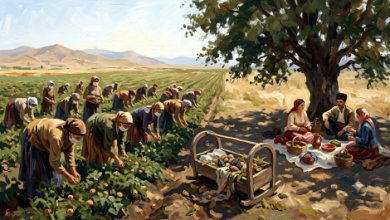
He was from Dadu, where the earth splits open in summer like a wound that refuses to close. There was no work in Dadu. There was pride, old feuds, and the iron laws of tribe and blood — but no work. So he gathered his family and came to Sachal Goth, that dense breathing corner of Karachi where Sindh’s poor rebuild themselves one rented room at a time.
He found a room. He found work. He told his wife — we have survived.
What he did not know was that he had also carried the dry crack of Dadu inside that single bag. A fracture that would one day split his own home in two.
—
Rabia grew up in those narrow lanes where houses pressed so close that neighbors heard every argument and every silence equally. She was twenty, dark-eyed, with a laugh she refused to muffle even when the lanes grew quiet at dusk.
Bilal was twenty-six. He lived two lanes away. His hands were calloused from childhood labor but something in his manner had stayed gentle, almost careful — the way certain people stay soft in places that punish softness. He noticed Rabia the way a thirsty man notices rain — suddenly, completely, without defense.
They spoke in the small stolen ways young people must in such places. A word dropped at the corner like a secret coin. A glance across the lane that lingered a heartbeat too long. A question slipped through a mutual cousin that was never really about what it seemed.
By the time anyone noticed, their story had already become a river — quiet, deep, carving its own path through the concrete and dust.
—
They married in secret, the way the brave marry here — with a witness, a nikahnama, and the full knowledge that the world around them would not forgive them.
A friend painted mehndi on her hands the night before the nikah. Two days later the patterns were still dark and intricate — a living map of a future she had dared to claim for herself.
—
When Saeed found out he did not shout. He went very quiet.
That quiet which in Sindh is more dangerous than noise. The kind that settles in the chest and hardens like the earth of Dadu in winter.
He had built nothing in this city. No land. No title. No name that the street would remember. What he had — the one territory the culture had always told him was entirely and unconditionally his — was a daughter whose conduct reflected his honor. When she planted her own flag in that territory and called it her life, the ground beneath him disappeared.
He walked into Sachal police station on May 19 and told them his daughter had been abducted. He said the word without flinching. He had perhaps repeated it so many times inside his own head that it had begun to feel true — that a girl choosing is the same as a girl being stolen. That her will and his theft were the same event, only seen from different sides.
The police arrested Bilal’s father.
—
The night before the court appearance Rabia sat on the floor of their small room and gathered her documents one by one.
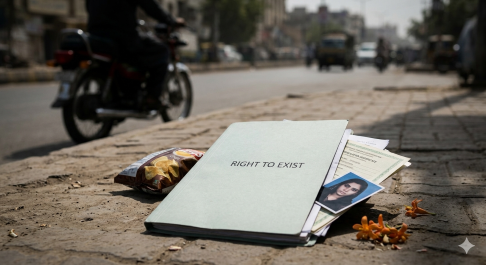
Her birth certificate. Her nikahnama. Her matriculation certificate — the one that proved she had sat in a classroom and learned and passed, that her mind had been measured and found capable. A few passport-sized photographs, her face in each one looking directly into the camera the way she looked at everything — without flinching. Some other papers. She placed them carefully inside a pale folder and held it in her lap for a moment, feeling the weight of it.
It was the weight of proof. Proof that she existed. Proof that she had been born with rights, had studied, had chosen, had married. Everything the world might demand to believe in her — it was all here, in this folder, in her hands.
She slept with it beside her like a shield.
—
On the morning of the court appearance Bilal bought her chips from a corner shop on the way. He pressed the packet into her hands and said — for after. After the court. After the case is closed. After his father is freed. After all of it, when they could finally sit somewhere and breathe, she would eat these chips and they would laugh at how frightened they had been.
She held the packet and smiled. For after.
She tucked the folder under her arm. They got into the back seat of the rented car, their heads finding each other the way they always did — naturally, completely, as though the small space between them was something neither of them had ever been able to leave unfilled.
—
She stood before the judge and said — I married of my own free will.
Not quietly. Not with her eyes down. She said it the way you say a thing you have been saving.
The judge examined the nikahnama. The case was disposed of. Bilal’s father walked out of the cell. Outside in the blinding Karachi sun Bilal reached for her hand and she let him take it and for one brief moment the world felt wide open, the way it so rarely does for people like them.
They were going to the NADRA office in Saudabad. Two names on one document. One small official life, finally made real.
The chips wrapper from that morning was still in her lap. For after.
The motorcycle had been following since the courthouse steps.
—
Near the RCD Ground in Saudabad it pulled alongside the car. The shooter was precise. Multiple shots at close range. Both of them in the head. The rented car drifted and stopped. The motorcycle dissolved into the Karachi traffic the way a stone disappears into water.
The driver survived. A relative survived too.
Rabia and Bilal did not.
They were found as they had always been — heads leaning together, the small warm gap between them closed, as if even at the last moment they had moved toward each other rather than away.
The chips wrapper was still in her lap.
And tucked under her arm, held even in death as she had held it in life — the pale folder. Inside it, her birth certificate. Her nikahnama. Her matriculation certificate. Her passport size photographs, her face looking directly into a future that had already been cancelled. Every document she had gathered to prove to the world that she existed, that she had rights that she had chosen, and that she was real.
She had carried all the proof of her life into the place where it ended.
The mehndi was still dark on her hands.
The suspected killers were her own relatives.
—
In Khairpur, three months before, a young woman named Sania was shot in her own yard by her uncle. She had married outside the tribe. Her body was in the ground before her mother in another village was told. The uncle moves freely. The case has gone cold.
In Jacobabad, a mother named Zarina was strangled by her brothers with her own dupatta because she refused to divorce the man she had chosen. They went to a shrine the next morning, washed their faces in the holy water and felt, by all accounts, at peace.
In Larkana, a boy named Sohail loved a landlord’s daughter. He was not a landlord. He disappeared the way the nameless poor disappear in Sindh — no FIR, no grave marker, no record that he ever existed. The girl was married to a cousin within weeks. No one speaks of Sohail. He was twenty-three years old.
—
Across the world the weather carries different names but always the same temperature.
In Iraqi Kurdistan in 2007, seventeen-year-old Du’a Khalil Aswad was stoned to death in broad daylight for loving across religious lines. A crowd gathered — men, women, neighbors, and strangers. Some of them filmed it on their phones and passed the video from hand to hand like any other piece of news. It took thirty minutes. She called out throughout. Nobody stepped forward.
In London in 2006, Banaz Mahmod went to the police five separate times. The fifth time she brought a hand-drawn map — drawn carefully in pencil, marking the exact location where her family planned to bury her body. She gave them names. She gave them dates. The officer wrote in his notes that she seemed overdramatic and sent her home. Her father and uncle had her strangled and buried her in a suitcase in a Birmingham garden. When investigators finally dug, the map she had drawn was accurate to the last mark. She was twenty years old and she had drawn her own burial map and the world had still not believed her.
In Stockholm in 2002, Fadime Şahindal stood before the Swedish parliament and said — I want only to live my own life. To love who I choose. Is that so much to ask, here, in this country. Her father was somewhere in Sweden listening. He waited six weeks. Then he came to her sister’s apartment, found Fadime there, and shot her in front of her mother and sister. She had spoken before a parliament. The parliament had applauded. Her father had a gun and a patience that democracy could not touch.
In Pakistan in 2016, Qandeel Baloch slept in her childhood bed. Her brother came into the room in the night. He used his hands. In the morning he told the cameras he felt no regret. She had existed too loudly. A significant part of the country nodded quietly and moved on.
—
Bilal gave Rabia chips on the way to court and said — for after. He leaned his head against hers in the back seat. He stood in a courtroom and waited while she declared herself free. He held her hand in the sun outside. He was twenty-six years old and he wanted nothing extraordinary — only the ordinary life of a man beside the woman he had chosen. A cup of tea somewhere quiet. Two names on one document. The small daily weight of someone else’s head on your shoulder.
They killed him for that.
—
Somewhere tonight in Dadu a girl sits near a window. There is a boy whose name she is practicing in the dark of her own head — the sound of it, the shape of it, what it might feel like to say it out loud to his face. The joy still feels small and warm, something she presses between her palms like a live coal against the coming cold.
The world around her is not paying attention yet.
Soon it will.
—
Rabia and Bilal were buried. The chips wrapper blew away in the Karachi wind. The rented car was cleaned and returned and rented again to someone else. The mehndi faded from her hands in the dark of the earth.
Somewhere in evidence, perhaps, the pale folder still exists. The birth certificate. The nikahnama. The matriculation certificate. The passport photographs with her face looking forward. All the documents she had gathered to prove she had the right to live.
They were not enough.
The CCTV footage exists. The motorcycle man has been identified. Whether the law will do what Banaz Mahmod’s hand-drawn map could not make it do — that remains, as it always remains here, uncertain.
What is not uncertain is this —
Saeed came from Dadu to survive.
He survived.
And a girl who carried every proof of her existence under her arm, who had studied and chosen and stood before a judge and won — did not.
That is the oldest, most ordinary, most unforgivable story in the world.
…………
For Rabia and Bilal.
For Banaz, who drew the map.
For Du’a, who called out in the street.
For Fadime, who asked the parliament.
For Qandeel, who existed loudly.
For Zarina. For Sania. For Sohail.
For every name the silence swallowed whole.
And for the girl at the window in Dadu tonight.
She still does not know.
Read: The Journey That Never Ends
__________________
 The author is a water expert, former Sindh member of Indus River System Authority (IRSA), and a prolific writer