The mistress of the treasuries had left, but the Saqiya remained, telling the countryside the story of a woman who turned her grief into life.
By Abdel Latif Moubarak | Egypt
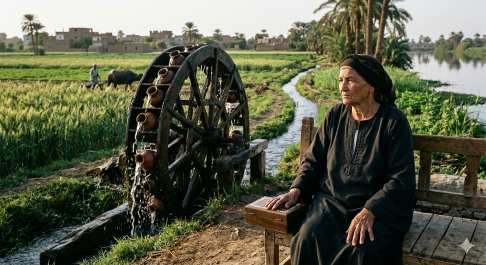
Under a pale rural sun, “Hajja Amna” sat on a wooden bench whose edges had been eroded by humidity. Before her, the ancient waterwheel—the Saqiya—turned in a rhythmic, monotonous motion, emitting a creak that sounded like a stifled sob. To Amna, the wheel wasn’t just lifting water to irrigate the crops; it was scooping memories from the well of her past and pouring them into the dry basin of her present. The friction of wood against wood was the only music she understood—a silent language between an eighty-year-old woman and a forgotten machine from a bygone era.
Amna’s hands resembled the roots of an ancient sycamore tree; protruding veins and deep lines carved by time, just as the waterwheel carved furrows into the clay. Every wrinkle on her face was a “treasury” for an old sorrow. Here was the ache of losing a husband in the prime of youth; there, the pain of sons departing for the false glitter of the cities. She watched the water falling from the qawadis (clay pots) and saw her years leaking through her fingers, unable to hold back a single drop.
“Why don’t they return, O Saqiya?” Amna whispered as she watched a lonely bird perch on the edge of the wheel to drink. She had three sons, taken by the “caller” of cement and iron in the capital. At first, letters arrived, then phone calls, then a long silence fell—a silence like the fields during a midday nap. The waterwheel was the only friend that never left; it turned in its place, loyal to the land and to the woman who never moved.
Beside her on the bench sat a small box made of walnut wood, inlaid with faded mother-of-pearl. She called it the “Treasury of Pain.” It contained no gold or money, only scraps of old clothing, a blurry photograph of her wedding, and a key to a house inhabited by nothing but ghosts. She opened the box whenever her longing grew heavy, breathing in the scent of “the past”—the smell of silt and the beautiful sweat of hard labor.
As the sun tilted toward sunset, the shadows of the waterwheel began to stretch across the ground like giant arms trying to embrace Amna. At that moment, she imagined she saw the faces of the departed in the reflection of the water. She saw her mother’s face carrying a water jar, and her husband’s face tethering the cattle to the wheel. The Saqiya was a time machine, reconstructing souls and turning grief from a heavy weight on the chest into a story told to the wind.
Amna contemplated the water falling from the pots only to return to the stream once more. She realized that sorrow, like water, moves in a closed circle. It leaves the heart, washes the soul with hot tears, and then returns to settle in the deep “treasuries” of the self. “The water that irrigates the land gives it life, and the sorrow that dwells in the heart ripens it,” she told herself, watching the green stalks sway in gratitude to the tireless wheel.
She remembered a harsh winter night years ago when the waterwheel broke down. Amna felt as if her own heart had stopped beating. She went down herself, despite her frail bones, to try and move it. She wasn’t looking to water the land; she was looking for a “voice” to comfort her loneliness. When the wheel finally turned, Amna cried as she never had before; that was the moment she knew her grief was the fuel for her survival.
The villagers often came to her: “Hajja Amna, come live in our homes, loneliness is hard.” She would smile and gently refuse. She wasn’t alone; she lived in the kingdom of her memories. The waterwheel was her personal guardian, and the sound of running water was her daily dialogue with God and nature. The treasuries she carried in her heart were too precious to leave behind for a life of noise that didn’t understand her silence.
She felt a sting in her chest, a strange coldness creeping into her limbs despite the warmth of the evening. She looked at the waterwheel with a long, lingering gaze of farewell. The creaking no longer bothered her; it had become a gentle, heavenly call. She placed her hand on the “Treasury of Pain” and closed her eyes. She wished, in that moment, to turn into water herself—to flow into the wheel, irrigate the land she loved, and transform her sorrows into green stalks of wheat.
In the morning, the villagers found her leaning her head against the wood of the bench, wearing a smile they hadn’t seen in years. Amna had departed, leaving the wooden box closed behind her. But the strange thing was that the waterwheel, though no cattle were pulling it, was turning slowly in the breeze, as if refusing to let the music stop. The mistress of the treasuries had left, but the Saqiya remained, telling the countryside the story of a woman who turned her grief into life.
Read: Rivers of Milk – A Short Story
___________________
 The author was born in Suez and writes poetry using classical Arabic and Egyptian vernacular. He received a Bachelor of Law from Ain Shams University. He was one of the most important poets of the 1980s and his poems were published in several literary magazines in Egypt and the Arab world, including the Arab magazine, Kuwait magazine, News Literature, Republic newspaper, Al-Ahram, the new publishing culture (magazine).[1] Received the Excellence and Creativity Shield from the Arab Media Union in 2014 and Won the shield of excellence and creativity from the East Academy 2021.He won the Sergio Camellini International Award in Italy in 2025. He won first place in the “Divinamente Donna” competition in Italy 2026.