The mask fell, and the injustice stood naked. The honeyed words that had fed them for days could not stop the hunger now. The elderly died dreaming of whiteness, and the gold that could have repaired their village wells was gone. They realized that the “Rivers of Milk” were a metaphor used by a butcher dressed in a preacher’s robes.
Abdel Latif Moubarak | Egypt
The village was dying of thirst. The wells had turned into dusty throats, and the earth was cracked like broken glass. Then, “Omran” appeared. He wore robes of blinding white, a perpetual smile, and a voice so sweet it felt like a melody played on the heartstrings. Standing in the square, he cried: “Why drink bitter salt when rivers of milk await you? I have found the path to the Hidden Valley, where the earth overflows with whiteness and eternal grace.”
No one asked for a map; they were intoxicated by his words. Omran described the rivers with such vividness that mouths watered in the dry heat. He told them: “The milk there never spoils, children will grow like giants, and the elderly will reclaim their youth.” He spoke of “Absolute Justice” and “Emotional Synergy”—shimmering terms that made the peasants forget their shovels and neglect their few remaining wells.
“To reach this paradise, we need provisions for the road,” Omran said with tender softness. He asked every family to hand over their gold and grain so he could “manage” it to ensure everyone’s safe arrival. “I want nothing for myself,” he whispered, eyes damp with feigned piety. “I am but your humble servant leading you to the White Heaven.” Trustingly, the people handed the fruits of their lives to a blade wrapped in silk.
The exodus began. They followed him for days under a merciless sun. When people collapsed from exhaustion, Omran would kneel beside them, stroke their brows, and say: “Patience, my beloved ones. The bitterness of the road is what makes the milk taste sweeter. Can you not smell the scent of grace? It is just behind that mountain.” They believed him because his voice felt cooler than water.
When mothers began to wail about their hungry children, Omran delivered a grand sermon on “Dignity of the Soul” and “Ascending Above Material Needs.” He convinced them that hunger was a “purification of the body” before entering the Valley of Milk. He starved their stomachs with honeyed sentences, making them feel ashamed to ask for a crust of bread.
They reached a treacherous ravine. Omran ordered the strong men to descend first to clear the path, while he remained at the top with the women and the gold to “protect” them. When a sharp-witted youth objected, Omran looked at him with artificial sorrow: “My son, suspicion has corrupted your heart, and doubt blocks the blessing.” The crowd, hypnotized by Omran’s charisma, drove the youth away, exiling the only man trying to save them.
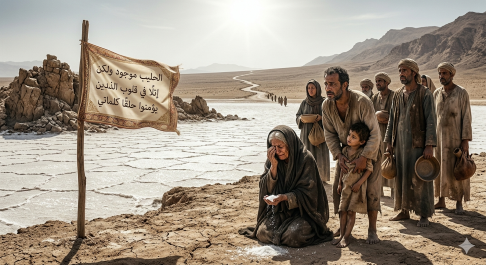
From the top of a hill, Omran pointed toward the horizon: “Look! The Rivers of Milk!” The people saw a white shimmer stretching across the distance. They screamed with joy, running frantically toward the light. In their delirium, they didn’t realize that what they saw were merely vast, barren salt flats reflecting the sun—a wasteland where nothing grows and no one drinks.
When they reached the flats and the salt stung their eyes, they turned back to find Omran. He had vanished, along with the caravan carrying their gold and food. He left nothing behind but a beautifully written note on a piece of silk: “I gave you hope, and hope is more expensive than gold. The milk exists, but only in the hearts of those who truly believe my words.”
The mask fell, and the injustice stood naked. The honeyed words that had fed them for days could not stop the hunger now. The elderly died dreaming of whiteness, and the gold that could have repaired their village wells was gone. They realized that the “Rivers of Milk” were a metaphor used by a butcher dressed in a preacher’s robes.
The survivors returned to their abandoned village, hearts heavy with shame. They learned that a hand offering a dream often hides a dagger, and that a bitter truth is a thousand times better than an illusion dripping with honey. Since that day, they fear anyone who describes “Rivers of Milk” before showing them how to dig a well for water.
Read: The Architecture of Emptiness
__________________
 The author was born in Suez and writes poetry using classical Arabic and Egyptian vernacular. He received a Bachelor of Law from Ain Shams University. He was one of the most important poets of the 1980s and his poems were published in several literary magazines in Egypt and the Arab world, including the Arab magazine, Kuwait magazine, News Literature, Republic newspaper, Al-Ahram, the new publishing culture (magazine).[1] Received the Excellence and Creativity Shield from the Arab Media Union in 2014 and Won the shield of excellence and creativity from the East Academy 2021.He won the Sergio Camellini International Award in Italy in 2025. He won first place in the “Divinamente Donna” competition in Italy 2026.