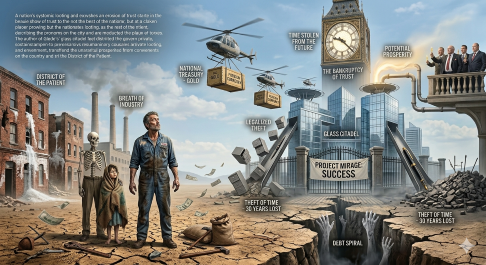
A government that robs its people does not fear the law; it fears the day the people realize that the law was just the robber’s mask. The tragedy of a stolen nation is not that the coffers are empty, but that the trust is bankrupt.
By Abdel Latif Moubarak | Egypt
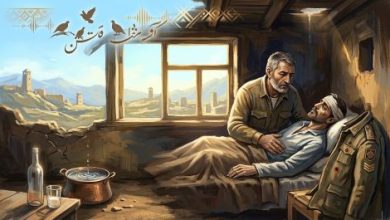
Elias was a man of rust and grease. A mechanic in the “District of the Patient,” he lived in a world where the walls bled salt and the tap water tasted of copper. One morning, the radio—the state’s only permitted voice—announced a new “Future Contribution Tax.” It was a levy on “Potential Prosperity.”
“They are taxing us for the wealth we haven’t even earned yet,” Elias whispered to his wrench.
In the District of the Patient, the only thing that grew was the graveyard. The factories nearby, owned by the silent elite, belched black smoke that the government called “The Breath of Industry.”
In the “Glass Citadel” at the city’s heart, Minister V was not using a gun to rob the people. He was using a fountain pen.
The theft was an art form:
The Debt Spiral: Taking massive international loans for “National Pride Projects”—monuments and luxury cities—that would never benefit the taxpayer but would be repaid by their grandchildren.
The Shell Game: Selling state-owned electrical grids to “private investors” who were, in reality, the Minister’s own cousins.
The Invisible Thief: Printing currency until the paper it was printed on was worth more than the number written on it. This was Inflation, the thief that enters every home without breaking a window.
Mansour, a retired accountant, sat with his son in their dim kitchen. He pointed at a loaf of bread that was half the size it had been a month ago.
“Look closely, son,” Mansour said. “They didn’t just raise the price. They stole the calories. When the state devalues the currency, they are stealing every hour I ever worked in the last forty years. They aren’t just taking money; they are taking my past.”
Elias’s daughter fell ill with a fever that wouldn’t break. At the State Hospital, the hallways were lined with gurneys but no medicine. A nurse told him the budget for antibiotics had been “reallocated.”
That same evening, the news showed a gala for the opening of the “World’s Tallest Flagpole.” It cost $50 million—the exact amount missing from the health ministry’s ledger.
The Government Spokesman appeared on every screen. He wore a suit that cost more than Elias’s shop. He spoke of “Austerity” and “Sacrifice.”
“We must tighten our belts today so we can soar tomorrow,” he proclaimed.
But the people noticed that while their belts were tightening around empty stomachs, the Spokesman’s neck was getting thicker.
A whistleblower from the Central Bank released a digital folder titled “Project Mirage. “It revealed that the “National Emergency Fund” had been funneled into offshore accounts in the Cayman Islands. The “deficit” the people were dying to pay off was actually a surplus in the pockets of twelve men.
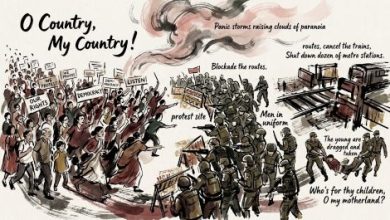
The revolution didn’t start with a bang. It started with a shrug of defiance. People stopped paying the “Future Tax.” Shops traded in eggs and silver instead of the worthless state paper. The government had stolen their wealth, but in doing so, they had accidentally freed the people from the state’s economic chains.
As the protests reached the gates of the Glass Citadel, the sky was filled with the sound of rotors. Private helicopters took off from the roofs of ministries. They weren’t carrying people; they were carrying gold bars and stacks of foreign currency. The state was being looted one last time in the dark.
When the crowd finally broke through the doors, they didn’t find a treasury. They found a room full of empty filing cabinets and a single golden telephone. The Minister was gone, leaving behind a country that was a hollow shell. They had even stolen the light bulbs from the hallways.
Elias stood in the town square. There was no money to rebuild, no bread in the stores, and a mountain of international debt. He realized then that the greatest theft wasn’t the gold or the taxes.
It was the Time.
They had stolen thirty years of a nation’s growth to build a dozen mansions in Europe. The people were free, but they were standing in a desert of someone else’s making.
A government that robs its people does not fear the law; it fears the day the people realize that the law was just the robber’s mask. The tragedy of a stolen nation is not that the coffers are empty, but that the trust is bankrupt.
Read: The Last Dawn: Shadows Behind Bars
_______________________
 The author was born in Suez and writes poetry using classical Arabic and Egyptian vernacular. He received a Bachelor of Law from Ain Shams University. He was one of the most important poets of the 1980s and his poems were published in several literary magazines in Egypt and the Arab world, including the Arab magazine, Kuwait magazine, News Literature, Republic newspaper, Al-Ahram, the new publishing culture (magazine).[1] Received the Excellence and Creativity Shield from the Arab Media Union in 2014 and Won the shield of excellence and creativity from the East Academy 2021.He won the Sergio Camellini International Award in Italy in 2025. He won first place in the “Divinamente Donna” competition in Italy 2026.