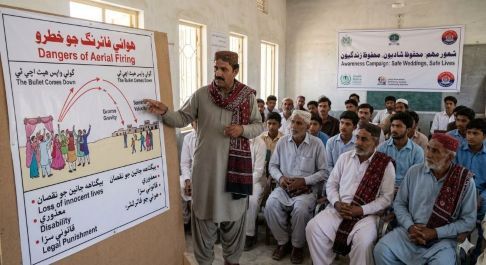
The Deadly Reality of Aerial Firing at Weddings in Pakistan
By Abdullah Usman Morai | Sweden
In many parts of Pakistan, especially during wedding celebrations, a dangerous and irresponsible practice continues to exist: aerial firing. For some people, firing bullets into the air has become a symbol of joy, power, masculinity, or celebration. The louder the gunshots, the more “grand” the wedding is considered by some communities. Yet behind this misguided tradition lies a horrifying reality: every bullet fired into the sky eventually returns to the ground, often with deadly consequences.
Many people wrongly believe that bullets fired upward disappear harmlessly into the air. Science and countless tragic incidents prove otherwise. When a bullet is fired into the sky, gravity eventually pulls it back to earth. Even though the bullet may lose some speed while ascending, it can still descend with enough force to injure or kill a human being.
Medical experts and law enforcement agencies around the world have repeatedly warned about the dangers of celebratory gunfire. In Pakistan, too, newspapers and television channels frequently report incidents where innocent children, women, pedestrians, or wedding guests are injured or killed by stray bullets.
There have been heartbreaking incidents in Karachi, Hyderabad, Lahore, Peshawar, Quetta, and rural Sindh, where families celebrating joy suddenly became mourning households. In one tragic case, a child playing on a rooftop was struck by a falling bullet during a nearby wedding celebration. In another incident, a bridegroom’s friend was injured when someone fired recklessly in excitement. These are not isolated incidents; they happen repeatedly every year.
The painful irony is that many of the victims are not even part of the wedding ceremony. A person sleeping at home, a child playing in a street, or a passerby on a motorcycle may suddenly become the victim of someone else’s “celebration.” This is not a celebration; it is negligence, irresponsibility, and a threat to public safety.
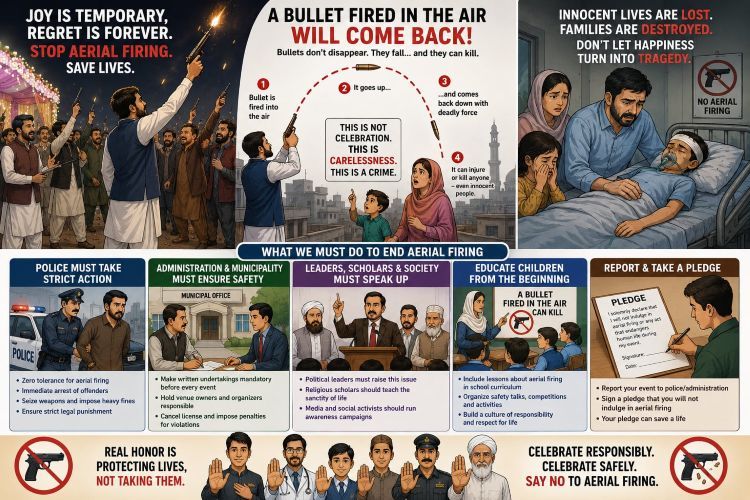 Pakistan already has laws against aerial firing. Police often announce crackdowns before wedding seasons or during public events. However, the major problem is weak implementation. Laws that remain only on paper cannot save lives. In many areas, people continue aerial firing openly because they believe nothing serious will happen to them. Sometimes, political influence, social connections, or a lack of strict policing allow offenders to escape punishment.
The question is not whether laws exist; the real question is whether the state is willing to enforce them consistently and fairly.
Police departments must adopt a zero-tolerance policy regarding aerial firing. If someone fires a weapon during a wedding, there should be immediate arrest, confiscation of weapons, heavy fines, and legal action without political pressure or compromise. Temporary detention alone is not enough. People only stop dangerous behavior when they know there will be serious consequences.
Municipal authorities and local administrations also have an important role. Wedding halls, marquees, and event organizers should be legally required to ensure that no firing takes place at their venues. If aerial firing occurs, the management of the wedding hall should also face penalties or temporary closure. This would create collective responsibility rather than placing blame only on individuals after a tragedy strikes.
One practical solution could be mandatory written undertakings. Before organizing weddings or large gatherings, families could be required to sign a declaration submitted to local police stations or municipal offices stating that no aerial firing, fireworks abuse, or dangerous activities will take place during the event. If violations occur, strict action should follow immediately. Such preventive measures may sound simple, but they create awareness and legal accountability.
Modern technology can also help. In many cities, surveillance cameras, mobile videos, and social media posts often capture such incidents. Police cyber units and local administrations can monitor viral videos showing aerial firing and take legal action against offenders instead of waiting for formal complaints. Public examples of punishment can discourage others from repeating the act.
However, laws and policing alone are not enough. The deeper issue is the social mindset. Many people still consider aerial firing a part of “tradition,” “honor,” or “celebration.” Harmful traditions survive because society normalizes them. Changing this mentality requires education and collective social awareness.
Political leaders, social activists, teachers, artists, and religious scholars must openly speak against this practice. Friday sermons in mosques can include messages about protecting human life and avoiding reckless behavior. Islam strongly emphasizes the sanctity of human life and condemns actions that endanger innocent people. Religious voices carry influence in Pakistani society, especially in rural and semi-urban communities, and they can play a vital role in changing attitudes.
Similarly, television dramas, public service campaigns, and social media influencers can help reshape public perception. Instead of glamorizing weapons and firing in celebrations, the media should portray the devastating consequences faced by victims and families.
Education may be the most powerful long-term solution. Lessons about public safety, civic responsibility, and the dangers of aerial firing should be included in primary school education. Children should learn from an early age that a falling bullet can kill someone just as easily as a directly fired one. When awareness begins in childhood, future generations are more likely to reject dangerous traditions.
Schools can organize safety workshops, essay competitions, and awareness campaigns where students discuss how irresponsible behavior harms society. A child educated about such dangers may later stop his/her own family members from participating in aerial firing. Social change often begins with small conversations inside homes.
Communities themselves must also reject this behavior socially. Families should stop inviting people known for carrying weapons into celebrations. Neighbors should report aerial firing instead of remaining silent out of fear or social pressure. Society must stop treating such behavior as bravery or excitement. Real honor lies in celebrating happiness without risking innocent lives.
One important point that deserves attention is the psychological aspect behind such actions. In many communities, weapons are wrongly associated with status, power, and masculinity. Some individuals feel that firing guns publicly makes them appear influential or fearless. This toxic mindset must be challenged culturally and socially. True strength is shown through responsibility, self-control, and respect for human life, not through reckless gunfire.
Countries around the world have suffered similar problems, but many have reduced such incidents through strict law enforcement, education, and social awareness. Pakistan can do the same if institutions and society work together sincerely.
A wedding is meant to celebrate love, family, hope, and new beginnings. No parent should lose a child because someone wanted to show excitement with a gun. No bride or groom should begin married life with tragedy. No innocent citizen should fear bullets falling from the sky while sitting peacefully at home.
The time has come for Pakistan to treat aerial firing not as a cultural habit but as a serious public safety issue. Strong laws, strict enforcement, educational reforms, community awareness, and collective responsibility are all necessary to eliminate this dangerous practice.
Celebrations should create memories, not funerals.
Read: Honor Killing: Patriarchy’s Deadliest Tool
___________________

Abdullah Soomro, penname Abdullah Usman Morai, hailing from Moro town of Sindh, province of Pakistan, is based in Stockholm Sweden. Currently he is working as Groundwater Engineer in Stockholm Sweden. He did BE (Agriculture) from Sindh Agriculture University Tando Jam and MSc water systems technology from KTH Stockholm Sweden as well as MSc Management from Stockholm University. Beside this he also did masters in journalism and economics from Shah Abdul Latif University Khairpur Mirs, Sindh. He is author of a travelogue book named ‘Musafatoon’. His second book is in process. He writes articles from time to time. A frequent traveler, he also does podcast on YouTube with channel name: VASJE Podcast.