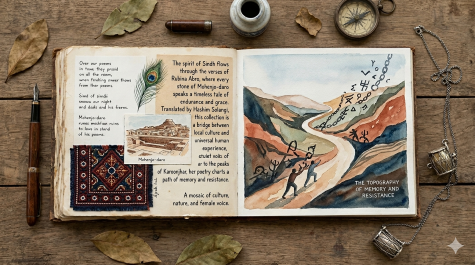
The more closely writers stay connected to their native soil, the more their words can speak to the entire world. In Collage of Verses, a vibrant collection of sixty poems of Sindhi poet Rubina Abro, this truth comes alive.
- Rubina Abro emerges not just as a vital voice for the people of Sindh, but as a poet of deep empathy and global importance.
Naveed Sandeelo
The deepest heart of literature lies in a simple truth: the more closely writers stay connected to their own native soil, the more their words can speak to the entire world. In Collage of Verses—a vibrant collection of sixty poems by the distinguished Sindhi poet Rubina Abro, translated into English by Prof. Muhammad Hashim Solangi—this truth comes alive. This collection is a beautiful, moving mosaic. It shifts gracefully between local folklore, honest feminist critique, a deep love for nature, and the modern loneliness of our digital age. What makes Collage of Verses so essential is not just how it preserves culture, but how it captures the universal anxieties of the human spirit while remaining proudly rooted in Sindh.
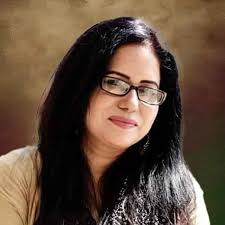
Rubina Abro stands as a prominent contemporary alongside some of Sindh’s most reputed female writers and poets, including Amar Sindhu, Rukhsana Preet, Haseena Sand, Arfana Mallah, Gul Badan Javed, Nasreen Altaf, Sabhyan Sangi, and Rafya Bukhari. Together, this powerful generation of literary voices has inspired a massive section of society, challenging old norms and sparking deep cultural conversations. Within this brilliant circle, Abro’s unique voice rings out clearly as the voice of the downtrodden society and poor folks. She writes with immense empathy for those who are often left unseen and unheard, turning their everyday struggles into profound poetry.
At the very core of Abro’s work is a deep love for the landscapes and history of Sindh. She frequently guides us through sacred places: the deserts of Thar, the peaks of Karoonjhar, the spiritual atmosphere of Sehwan, and the ancient ruins of Moen Jo Daro. She populates these spaces with historic and legendary figures like the freedom fighter Rooplo Kolhi, Raja Dahar, and the mystic saints Sachal Sarmast and Shah Abdul Latif Bhittai. Abro does not treat these historical figures and places like dusty museum exhibits. Instead, she uses them as living symbols of resistance for the marginalized. Her approach feels very much like that of the great Palestinian poet Mahmoud Darwish. Just as Darwish used the olive tree and the lost orchards of Galilee to talk about exile and identity for everyone, Abro turns the arid sands of Thar and the ruins of Moen Jo Daro into powerful symbols of collective memory and political endurance.
Abro’s feminist voice is another cornerstone of this collection. In raw, deeply felt poems like “The Darawar Daughter of the Motherland,” “The Red Colour,” “Ancient Woman,” and “Saving Face,” she directly challenges the patriarchal structures that cause violence against women and try to erase their stories. Her portrayal of women’s experiences and historical trauma never feels like simple preaching. Instead, it connects her to a grand lineage of global poetry. You can hear echoes of Sylvia Plath’s sharp domestic discomfort and Audre Lorde’s powerful, revolutionary rage. By linking the “Ancient Woman” of history to the gender-based violence of today, Abro does something incredibly brave: she places the marginalized realities of womanhood right at the center of her nation’s history.
On a philosophical level, Collage of Verses is a book of honest, open-ended questioning. Poems like “Neither You Nor I,” “Isolation,” “The Ego,” and “Hamlet” do not try to comfort us with easy answers. Instead, they explore what it means to feel isolated, fragmented, and weighed down by deep thoughts. Here, Abro bridges the gap between Eastern mysticism and Western philosophy. Her quiet questioning reads like the introspective work of Rainer Maria Rilke, where the poet stands open and exposed to the vast emptiness of life. Yet, this existential sadness is beautifully softened by her relationship with the natural world. Birds, rivers, clouds, and deserts are not just static backdrops in her writing; they are active characters. This spiritual intimacy with nature feels a lot like the poetry of William Wordsworth or Mary Oliver. As the Romantic poet William Words Worth once suggested, “Poetry is the spontaneous overflow of powerful feelings: it takes its origin from emotion recollected in tranquility.” and nature becomes the very language Abro uses to let those deep, spontaneous feelings flow to express the soul’s hidden longings and grief.
A genuinely refreshing side of Abro’s poetry is that she refuses to pretend the modern world doesn’t exist. She doesn’t just hide in an idealized, peaceful past. She looks right at the fractured reality of the 21st century—a world shaped by Facebook, Instagram, WhatsApp, and emails. In poems like “Telepathy,” she asks an important question: are these technologies that promise to connect us actually making us lonelier? This specific tension—the clash between our ancient spiritual needs and our modern, tech-driven isolation—reminds us of the late Polish poet Czesław Miłosz, who often worried that modern advancements could numb our capacity to feel genuinely present with one another.
Translating a poet whose work is so filled with specific cultural meaning is a daunting task. There is an old saying that poetry is what gets “lost in translation,” but Prof. Muhammad Hashim Solangi has done something truly wonderful. He successfully captures the rhythmic energy and visual weight of the original Sindhi text. Naturally, a few highly local phrases and cultural nuances might make readers unfamiliar with South Asian literature pause for a moment. But this richness is not a flaw. It forces the English language to stretch and adapt to a completely different way of thinking. It achieves what the philosopher Walter Benjamin called an ideal translation: one that lets the beautiful voice of the original language shine clearly through the new one.
Ultimately, Collage of Verses is a triumphant bridge between the regional and the universal. Rubina Abro emerges not just as a vital voice for the people of Sindh, but as a poet of deep empathy and global importance. Her work proves that if you dig deeply enough into your own native soil, you will eventually find the shared water of human experience that connects us all. This collection is essential reading for anyone invested in comparative literature, contemporary feminist poetics, and the enduring power of post-colonial verse.
Read: Tracing the Philosophical Roots
_________________
 Naveed Sandeelo is a poet, writer and critic, and Lecturer at Department of Philosophy University of Sindh Jamshoro. He is author of five books: three books are on the subject of philosophy. Doing PhD at the department of Philosophy University of Karachi.