Stories of Karachi’s Taxi Drivers from 1993 to 2000
Zaffar Junejo
[Author’s Note: I joined a non-government organization in mid-1993. In those days, we were frequent travelers to other Asian countries, and during that period I maintained a diary. I once showed the notes to Muhammad Ibrahim Joyo — the legendary scholar, translator, and intellectual giant of the Sindhi world — who suggested categorizing the entries by theme and getting them published. He recalled that long ago, perhaps in 1955, the Sindhi journal Mehran had launched a similar idea titled ‘Hik Deenh Ji Ghaleh’ (The Story of a Day), even offering a prize for it. He himself had submitted the first story, he told me with a smile, just to set a standard for other writers. Later, Maulana Ghulam Muhammad Girami, a scholar of high standing and journalist; Shamsher ul Haidri, a distinguished Sindhi poet, journalist, and playwright; and Siraj ul Haq Memon, an iconic novelist, linguist, and journalist, all contributed their observations of a single day. These writings were published until 1968.
I agreed with Joyo Sahib that I would group the write-ups by subject and get them published, but I failed to do so. Recently, I sat down to organize my notes. I found various entries about the taxi drivers of Karachi city. Some were very brief and incomplete; others were short but held a finished truth. I have chosen five stories from each year, all of them gathered from the drivers of those cars. In total, there will be thirty-five stories covering the period from 1993 to 2000.]
A Man Carries His Village
The sun was not yet up over Karachi, but the day was already warm.
I left the flat early to catch the Clifton bus. The pavement was grey and cracked. Two blocks down, the Pathan tea stall threw a yellow light onto the dirt road. Next to it, the newspaper stand held the morning editions, hung by small metal clips. No one bought them. Men just stood there in the damp air, leaning close to read the black headlines. When the crowd grew thick at that stand, it meant someone was dead. Usually, it was an ethnic riot or a body left in a gunny bag.
I did not stop. A mini-bus was coming, its diesel engine rattling the road.
At the office, the rooms smelled of old paper and dust. I asked the tea boy for the paper.
“Too early,” he said. He did not look up from his tray. “Ten o’clock.”
He gave me a cup of hot, sweet tea instead. I drank it fast, then walked over to the Social Welfare Office. The clerk there had the registration papers for an NGO based in Khairpur Mirs. We sat through a long meeting in a room with a slow ceiling fan. At around four o’clock, I left the office.
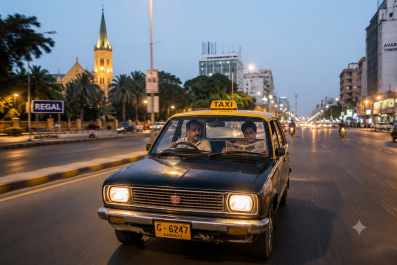
I walked down to Saddar to find a cab. One was parked at Regal Chowk, right across from the Thomas and Thomas bookshop. The paint was peeling off the hood. I tapped the window, and he motioned for me to take the front seat.
“Salam,” the driver murmured. His hands stayed flat on the steering wheel. He was a tall man from the north, his face dark and lined like dry leather.
“Salam,” I responded.
On the plastic dashboard lay three evening newspapers, folded small. The driver stared straight ahead at the traffic, his jaw set hard. He did not look sad; he looked numb.
“Something wrong, Khanji?”
He did not speak. He just flicked his fingers toward the dashboard.
I reached out and took the top paper. A small black box on the front page carried the story. A young couple had gone to the city court for a civil marriage. They were shot dead on the steps. I laid the paper across my knees. In Karachi, these stories came every week.
The taxi rattled as he shifted into second gear. He watched the road, his eyes reflecting the brake lights of the rickshaws ahead.
“Read the rest,” he said. His voice was low, coming from deep in his chest.
I turned the page. The girl was Pashtun. The boy was Urdu-speaking. Both were twenty, studying for their Bachelor of Arts, and living in the same neighbourhood. The boy had asked her parents for her hand. The mother had agreed, but the brother and the cousin refused. The couple ran away. On the day of their first court hearing, the cousin and brother arrived with a TT pistol. The brother fired until the magazine was empty, then shouted Allah-u-Akbar into the crowded corridor until the police tackled him.
The city noise flooded through the open windows.
“The world changes, Khan,” I said, looking out at the billboards. “People live together now. They study together. Love happens. It is normal.”
He let the clutch out slowly. “She was from my village. Back near Peshawar.”
“You knew her?”
“I knew the family,” he said. “They have been in Karachi for ten years. Her uncle has been here thirty. Maybe more. She was a smart girl. Eager to learn.”
The traffic slowed near Hassan Square. The concrete apartments rose up like grey cliffs against the hazy sky.
“They say the cousin shot her,” he continued, “but the brother took the blame. The police will go easy on a brother. They understand Ghairat. Honor.”
“Was the cousin uneducated?”
“Born here,” the driver said. “Educated here.”
We stopped near the Hassan Square flats where I had to drop off the Khairpur registration papers. I reached into my pocket for some five-hundred-rupee notes, but I kept my hand there.
“Why do it then?” I asked. “If they live here, if they are educated here, why the brutality?”
He turned his head then, looking me straight in the eyes. The anger in him had gone cold, leaving only something old and heavy.
“Sahib,” he said, “we carry Peshawar inside our brains and our blood. It does not matter how many years we spend in Karachi. We take the city’s money, but we do not share its joy. We stay inside our own walls because we are afraid to change. Our pride, our Ghairat—perhaps it is the only thing that keeps us safe from becoming nothing.”
I handed him the money. He took it without counting it and slotted the cab into gear. As the taxi pulled away into the dust, his words stayed in the hot air. A man carries his village with him, no matter where he dies.
______________________
 Dr. Zaffar Junejo has a Ph.D in History from the University of Malaya. His areas of interest are post-colonial history, social history and peasants’ history. He may be reached at junejozi@gmail.com