The dismantling of the old honor-bound structures did not liberate the society; it merely exchanged an organic system of mutual obligation for a fragmented, modern dependency.
Noor Muhammad Marri, Advocate | Islamabad
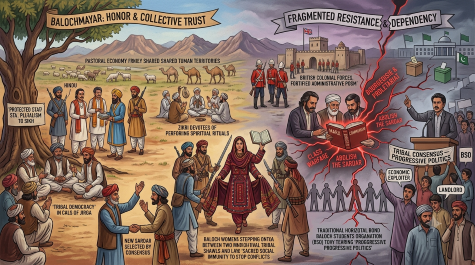
Before the advent of British colonial intervention, Baloch society operated as a remarkably egalitarian, just, and self-contained ecosystem, anchored by an organic code of honor known as Balochmayar. Within this traditional matrix, the deep socio-political fractures of class warfare, structural religious inequality, and minority segregation were virtually non-existent. The fundamental baseline of this enduring harmony was rooted in a pastoral, kinship-based economy where the land of the respective tribes was viewed not as private, monopolized property, but as a collective asset available to all. Every Baloch was inherently entitled to the shared grazing pastures (tuman territories), a structural reality that prevented the rise of the rigid, vertical stratifications seen in highly feudalized agrarian societies or neighboring civilizations. Unlike the complex social hierarchies of Hinduism, which bounded individuals to a permanent status from birth, or the deep historical stratifications of Arab societies, traditional Balochistan possessed no equivalent concept of institutionalized slavery or immutable caste degradation. Even the Syeds—who entered the region as descendants of the Prophet—were integrated into the tribal matrix not as an absolute, ruling Brahmin-like class that extracted subservience from the populace, but rather as spiritual mediators, counselors, and keepers of peace whose status depended on their adherence to the collective moral code. There was no concept of an untouchable class; the common tribesman stood on equal footing with the highest lineage, bound by mutual respect rather than birthright subservience.
This system of communal resource management formed the bedrock of an authentic tribal democracy. Within this framework, the position of the Sardar or Nawab was far from absolute, autocratic, or strictly hereditary; leaders were chosen through a rigorous system of consensus by the council of elders (Jirga) based strictly on their integrity (Imandari), personal character (Kirdar), and bravery (Bahaduri). If a leader lacked these intrinsic virtues, the tribe possessed the democratic leverage to bypass them in favor of someone more capable. The authority of the chosen leader was permanently legitimized by shared risk. The Sardar was never an insulated, rear-guard commander; rather, he and his immediate family members were honor-bound to lead from the front lines in any conflict, bearing the ultimate cost of war alongside the common tribesman. This reinforced a deep, horizontal bond of solidarity across the entire tribe, ensuring that leadership remained an office of heavy obligation and communal custody rather than an instrument of economic extraction or personal privilege.
This inclusive and protective structure extended seamlessly to religious pluralism, providing a sanctuary for diverse beliefs in an otherwise turbulent regional landscape. Non-Muslim Baloch communities, particularly Hindu and Sikh Baloch, were never treated as segregated outsiders or secondary citizens. Integrated fully into the socio-economic life of the tuman, they often managed trade and financial networks with the complete backing of the tribal leadership. Under the sacred code of hospitality and protection, they were classified as Banhari—protected entities whose safety was inextricably linked to the tribe’s collective standing. Any insult, extortion, or aggression directed toward a Hindu or Sikh member of the tribe was treated legally and socially as a direct assault on the entire tribe’s collective honor, demanding an equivalent, unyielding communal response.
This spirit of profound religious tolerance is equally evident in the historical position of the Zikri sect within Baloch society. While neighboring regions often subjected religious minorities and heterodox sects to violent persecution and systemic marginalization, the Zikris found a secure home under the protective umbrella of Balochmayar. The Baloch tribes fiercely defended the Zikri community from external theological purges and sectarian interventions, viewing them first and foremost as equal members of the Baloch national identity. Their right to practice their distinct spiritual traditions was guarded as a matter of tribal sovereignty and honor. In the Baloch ethos, shared blood, language, and the code of honor consistently superseded sectarian divisions, preventing the rise of the fundamentalist strife that plagued other parts of the subcontinent.
Mirroring this high ethical standard was the supreme status accorded to women, who held the highest esteem in society and functioned as the ultimate arbiters of peace. Under the traditional rule of Mehtar, women possessed a sacred social immunity that could override the most violent impulses of men. When an inter-tribal enmity or blood feud (Siyahkari) threatened total mutual destruction across generations, a delegation of women could intervene by stepping directly onto the active battlefield or into the center of an adversary’s domain. The moment they appeared—often placing their shawls on the ground or holding the Holy Qur’an—thousands of years of hostility were instantly frozen. To ignore a woman’s appeal for peace or to cause her even accidental harm during an intervention was considered an unpardonable, catastrophic violation of honor. Such an act would instantly brand the perpetrators with permanent social disgrace, isolating them completely from the broader tribal confederation. Through this mechanism, women held the keys to conflict resolution, transforming deep-seated vendettas into opportunities for reconciliation.
However, this organic and beautifully balanced social fabric was fundamentally disrupted when modern, Eurocentric political ideologies were aggressively imported into a landscape completely devoid of industrial mechanics. Lacking factories, industrial chimneys, or an inherent capital-labor dynamic, Balochistan did not possess the structural baseline for a class war. Yet, certain Baloch leaders, notably Nawab Yousaf Aziz Magsi, became profoundly influenced by Marxist and communist literature during their exposures to external academic and anti-colonial circles in the early 20th century. In his desire to dismantle the British Sandeman System—which had deliberately frozen the organic, consensual nature of tribal democracy and replaced it with a rigid, British-subsidized hereditary autocracy—Magsi introduced a rigid class question where none organically existed.
By superimposing the binary language of the bourgeoisie and proletariat onto a pastoral kinship structure, this ideological shift put an axe to the foundational fabrics of Baloch society. It stripped the Sardar of his traditional, organic role as a vanguard fighter and custodian of collective tribal wealth, redefining him strictly through a Western lens as an economic exploiter and landlord. This conceptual poison eventually infected successive generations of intelligentsia, finding a fertile home within the Baloch Students Organization (BSO) and giving rise to an aggressive, ideologically driven anti-Sardar faction. By shifting the primary focus of resistance from external colonial structures to internal class enemies, the very social cohesion that had protected the Baloch people from external assimilation for centuries was fractured from within.
Figures like Mir Ghaus Bakhsh Bizenjo and later Dr. Malik Baloch propagated this exact agenda under the guise of progressive modernization. By utilizing the rhetoric of progressive, middle-class politics, they sought to bypass traditional tribal consensus entirely. In doing so, however, they inadvertently served the strategic, centralizing interests of the state establishment, which sought nothing more than the fragmentation of cohesive tribal resistance. By hollowing out the ancient tribal democracy and replacing it with clientelist parliamentary politics, they did not create a classless utopia; instead, they left the common tribesman vulnerable, isolated from their traditional safety networks, and caught in the calculations of an external administrative apparatus. The dismantling of the old honor-bound structures did not liberate the society; it merely exchanged an organic system of mutual obligation for a fragmented, modern dependency.
References
- The Baloch and Their Country” — Longworth Dames
- Inside Balochistan: A Political Autobiography of Khan-e-Azam Mir Ahmed Yar Khan Ahmedzai” — Mir Ahmed Yar Khan Ahmedzai
- “The Frontiers of Pakistan: A Study of Frontier Policy in British India” — Ayub Bakhsh Awan
- “In Balochistan’s Search for Freedom” — Selig S. Harrison
- “In Search of Solutions” — Mir Ghaus Bakhsh Bizenjo (Edited by B.M. Kutty)
- “The Politics of Ethnicity in Pakistan: The Baloch, Sindhi and Mohajir Ethnic Movements” — Farhan Hanif Siddiqi
- “Balochistan: On the Margins of History” — Mir Mohammad Ali Talpur
Read: Historical Illusion of Peaceful Progress
_____________________
 Noor Muhammad Marri Advocate & Mediator is based in Islamabad