Stories of Karachi’s Taxi Drivers from 1993 to 2000
Zaffar Junejo
[Author’s Note: I joined a non-government organization in mid-1993. In those days, we were frequent travelers to other Asian countries, and during that period I maintained a diary. I once showed the notes to Muhammad Ibrahim Joyo — the legendary scholar, translator, and intellectual giant of the Sindhi world — who suggested categorizing the entries by theme and getting them published. He recalled that long ago, perhaps in 1955, the Sindhi journal Mehran had launched a similar idea titled ‘Hik Deenh Ji Ghaleh’ (The Story of a Day), even offering a prize for it. He himself had submitted the first story, he told me with a smile, just to set a standard for other writers. Later, Maulana Ghulam Muhammad Girami, a scholar of high standing and journalist; Shamsher ul Haidri, a distinguished Sindhi poet, journalist, and playwright; and Siraj ul Haq Memon, an iconic novelist, linguist, and journalist, all contributed their observations of a single day. These writings were published until 1968.
I agreed with Joyo Sahib that I would group the write-ups by subject and get them published, but I failed to do so. Recently, I sat down to organize my notes. I found various entries about the taxi drivers of Karachi city. Some were very brief and incomplete; others were short but held a finished truth. I have chosen five stories from each year, all of them gathered from the drivers of those cars. In total, there will be thirty-five stories covering the period from 1993 to 2000.]
The Pajero and the Silent Man
In the middle of July, the office told me that the Community Development Officer of an oil company was coming. They wanted to see our work and might support the NGO later.
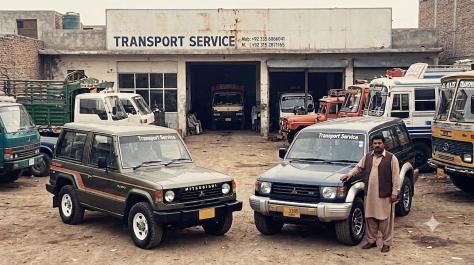
I went to a transport company. A Pajero waited outside. It had dark glass and clean seats. Inside the office, a clerk pushed papers toward me. I signed where he pointed. The papers already carried my name, but he still asked me to sign again in the margin.
Then he brought the driver out. The man stood near the door. He was broad-shouldered and his clothes were clean. He held the keys tightly in his fist.
“This is Sultan Arain,” the clerk said.
Sultan nodded.
We got into the Pajero, he started the engine, and we left the city. The road ran through dry land. Trucks passed us, leaving clouds of dust behind them. A tea stall stood near a bend in the road, where men sat outside watching the traffic.
After some time, I looked over at Sultan. “How long have you worked for this company?”
He kept both hands firmly on the wheel. “Five years.”
“Only Pajero work—just driving?”
“I drive many people,” he said. “Consultants, foreign organizations, oil companies, private people.” Sultan looked at the road, and then he smiled. “People change when they go home.”
I watched him. “How?”
He moved one hand from the wheel and pulled down the sun visor. “They leave Islamabad laughing. They speak English. They call everyone ‘brother.’ Then, when we get near their village, their faces change. They sit up straight. They open the blinds. They become quiet.”
“Why?”
“They want people to see them in the Pajero.”
“Does that happen often?”
“Yes.”
The road became narrow, and a herd of goats crossed ahead of us. Sultan slowed down. A boy struck the goats with a stick, and the animals moved away.
Sultan cleared his throat. “One man hired this Pajero from Islamabad to Nawabshah,” he said. “His name was Jaffar.”
“What happened?”
“He became nervous before we reached Nawabshah.” Sultan tapped the steering wheel with his thumb. “Jaffar leaned toward me and spoke softly. He said, ‘We are going to a wedding. I will introduce you as my cousin. You work in Saudi Arabia, and we have a partnership in a car showroom in Islamabad.'” Jaffar gave a small laugh. “Then he put five hundred rupees in my pocket.”
“And you agreed?”
“I agreed partly.”
“What does that mean?”
“It means I went along with it.” He drove for a while before continuing. “At the wedding, he introduced me to everyone. He said I was his cousin, that I worked in Saudi Arabia, and that we owned car showrooms in Islamabad.”
“What did you do?”
“I just stood there.” Sultan lifted his hand from the wheel and showed me an empty palm. “I held a packet of Gold Leaf cigarettes in one hand and a lighter in the other. I smiled, but I did not speak.”
“Why not?”
“Because a man who speaks too much exposes himself.”
I looked through the window. The land was flat, a line of trees stood far away, and heat waves shook above the asphalt. “Did people believe him?”
“They believed him,” Sultan smiled again. “One man took me aside. He stood close to me and asked if the car showroom business was good.”
“What did you tell him?”
“I told him everything I knew.”
“What did you know?”
“Nothing.” He laughed, but his eyes stayed fixed on the road. “I told him cars sell, cars need parts, people need transport, Islamabad is growing, and Saudi money comes back. A man can earn if he works.”
“And then?”
“He asked me to speak to my cousin. He wanted to invest and become a partner.”
“What did you say?”
“I said, ‘I will tell him.’ Right then, Jaffar came over. He shouted, ‘Come, brother, we must go!'”
“You left the man?”
“I left him right in the middle of his question.”
“What happened after that?”
“The man called Jaffar aside. They spoke near the gate.”
“Could you hear them?”
“Yes.” Sultan bent forward and looked into the side mirror. “The man said he wanted to invest. Jaffar told him not to worry and told him he could increase his money by thirty percent.”
“And you?”
“I started the Pajero. Jaffar came back, sat in the front seat, and asked me how the food was.”
“What did you say?”
“I said it was delicious.”
We reached Hyderabad before sunset. Sultan stopped at a hotel where we ate rice and meat, and he smoked outside after dinner. The next morning, we drove back toward Islamabad. Sultan did not speak much as the Pajero moved north.
__________________
 Dr. Zaffar Junejo has a Ph.D in History from the University of Malaya. His areas of interest are post-colonial history, social history and peasants’ history. He may be reached at junejozi@gmail.com