Faith will be on the ballot in 2027. That is certain. But hunger is also on the ballot. Fear is also on the ballot. Frustration is also on the ballot. For the first time in a long while, those things may weigh as much as, or even more than, religious sentiment.
Michael Adeboboye
Let’s puncture the assumption we have lived with for decades. In Nigeria, we say it as fact: religion decides elections. The North votes one way. The South-East votes another. The South-West splits and then decides. Pastors endorse. Imams guide. CAN speaks. JNI speaks. And the votes follow. But 2027 is not 2015. It is not even 2023.
This Nigeria is entering the election cycle with a different kind of pain. Food is a luxury. Fuel is a debate. The naira is a story. Schools are expensive. Hospitals are expensive. And insecurity is no longer a headline in faraway states. It is your neighbor, your cousin, your driver, your WhatsApp status. So we have to ask the uncomfortable question out loud: In the face of economic crisis, political frustration, and daily insecurity, will religious sentiment still be the yardstick Nigerians use to vote in 2027? Or has hardship finally grown louder than the pulpit?
There is no doubt that religion remains powerful in Nigeria. It is not just worship. It is identity, community, language, and memory. When a politician stands in a church and the congregation rises, or when he sits on the floor of a mosque and prays with the faithful, something is being communicated beyond policy. It says: I see you. I am like you. I will protect you. That message wins elections. We saw it in 2023. The Muslim-Muslim ticket became the central argument for months. CAN held meetings. Commentators wrote essays. Social media fought to the point of exhaustion. The debate was not about debt-to-GDP or power generation. It was about representation, about fear, about history.
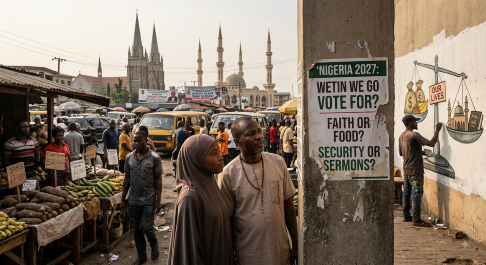
But 2023 also gave us something else. It gave us a government that, two years later, is being judged not by the faith of its leaders, but by the price of rice. By the availability of fuel. By whether children can travel home for Sallah or Christmas without fear. And that is where the crack is beginning to show. Walk into any market in Kano, Onitsha, Ibadan, or Port Harcourt today and the conversation is not theology. It is tomatoes. It is transport. It is school fees. A mother who spent Sunday in church or Friday in the mosque will still go home to an empty pot. An Imam who preached about justice will still bury a member kidnapped on the highway. A pastor who prayed for peace will still watch his youth leave the country. Hardship does not check your faith before it hits you.
This is the tension 2027 will sit on. Religious mobilization is still real. CAN will issue communiques. PFN will hold summits. JNI and NSCIA will host candidates during Ramadan. Sermons will mention leadership. Prophecies will mention names. WhatsApp will circulate flyers telling Christians to vote only one way, and Muslims to vote only the other. Politicians will queue for photo opportunities at vigils and Eid prayers because they know those images travel. But mobilization now meets a more skeptical audience. Urban youth, who are the biggest voting bloc, are not living in 1999. They are on TikTok, on X, on YouTube. They compare Nigeria to Ghana, to Kenya, to Rwanda. They ask about data, about jobs, about internet, about visas. They are not rejecting faith. Many are devout. But they are asking if faith and competence can coexist, and if they cannot, which one feeds them.
Insecurity has also changed the calculation. Banditry in the North-West does not ask if you are Muslim. Separatist violence in the South-East does not ask if you are Christian. Kidnappers on the Abuja-Kaduna road do not open the boot to check your Bible or Quran. When a road is not safe, when a farm is not safe, when a school is not safe, the first question in a voter’s head is not “who is he praying to?” The first question is “who can stop this? “There is also governance fatigue. Nigerians have tried voting for “one of us” and ended up with the same hardship. They have tried “balancing the ticket” and still could not pay bills. They have tried “he is a pastor” and “he is an alhaji” and the result on the ground did not change fast enough. That creates doubt. No doubt in God. Doubt in the formula. Does this mean religion will disappear from 2027? No. That would be naive.
In the North, identity and faith are still deeply tied to political choice because of history, institutions, and structure. In the South-East and South-South, Christian identity still matters because of memory and minority politics. In the South-West, because the population is mixed, candidates will still do both — church on Sunday, mosque on Friday — and speak the language of inclusion. But what may be changing is the weight. Religion may move from being the only yardstick to being one of the yardsticks. Voters may still want to know the faith of a candidate, but they may also want to know the plan for inflation. They may still want to know the religious balance of a ticket, but they may also want to know the security strategy. The danger is that politicians know this too. And so they will try to use religion to distract from failure. When the economy is bad, bring out faith. When security is failing, bring out faith. When there is no answer, bring out “they are attacking our people.” That is the dreaded path. Because once an election is framed as Muslim versus Christian, it becomes very hard to govern after. The winner is not seen as president of Nigeria. The winner is seen as president of one side. So the real questions for 2027 are not about candidates. They are about us. If a candidate shares your faith but cannot explain how he will bring down food prices, is he your candidate? If a candidate is of a different faith but has a clear record on security and jobs, can you cross the line? Are we voting to feel represented, or to actually live better? Who benefits when we spend six months fighting over a VP’s religion while the naira slides?
These are not abstract questions. They will be asked in beer parlors and in WhatsApp groups. They will be asked in university hostels and in market stalls. They will be asked quietly in churches after service, and quietly in mosques after prayers. The media also has a role here. We must refuse to reduce 2027 to a religious census. Yes, report what CAN says. Yes, report what JNI says. But also ask: what is the policy? What is the track record? What is the plan? Otherwise we become amplifiers for the very division that keeps us poor.
Faith will be on the ballot in 2027. That is certain. But hunger is also on the ballot. Fear is also on the ballot. Frustration is also on the ballot. For the first time in a long while, those things may weigh as much as, or even more than, religious sentiment. If that happens, then 2027 will not just be another election. It will be a referendum on whether Nigerians are ready to move from “who is one of us” to “who can deliver for all of us. “And that shift, if it comes, will be bigger than any party, any ticket, and any sermon. Because a nation that votes with its stomach, its safety, and its future — not only with its faith — is a nation that may finally start demanding governance, not just representation.
__________________
 Michael Adeboboye is the Chairman of Board, Congress of African Journalists – CAJ
Courtesy: Congress of African Journalists International Magazine