In today’s modern age, it seems that a person’s name is no longer the most important part of his identity. Instead, it is the code that defines him. We now live in a forest of numbers, where every door, every machine, every system, and every service demands yet another code.
Abdullah Usman Morai | Sweden
There was a time when, before leaving home in the morning, the only thing a person worried about was carrying the house key. If they could feel it in their pocket, they considered themselves fully prepared for the day. There was no need to memorize a string of secret numbers, no requirement to log into an app, and no obligation to prove their identity to a machine every few steps. But the world has changed.
In today’s modern age, it seems that a person’s name is no longer the most important part of his identity. Instead, it is the code that defines him. We now live in a forest of numbers, where every door, every machine, every system, and every service demands yet another code.
If you live in a developed country, you probably use dozens of different codes from the moment you wake up until you go to bed. The amusing part is that you hardly even notice how many you use.
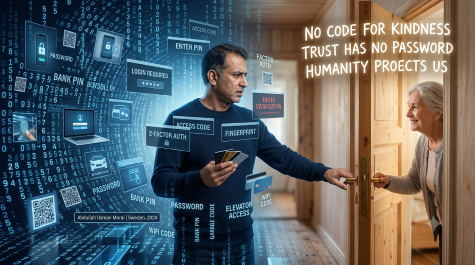
To leave your home, you unlock the front door with a key or an access code. Then comes the garage code or an electronic key. If you drive, your car may have a digital key. Upon arriving at work, you need another code or electronic access card to enter the building. The elevator may require a separate code. The office door has another one. Your computer needs a password. Logging into the company’s network requires another password. Your email has its own credentials, your work system another, your bank account another, your mobile banking ID another, and identity verification yet another security code.
Sometimes it feels as though modern humans have become walking password managers.
The funniest moments, however, occur when the brain grows tired and all these codes begin to blur together. Imagine arriving at your office, standing confidently in front of the elevator, and entering four digits. Nothing happens. You try again. Still nothing. A few moments later, you suddenly realize that you’ve been entering your bank card PIN instead of the elevator access code!
There is one thing technology has never been able to replace: genuine human compassion and love. There is no code for kindness and no app for empathy. Trust still has no password. Honesty cannot be implanted through a microchip, and no company has yet invented two-factor authentication for humanity itself.
At times, you find yourself trying the office code at your apartment entrance, and the home code at the office door. Some people become so automated that they attempt to scan their public transport card inside their residential elevator or pull out their bank card when standing in front of the office coffee machine. Then, after returning home, they instinctively take out their office access card and try to unlock the front door, as if their home were company property.
Occasionally, we even find ourselves entering our bank card PIN to unlock our mobile phone until the phone flashes a warning:
“One final attempt remaining.”
At that very moment, even our own memory begins to feel unreliable.
Our grandparents probably only needed to remember two things: the way home and the key to the house. Today’s generation seems to remember more passwords than birthdays.
This raises an important question: Are all these codes simply inconvenient?
Perhaps not.
In reality, every one of these codes exists to protect us. They safeguard our money, personal information, offices, homes, companies, and identities. If anyone could enter anywhere without verification, the world would undoubtedly become a far more dangerous place. The daily inconvenience we experience is, in truth, the price we pay for security.
Yet human nature is fascinating. The very things designed to protect us often become a source of comedy as well.
Nowadays, if a friend says, “I can’t remember my code,” the first question is no longer which code they mean: Is it the bank PIN? The phone passcode? The office access code? The elevator code? The garage code? The computer password? Or the Wi-Fi password?
Sometimes it even seems that, in the future, people might ask each other before getting married,
“So… how many passwords do you have?”
Judging by the pace of technological progress, it’s quite possible that within the next twenty or thirty years, even these numerical codes will disappear. We may all carry a tiny microchip implanted in our bodies that simultaneously handles our identity, banking, workplace access, home entry, vehicle, healthcare, travel, and countless other services.
Perhaps such technology already exists in one form or another.
Maybe simply standing in front of your door will unlock it automatically. The elevator may already know which floor you intend to go to visit. Your car might recognize you and start on its own. Banks could identify you through your iris or facial recognition alone.
And perhaps one day, people will no longer need to remember a single password.
But then a new problem may arise. What if that one tiny chip fails? What if artificial intelligence refuses to recognize you? What if the system politely informs you, “We’re sorry – Your identity could not be verified.”
At that moment, a person may find themselves standing outside a locked door while the machine refuses to let them in.
Every step forward in technology inevitably raises new questions.
Our world is gradually moving from physical keys to digital codes, from codes to biometrics, and from biometrics to artificial intelligence. The human being of the future may be identified more by data than by words.
Yet there is one thing technology has never been able to replace: genuine human compassion and love. There is no code for kindness and no app for empathy. Trust still has no password. Honesty cannot be implanted through a microchip, and no company has yet invented two-factor authentication for humanity itself.
Perhaps the greatest achievement of the future will not be creating even more sophisticated security codes. Rather, it will be learning to open the doors of our hearts with the same care and responsibility with which we open our digital doors today.
Because, in the end, it is not codes alone that keep us safe.
Our character, our integrity, our trustworthiness, and our humanity protect us far more than any password ever can.
Read: Tunnel Farming: Sindh’s Agricultural Future
_________________
 Abdullah Soomro, penname Abdullah Usman Morai, hailing from Moro town of Sindh, province of Pakistan, is based in Stockholm Sweden. Currently he is working as Groundwater Engineer in Stockholm Sweden. He did BE (Agriculture) from Sindh Agriculture University Tando Jam and MSc water systems technology from KTH Stockholm Sweden as well as MSc Management from Stockholm University. Beside this he also did masters in journalism and economics from Shah Abdul Latif University Khairpur Mirs, Sindh. He is author of a travelogue book named ‘Musafatoon’. His second book is in process. He writes articles from time to time. A frequent traveler, he also does podcast on YouTube with channel name: VASJE Podcast.