

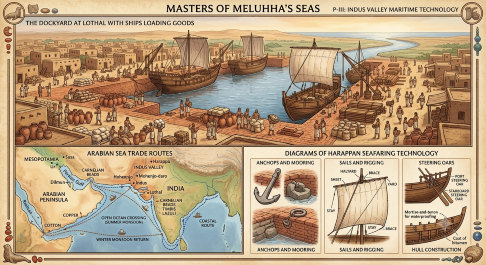
The Indus Valley Civilization as One of the World’s Earliest Maritime Trading Powers
Maritime Legacy, Global Context, and the Forgotten Seafaring Heritage
- The Indus Valley Civilization should not be remembered solely for the monumental ruins of Mohenjo-daro or its sophisticated drainage systems. Equally significant was its role as one of the earliest organized maritime trading civilizations of the Bronze Age.
Dr. Nisar Ahmed Solangi
Part III
The Maritime Zenith of the Indus Civilization during the Bronze Age
The maritime achievements of the Indus Valley Civilization were the culmination of a long process of cultural and technological development that began with the early farming communities of Mehrgarh around 7000 BCE. The archeological and genetic consensus confirms that Indus Valley Civilization (IVC) did not appear suddenly but evolved organically, with deep cultural roots in the Neolithic and Chalcolithic tradition established at Mehar Garh between 7000- 2000 BCE. And transition represents a mix of regional cultural evolution and gene flow, rather than an isolated unilinear march from one site.
Over several millennia these communities evolved into one of the world’s largest urban civilizations, extending across nearly one million square kilometers of present-day Pakistan and northwestern India.
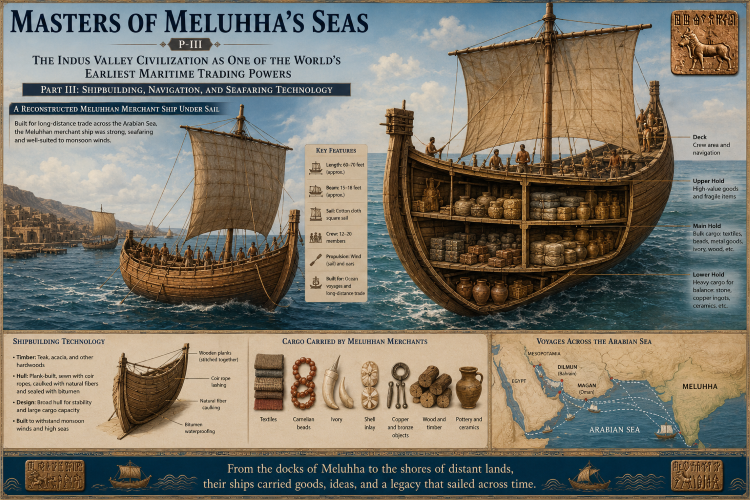
By the Mature Harappan period (c. 2600–1900 BCE), the civilization had established an extensive network of planned cities, manufacturing centers, inland waterways, and coastal ports. This infrastructure enabled the movement of goods, people, and ideas across both land and sea, creating an economic system of remarkable sophistication for the third millennium BCE.
Archaeological discoveries demonstrate that Harappan merchants maintained commercial contacts across the Arabian Sea with Oman (ancient Magan), Bahrain (ancient Dilmun), Mesopotamia, and the wider Persian Gulf region. Through these networks flowed not only manufactured goods and raw materials but also technologies, artistic traditions, administrative practices, and cultural influences.
Rather than representing isolated voyages, these interactions formed part of a sustained maritime system that connected South Asia with the broader economic world of the Bronze Age.
 The Indus Civilization in Comparison with Contemporary Maritime Civilizations
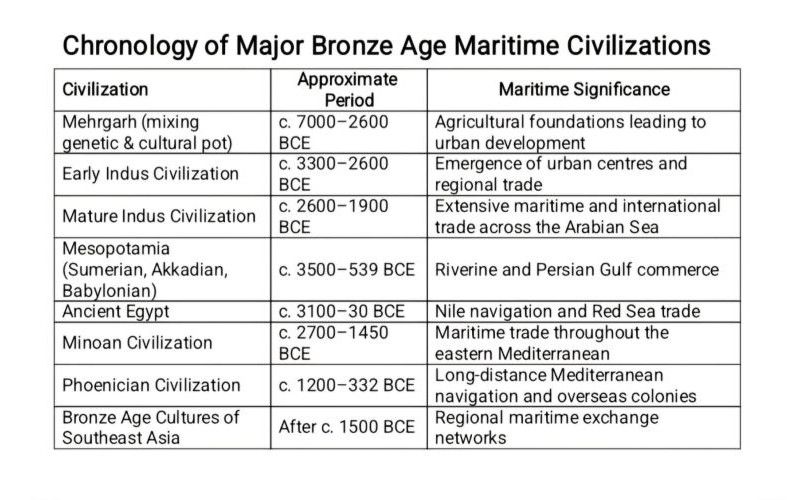
Several civilizations contributed significantly to maritime commerce during antiquity. Mesopotamia utilized the Tigris and Euphrates river systems to reach the Persian Gulf; Egypt developed navigation along the Nile and the Red Sea; the Minoans established an influential maritime economy in the eastern Mediterranean; and the Phoenicians later became renowned as master navigators and colonizers throughout the Mediterranean basin.
The Indus Civilization occupied a different but equally important geographical sphere. Its maritime activities centered on the Arabian Sea and the Persian Gulf, linking South Asia with Western Asia through well-organized commercial routes.
Chronology is particularly significant in understanding the historical position of these civilizations. The Mature Harappan maritime network flourished between 2600 and 1900 BCE, centuries before the rise of Phoenician maritime dominance after 1200 BCE.
The Minoan civilization was broadly contemporary with the Mature Harappan period, while Egypt and Mesopotamia had already developed important riverine and maritime trading systems. Consequently, the available evidence does not support ranking these civilizations in terms of superiority. Instead, each emerged as a major regional maritime power within its own geographical and historical context.
What distinguishes the Indus Civilization is the remarkable integration of standardized urban planning, industrial production, inland transportation, coastal ports, and overseas commerce into a single economic system. Few Bronze Age civilizations demonstrate such a high degree of uniformity across such a vast geographical area.
 A Forgotten Maritime Heritage
For much of modern history, the maritime accomplishments of the Indus Civilization have received less attention than those of Egypt, Mesopotamia, Greece, or Phoenicia. This imbalance stems partly from the fact that the Indus script remains undeciphered, limiting our understanding of Harappan political institutions, commercial administration, and historical narratives.
In contrast, the decipherment of Mesopotamian cuneiform and Egyptian hieroglyphs has enabled historians to reconstruct their civilizations in considerably greater detail.
Nevertheless, archaeological research conducted over the past half-century has significantly transformed our understanding of the Indus world. Excavations at coastal settlements, studies of Harappan craft industries, geochemical analyses of traded materials, underwater archaeology, and renewed interpretations of Mesopotamian texts have collectively revealed the extent of Harappan participation in long-distance maritime exchange.
Today, most archaeologists agree that the Indus Civilization was one of the principal economic centers of the Bronze Age. Its standardized manufacturing, regulated systems of weights and measures, sophisticated urban planning, and extensive maritime connections distinguish it as one of humanity’s earliest examples of an integrated commercial civilization.
Legacy for World History
The significance of the Indus Civilization extends beyond archaeology. Its achievements illustrate how technological innovation, urban organization, and maritime connectivity could sustain economic prosperity more than four thousand years ago.
The Harappans demonstrated that successful commerce required more than ships and ports. It depended equally upon standardized production, reliable systems of measurement, administrative coordination, skilled craftsmanship, and mutual trust between trading partners.
Many of these principles remain fundamental to international commerce today.
Although modern concepts such as globalization or supply-chain management belong to a much later age, they offer useful analytical frameworks for appreciating the remarkable organizational capabilities of the Harappan economy.
Conclusion
The Indus Valley Civilization should not be remembered solely for the monumental ruins of Mohenjo-daro or its sophisticated drainage systems. Equally significant was its role as one of the earliest organized maritime trading civilizations of the Bronze Age.
Its ports, standardized industries, commercial administration, and overseas exchange networks connected South Asia with the civilizations of Western Asia centuries before classical maritime empires emerged.
Current archaeological evidence supports the conclusion that the Indus Civilization was among the world’s earliest large-scale urban economies to integrate manufacturing, inland transportation, maritime commerce, and long-distance international trade into a coherent economic system.
Future archaeological research—including marine archaeology, geoarchaeological investigations, residue analysis, isotopic sourcing of traded materials, and, perhaps most importantly, the eventual decipherment of the Indus script—will undoubtedly deepen our understanding of this remarkable civilization.
Until then, the seafarers of Meluhha deserve recognition not merely as merchants of antiquity but as pioneers whose maritime enterprise helped shape the interconnected world of the Bronze Age.
References (APA 7th Edition)
Chakrabarti, D. K. (1990). The External Trade of the Harappan Civilization. Munshiram Manoharlal.
Kenoyer, J. M. (1998). Ancient Cities of the Indus Valley Civilization. Oxford University Press.
Law, R. W. (2011). Inter-Regional Interaction and Urbanism in the Ancient Indus Valley. Palgrave Macmillan.
McIntosh, J. (2008). The Ancient Indus Valley: New Perspectives. ABC-CLIO.
Possehl, G. L. (2002). The Indus Civilization: A Contemporary Perspective. AltaMira Press.
Ratnagar, S. (2004). Trading Encounters: From the Euphrates to the Indus in the Bronze Age. Oxford University Press.
Rao, S. R. (1985). Lothal and the Indus Civilization. Asia Publishing House.
UNESCO. (2021). Nomination Dossier: Lothal – The Harappan Port City. UNESCO World Heritage Centre.
Vidale, M. (2010). “Indus Craft Production and Long-Distance Exchange.” In Connections and Complexity: New Approaches to the Archaeology of South Asia.
Wright, R. P. (2010). The Ancient Indus: Urbanism, Economy, and Society. Cambridge University Press.
_________________________
Dr. Nisar Ahmed Ali Nawaz Solangi is a distinguished Public Health Specialist with over 28 years of experience in primary healthcare, health management, and policy development. Throughout his career, he has served in leadership capacities, He holds MBBS from the University of Sindh and a Master of Public Health from Griffith University, Australia. He is a dedicated polymath committed to the intersection of ancient civilization and emerging technology. He is deeply engaged in the study of the Indus Valley Civilization—focusing on its maritime history, trade networks, and egalitarian governance. Currently based in Saudi Arabia, Dr. Solangi is a tireless advocate for the digital preservation and global dissemination of the Sindhi language and culture. He is actively involved in pioneering initiatives on social media” Our Digital World”. By bridging the gap between historical heritage and digital innovation, he aims to create a new paradigm for cultural representation in the AI era.


