

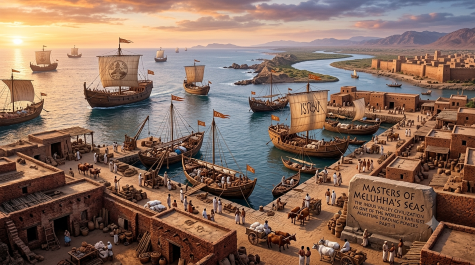
The Indus Valley Civilization as One of the World’s Earliest Maritime Trading Powers
Meluhha, Maritime Commerce, and the Rise of a Bronze Age Trading Economy
Dr. Nisar Ahmed Solangi
Part II
Meluhha: The Indus Civilization in the Records of Mesopotamia
Perhaps the strongest evidence for the international commercial significance of the Indus Valley Civilization comes not from South Asia itself but from the cuneiform inscriptions of ancient Mesopotamia. These texts repeatedly refer to a distant land known as Meluhha, which many archaeologists and Assyriologists identify with the Indus Civilization.
Although a small number of scholars have proposed alternative locations for Meluhha, the prevailing academic consensus associates it with the Indus region because of the convergence of textual, archaeological, and material evidence. Mesopotamian inscriptions from the Akkadian and Ur III periods describe Meluhha as a source of exotic raw materials, luxury goods, and skilled craftsmanship.
One particularly significant reference mentions the existence of a “Meluhha interpreter,” suggesting that merchants from the Indus Valley maintained regular commercial relations with Mesopotamian ports despite linguistic differences. Such evidence implies that trade was neither sporadic nor accidental but sufficiently organized to require professional intermediaries.
These records reveal that the Indus merchants were not merely occasional visitors to foreign ports; they were active participants in an interconnected commercial system that linked the Arabian Sea with the Persian Gulf and the cities of southern Mesopotamia.
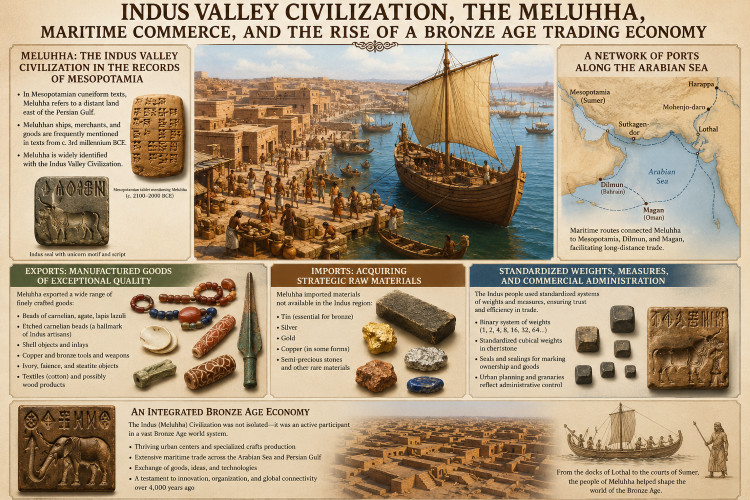 A Network of Ports Along the Arabian Sea
While Lothal remains the most celebrated Harappan port, it was only one component of a broader maritime network extending along the Makran and Gujarat coasts.
Archaeological investigations have identified several coastal settlements—including Sutkagen Dor, Balakot, Kuntasi, and Nageshwar—that appear to have served as important centers of maritime exchange and specialized production.
These ports connected the inland cities of the Indus Civilization with the Arabian Sea through an integrated transportation system. Goods produced in urban centers were transported along rivers and overland routes to coastal settlements, where they were loaded onto seagoing vessels destined for overseas markets.
Excavations at several of these sites have uncovered warehouses, industrial workshops, shell-processing facilities, bead-making industries, standardized weights, seals, and residential quarters. Together, these findings indicate that Harappan ports were carefully organized commercial centers rather than simple fishing villages or temporary anchorages.
The existence of multiple ports also suggests that the Indus maritime economy did not depend upon a single harbour. Instead, it operated through a regional network that increased resilience, facilitated specialization, and strengthened long-distance trade.
Exports: Manufactured Goods of Exceptional Quality
The economic strength of the Indus Civilization rested not only on agriculture but also on highly developed craft industries.
Harappan artisans produced an extraordinary range of manufactured goods that were traded across South Asia and beyond. Among the best-known exports were finely woven cotton textiles—the earliest known examples of cotton production in the world—along with expertly crafted carnelian beads, agate ornaments, shell jewellery, ivory carvings, copper and bronze tools, terracotta vessels, timber products, and finely worked semi-precious stones.
The production of etched carnelian beads demonstrates an especially sophisticated level of technological expertise. Their manufacture required carefully controlled heating, engraving, polishing, and drilling techniques, reflecting remarkable craftsmanship.
Archaeological excavations in Mesopotamia have yielded numerous Harappan-style seals, carnelian beads, shell ornaments, and other artefacts originating from the Indus region. Such discoveries provide compelling evidence that Harappan goods were highly valued in foreign markets and circulated widely across the Bronze Age world.
These exports were not merely commodities; they represented the technological knowledge, artistic traditions, and industrial capabilities of one of the world’s earliest urban civilizations.
Imports: Acquiring Strategic Raw Materials
The Indus merchants were not simply exporters. Their commercial success also depended upon the systematic acquisition of raw materials unavailable within the Indus plains.
Copper, an essential component of bronze production, was imported from Oman (ancient Magan) and neighbouring regions of southeastern Arabia. Lapis lazuli, prized throughout the ancient Near East, reached the Indus cities from mines in present-day Afghanistan. Turquoise, silver, tin, gold, and other valuable minerals were acquired through exchange networks extending into Iran and Central Asia.
These imported resources supplied Harappan workshops, where skilled craftsmen transformed raw materials into finished products of exceptional quality before redistributing them through regional and overseas trade.
This pattern demonstrates a sophisticated economic structure characterized by procurement, manufacturing, storage, transportation, and export—a remarkably advanced system for the third millennium BCE.
Standardized Weights, Measures, and Commercial Administration
One of the most remarkable achievements of the Indus Civilization was the establishment of a highly standardized system of weights and measures.
Archaeologists have recovered thousands of carefully calibrated stone weights from sites spread across more than one million square kilometers. Their remarkable consistency suggests the existence of shared commercial standards throughout the civilization.
Similarly, baked bricks were manufactured according to standardized proportions—typically in the ratio of 1:2:4—while seals, storage facilities, workshops, and industrial installations display comparable levels of standardization.
Such uniformity was unlikely to have emerged by chance. Instead, it points toward sophisticated administrative practices capable of regulating production, commerce, and distribution across an immense geographical area.
Standardized measurements would have increased confidence among merchants, reduced commercial disputes, and facilitated trade between cities separated by hundreds of kilometers. These practices represent one of the earliest known examples of economic standardization in human history.
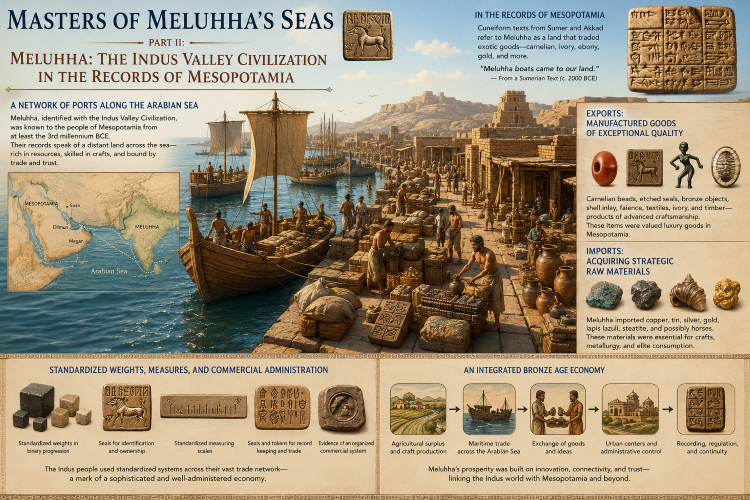 An Integrated Bronze Age Economy
Modern archaeological research increasingly portrays the Indus Civilization as one of the most integrated urban economies of the Bronze Age.
Its cities functioned as manufacturing centers; river systems served as transportation corridors; ports operated as commercial hubs; and maritime routes connected South Asia with distant civilizations across the Arabian Sea and the Persian Gulf.
Rather than functioning as isolated settlements, Harappan cities formed a coordinated economic network characterized by standardized production, efficient distribution, and long-distance exchange.
From a modern analytical perspective, this interconnected system bears similarities to what economists describe as an integrated supply chain. Although the term itself is modern, it provides a useful framework for understanding how raw materials, manufactured goods, merchants, and information moved through the Harappan economy.
The importance of this system extended beyond commerce alone. Long-distance trade also encouraged the exchange of technologies, artistic motifs, administrative practices, and cultural ideas, contributing to the broader interconnectedness of Bronze Age civilizations.
The evidence available today suggests that the Indus Valley Civilization should be understood not merely as an urban culture of remarkable engineering, but as one of the earliest large-scale commercial economies to combine manufacturing, standardized administration, inland transportation, maritime trade, and international exchange into a coherent and enduring economic system.
References (APA 7th Edition)
Chakrabarti, D. K. (1990). The External Trade of the Harappan Civilization. Munshiram Manoharlal.
Kenoyer, J. M. (1998). Ancient Cities of the Indus Valley Civilization. Oxford University Press.
Law, R. W. (2011). Inter-Regional Interaction and Urbanism in the Ancient Indus Valley. Palgrave Macmillan.
McIntosh, J. (2008). The Ancient Indus Valley: New Perspectives. ABC-CLIO.
Possehl, G. L. (2002). The Indus Civilization: A Contemporary Perspective. AltaMira Press.
Ratnagar, S. (2004). Trading Encounters: From the Euphrates to the Indus in the Bronze Age. Oxford University Press.
Wright, R. P. (2010). The Ancient Indus: Urbanism, Economy, and Society. Cambridge University Press.
Vidale, M. (2010). Indus Crafts and Trade Networks. In Connections and Complexity: New Approaches to the Archaeology of South Asia
Read: Part-1
__________________
Dr. Nisar Ahmed Ali Nawaz Solangi is a distinguished Public Health Specialist with over 28 years of experience in primary healthcare, health management, and policy development. Throughout his career, he has served in leadership capacities, He holds MBBS from the University of Sindh and a Master of Public Health from Griffith University, Australia. He is a dedicated polymath committed to the intersection of ancient civilization and emerging technology. He is deeply engaged in the study of the Indus Valley Civilization—focusing on its maritime history, trade networks, and egalitarian governance. Currently based in Saudi Arabia, Dr. Solangi is a tireless advocate for the digital preservation and global dissemination of the Sindhi language and culture. He is actively involved in pioneering initiatives on social media” Our Digital World”. By bridging the gap between historical heritage and digital innovation, he aims to create a new paradigm for cultural representation in the AI era.


تمام بہترین تحریر