There was a time in Sindh when even the smallest milestones of life were wrapped in celebration, meaning, and community spirit.
- Among them is a deeply rooted yet increasingly forgotten ritual, the ceremonial celebration of a young boy’s circumcision.
By Abdullah Usman Morai | Sweden
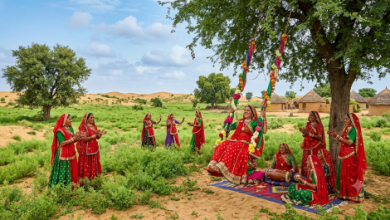
There was a time in Sindh when even the smallest milestones of life were wrapped in celebration, meaning, and community spirit. Some of these traditions still breathe faintly in the rural corners of the province, while others have quietly faded into memory. Among them is a deeply rooted yet increasingly forgotten ritual, the ceremonial celebration of a young boy’s circumcision.
Today, circumcision is largely seen as a routine medical procedure, performed in sterile clinics by trained doctors. It is quick, safe, and often devoid of the cultural richness it once carried. But in the past, particularly in the villages and small towns of Sindh, this event was far more than a necessity; it was a social festival, a rite of passage, and a moment of pride for the family.
The child, usually a toddler, was considered to be a groom.
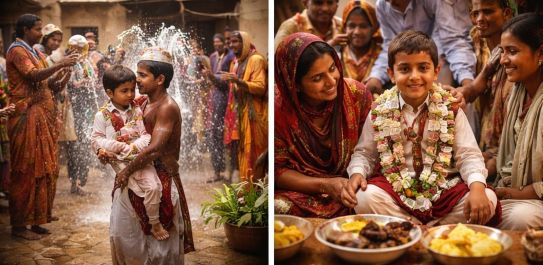
On the day of the ceremony, the young boy would be dressed in traditional attire that symbolized honor and celebration. He wore crisp white clothes, adorned with a Sindhi topi and draped in a vibrant Sindhi ajrak. Around his waist, a red godd (loincloth) was tied, completing a look that mirrored a bridegroom on his wedding day. The transformation was symbolic; it marked his transition into a new stage of life, even if he was too young to understand it.
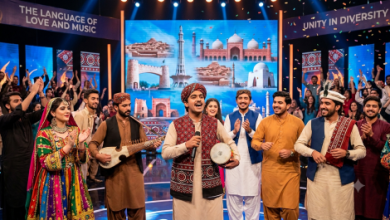
 Before the actual procedure, there was an event known as sargas. This was perhaps the most visually striking part of the ritual. The child would often be seated on the back of a decorated horse and taken around the village or town in a celebratory procession. Family members, relatives, and friends would accompany him, turning the occasion into a public festivity. It was not just about the child; it was about announcing joy, pride, and continuity of tradition to the entire community.
Music, laughter, and chatter filled the air, making the procession even more lively and memorable. Some duhul players beat the drums with rhythmic energy, their sounds echoing through the narrow lanes and open fields. Alongside them, a few men played music from mouth flutes, adding a melodic layer to the celebration. The blend of drumbeats and flute tunes created an atmosphere that was both festive and deeply rooted in Sindhi cultural expression. For the elders, it was a reminder of their own childhoods. For the younger ones, it was a spectacle of color and excitement. And for the parents, it was a moment of both pride and anxiety.
The actual procedure itself was performed not by doctors, but by hajams, traditional barbers who were entrusted with this delicate responsibility. Their role in society extended far beyond haircuts; they were considered skilled practitioners of certain cultural rites.
Yet, what stands out most is not just the act itself, but the emotional choreography surrounding it.
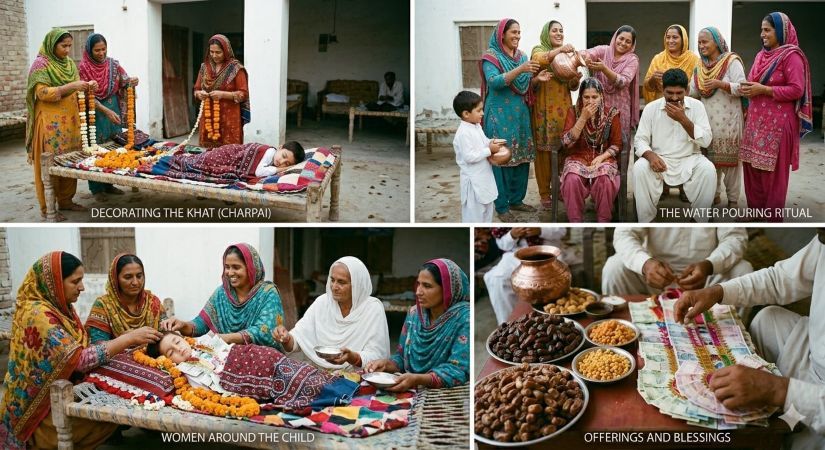
Before the procedure, women of the household, mothers, aunts, and grandmothers would prepare powdered sugar made from rock sugar or thread sugar known as misri. This sweet powder was gently placed in the child’s mouth, perhaps to comfort him, perhaps as a symbolic gesture of sweetness before pain.
Then came a moment that was both tender and strategic.
To distract the child, someone would point toward the wall and say, “Look, there’s a bird!” In that fleeting second of innocence, as the child lifted his gaze in curiosity, the hajam would perform the cut. It was quick, almost invisible in its execution, yet deeply significant in its meaning.
The maternal uncle played a crucial role in this ritual. In many Sindhi traditions, the mama holds a special place, often symbolizing protection and affection. During this ceremony, he would hold the child firmly, ensuring he remained still. After the procedure, it was often the maternal uncle who carried the child back home, cradling him with care and pride. It was as if the responsibility of the child’s well-being momentarily shifted into his arms.
 But the ritual did not end there.
As the child returned home, another curious and vibrant tradition unfolded: water was poured over family members, especially the parents. The origins of this practice are not entirely clear. Was it symbolic purification? A gesture of relief? Or simply an expression of joy? Perhaps it was all of these things combined. Like many cultural rituals, its meaning was felt more than explained.
Meanwhile, guests continued to celebrate.
Hospitality, a cornerstone of Sindhi culture, was on full display. Guests were served sun-dried dates, boondi, and various sweets. In many households, elaborate meals were prepared, turning the event into a feast. Laughter echoed through courtyards, conversations flowed, and bonds were strengthened.
One of the most touching aspects of this tradition was the exchange of money garlands. Relatives would place garlands made of currency notes around the child’s neck, a gesture of blessing and prosperity. In some cases, similar garlands were also given to the parents, acknowledging their role and sharing in their happiness.
These moments were not just ceremonial; they were deeply communal. They reflected a society where individual milestones were collectively celebrated, where joy was multiplied by sharing it, and where traditions served as threads weaving people together.
However, as time moved forward, change became inevitable.
With advancements in medicine and increased awareness of hygiene and safety, the role of hajams gradually diminished. Parents began to prefer doctors and clinical environments, ensuring a safer experience for their children. This shift was not only practical but necessary. Health and safety must always come first.
Yet, in this transition, something intangible was lost.
The color, the music, the shared laughter, the emotional depth, and the cultural essence of the ritual began to fade. What was once a vibrant community event slowly transformed into a private, clinical procedure.
But must it be so?
Progress does not have to erase tradition. It can, instead, reshape it.
There is no reason why the cultural elements of this ritual cannot coexist with modern medical practices. The procedure can be safely performed by doctors, while the surrounding celebrations, the attire, the gathering of loved ones, the rhythmic drumbeats, the melodies of the mouth flutes, the sharing of food, and the symbolic gestures can still be preserved.
Traditions are not static; they evolve. And in that evolution lies an opportunity, not just to remember the past, but to reinterpret it in ways that align with present realities.
In the case of this Sindhi ritual, perhaps what we are witnessing is not its disappearance, but its transformation. In some rural areas, echoes of these practices still linger, carried forward by those who value their cultural roots. In urban settings, they may re-emerge in new forms, adapted yet recognizable.
Ultimately, the question is not whether such traditions should remain unchanged, but whether we are willing to preserve their spirit.
Because in these rituals lie stories of families, of communities, of shared humanity. They remind us that life’s milestones, no matter how small, deserve acknowledgment. They teach us that joy is richer when it is shared, and that culture is not just inherited, it is lived.
And perhaps, somewhere in Sindh, a child still rides a decorated horse, dressed like a groom, accompanied by the beat of drums and the soft music of flutes, surrounded by laughter and love, unaware that he is part of a tradition that refuses to be forgotten.
Read: The Warmth of Sindhi Bonds
________________
 Abdullah Soomro, penname Abdullah Usman Morai, hailing from Moro town of Sindh, province of Pakistan, is based in Stockholm Sweden. Currently he is working as Groundwater Engineer in Stockholm Sweden. He did BE (Agriculture) from Sindh Agriculture University Tando Jam and MSc water systems technology from KTH Stockholm Sweden as well as MSc Management from Stockholm University. Beside this he also did masters in journalism and economics from Shah Abdul Latif University Khairpur Mirs, Sindh. He is author of a travelogue book named ‘Musafatoon’. His second book is in process. He writes articles from time to time. A frequent traveler, he also does podcast on YouTube with channel name: VASJE Podcast.