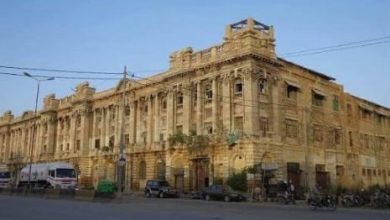
The museum, established at Governor House in Karachi, is a remarkable addition to the cultural and academic landscape of the country, celebrating the rich legacy of the printed word
By Syed Ali Shah
Pakistan’s first Printing Press Museum, established in Sindh Governor House was formally inaugurated by the Provincial Minister Jam Ikramullah Dharejo on 29th October 2025.
The museum project was executed by the former controller of Printing press Faheem Qureshi under the supervision of Dr. Kaleemullah Lashari.
This museum is a remarkable addition to the cultural and academic landscape of the country, celebrating the rich legacy of the printed word. Museums are windows to our past. Just as wildlife museums help to learn about animals that once roamed the earth and personality-based museums preserve the memory of legendary figures such as the Pir Paggara Museum at Pir Jo Goth, this Printing Press Museum offers a unique lens into the history of print culture. It differs from archaeological and general history museums like the National Museum Karachi, because it focuses specifically on the evolution of printing technology and the intellectual history that printing nurtured.
 Around the world, printing press museums hold a special place due to the transformative power of the printed page. Notable examples include: The Gutenberg Museum, Mainz, Germany (One of the world’s oldest printing museums, dedicated to Johannes Gutenberg and home to original Gutenberg Bibles) , Museum Plantin-Moretus, Antwerp, Belgium (A UNESCO World Heritage Site preserving the world’s oldest printing press and the historical house of the Plantin-Moretus family, pioneers in commercial printing), The Printing Museum, Tokyo, Japan (A modern institution showcasing the history and future of printing technology, including calligraphy, movable type, and digital printing) & The British Printing Museum Collections, London, UK (A scattered but historically rich set of archives and exhibits across institutions highlighting printing’s influence on literature, governance, and science).
The Printing Press Museum of Sindh now stands proudly among these prominent institutions, contributing Pakistan’s voice to the global story of printed heritage.
Visitors enter through a spacious lobby designed for reception and relaxation, followed by a dedicated projection room where a documentary introduces the museum and the evolution of printing. The museum experience begins with symbolic reverence: one of the old copies of the Holy Bible, the Holy Quran and Shah Jo Risalo greet the visitor, representing the spiritual, cultural, and literary worlds that printing helped transmit and preserve. A bust of Johannes Gutenberg stands proudly near the entrance, paying tribute to the pioneer of modern printing. Alongside, a detailed display highlights the global history of printing and its development from wooden movable type to mechanized presses. This section also showcases research on the emergence of printing in Sindh, shedding light on the earliest publishers and publications from 1845 to 1947 and beyond. The museum houses an impressive collection of printing machinery ranging from the mid-19th century to modern times where my research work is also published. Two special rooms preserve rare books and old computers, demonstrating the technological bridge between print culture and the digital age. To complete the visitor experience, the museum offers a gift shop, a canteen, and a children’s play area, making it a welcoming place for families, students, and researchers.
The project team of Dr. Kaleemulah Lashari, including Faraz Odho (Architect), Kainat Baloch, Syed Ali Shah (Researchers), Faraz Nazar (Design & Printing), Zulnurain Hyder, Waqas Khan and Muhammed Ali (3D, Designing, Mappings & Documentaries), worked tirelessly to bring this vision to life & team have helped build not only a museum, but a also legacy.
This museum is more than a building with machines. It is a tribute to knowledge, creativity, and the enduring value of the written word. For students, historians, and curious visitors, it serves as a bridge connecting Pakistan’s intellectual past to its bright and informed future.
________________