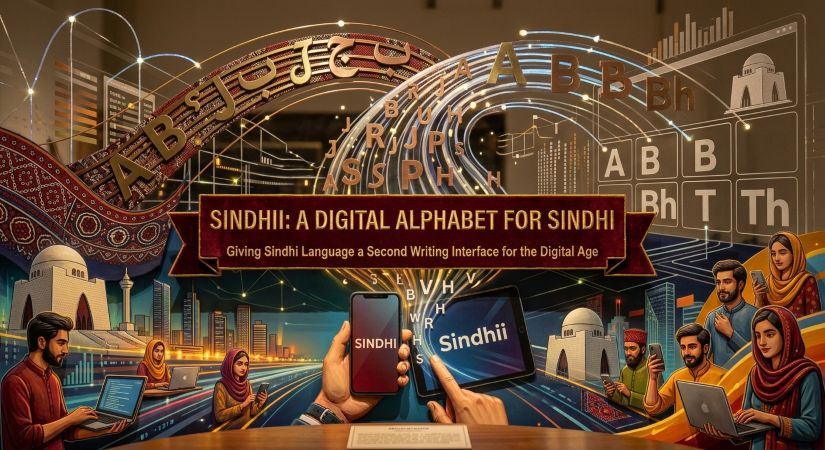
Giving Sindhi Language a Second Writing Interface for the Digital Age
By: Raphic Burdo
Languages survive not merely because people speak them, but because they continue to find ways of expressing themselves in the technologies and institutions of every new age. Sindhi is one of the great classical languages of South Asia. It possesses a rich literary tradition, a distinctive phonological system, a sophisticated vocabulary shaped by centuries of cultural interaction, and a script that carries enormous historical and cultural significance. The Sindhi script used today is not simply a mechanism for recording speech; it is part of Sindhi identity, literature and collective memory. Yet the digital age has created a new challenge.
The problem is not that Sindhi lacks a script. The problem is that Sindhi needs a sufficiently accessible second writing interface for the digital world. This is the problem that Sindhii – A Digital Alphabet for Sindhi seeks to address.
Sindhii is a proposed intelligent digital interface for the Sindhi language, designed to bring Sindhi naturally into the digital age without replacing or diminishing its traditional script. The name combines Sindhi with an additional “i”, evoking the idea of an intelligent interface—much as the “i” in iconic technology products has come to signify innovation and digital connectivity. Sindhii seeks to develop a simple, standardized, QWERTY-compatible way of writing Sindhi that faithfully represents its distinctive sounds while enabling seamless use across phones, computers, social media, education and emerging AI technologies. Its larger ambition is to create a bridge between Sindhi heritage and digital intelligence: preserving the script, expanding access to the language, and making Sindhi fully searchable, teachable, translatable, speakable and AI-ready.
The central proposition of Sindhii is deliberately simple. Sindhii will not replace the Sindhi script. It will complement it. It is a second interface, not a replacement. The existing Sindhi script may remain the principal script of Sindhi literature, education, publishing, cultural expression and formal use. It should be preserved, strengthened and digitized. Sindhii has a different purpose. It is intended to provide Sindhi speakers with a standardized, phonologically faithful, English-keyboard-compatible way of writing Sindhi. In other words, Sindhi would have two complementary writing interfaces. Sindhi script for cultural continuity and formal literacy, and Sindhii for digital accessibility and technological interoperability. The distinction matters. The objective is not to “Romanize” Sindhi in the loose and often inconsistent manner in which people currently write Sindhi using English letters. The objective is to create a designed orthographic system based on the actual sound structure of Sindhi.
Let us elaborate the digital problem. A young Sindhi speaker today can open a phone or computer and communicate instantly in English. English has become deeply embedded in the architecture of digital technology. The QWERTY keyboard, Latin characters, software interfaces, databases, URLs, programming environments and many international communication platforms were designed around the Latin alphabet. Sindhi presents a different situation. A user who wants to write Sindhi properly generally needs access to a Sindhi keyboard or an appropriate Unicode input system. This is entirely possible on modern devices, but it introduces friction. For many users, particularly those who can speak Sindhi but have limited literacy in the Sindhi script, the barrier is even greater.
As a result, millions of Sindhi speakers naturally resort to informal Roman writing. This is not a failure of the speakers. It is a consequence of the technology. People adapt language to the tools available to them. WhatsApp messages, social media posts, text messages and informal digital communication therefore frequently contain Sindhi written in inconsistent combinations of English letters. The same Sindhi sound may be represented by several different spellings, while the same sequence of Latin letters may represent different Sindhi sounds. Such systems are useful for communication, but they are poor foundations for a modern language technology ecosystem.
A language that cannot be represented consistently in a computationally simple form faces disadvantages in search, spell-checking, machine translation, speech technology, language education, corpus development and artificial intelligence. Sindhii is intended to address precisely this gap.
As we move forward, we will realize that Sindhi is particularly suited to a phonological approach. Sindhi is not merely another language that can be casually transliterated into English letters. Its phonological richness makes the task both challenging and intellectually important. Sindhi contains distinctions that are uncommon even among the languages of the Indo-Aryan family, including a remarkable series of implosive consonants, aspirated and breathy consonants, retroflexes and several other contrasts that require careful representation.
A successful digital alphabet must therefore answer a fundamental question. How can the distinctive sound system of Sindhi be represented using the limited character inventory of an ordinary English keyboard without destroying important phonological distinctions? The answer should not be to invent arbitrary spellings. Nor should it require users to type specialized linguistic symbols such as IPA characters or letters carrying numerous diacritics. The challenge is to design an economical ASCII-compatible orthography in which the distinctive sounds of Sindhi can be represented through systematic combinations of ordinary keyboard characters. For example, rather than requiring a user to type specialized phonetic symbols, a carefully designed system could use predictable letter combinations to distinguish related sounds. The essential principle would be: One Sindhi phonological distinction should have one predictable digital representation. This makes the system learnable by humans and usable by machines.
What we are proposing is beyond “Roman Sindhi”. There is already a phenomenon commonly called Roman Sindhi. It is valuable because it demonstrates that speakers want to write Sindhi using Latin characters. But informal Roman Sindhi is generally not a standardized orthography. Different users make different choices. One person may write a particular sound as “aa”; another may use “a”. One may write “kh”; another may use “x”. A retroflex or implosive sound may be represented in several different ways or not distinguished at all. Informal writing evolves organically and serves an important social function. It should not be condemned. But informal transliteration and a digital orthography serve different purposes.
Roman Sindhi allows people to communicate. Sindhii should allow people to communicate and enable machines to understand what they are communicating. That is the difference.
In terms of the design philosophy of Sindhii, it should be built around five principles.
- Phonological fidelity: The system must respect the distinctive sound inventory of Sindhi. If Sindhi distinguishes two sounds, the orthography should not casually collapse them into one symbol merely because English does not distinguish them.
- QWERTY compatibility: Every character required for ordinary Sindhii writing should be available on a Standard English keyboard. The ideal system should require no special keyboard, no special font, no diacritics, no Unicode-only linguistic symbols. A person should be able to type Sindhii on an ordinary English keyboard.
- Systematicity: Related sounds should have related representations. Where possible, the system should allow a learner to understand the relationship between sounds and their written forms. The orthography should therefore behave more like an engineered system than a collection of historical spellings.
- Reversibility: This is perhaps the most important technological principle. Sindhii should be designed so that software can reliably convert legacy Sindhi script into Sindhii, and Sindhii into Sindhi script. The second direction is especially important. If a user types Sindhii, a digital system should eventually be able to reconstruct the corresponding Sindhi-script text with a very high degree of accuracy. This makes Sindhii not simply a writing convention, but a potential language technology layer.
- Simplicity: A successful alphabet cannot be designed exclusively for linguists. It must work for a student, a journalist, a government official, a shopkeeper, a novelist, a social-media user and an elderly Sindhi speaker. The system must therefore minimize cognitive and typing complexity.
 Here, we advocate preservation of Sindhi language through expansion, rather than through replacement. There is sometimes an understandable fear that introducing an alternative script could weaken the existing script. Sindhii should do precisely the opposite. The project should strengthen the Sindhi script by creating an additional pathway into it. Consider a young Sindhi speaker who can speak Sindhi fluently but cannot type the traditional script confidently. Today, that person may write Sindhi using inconsistent Roman spellings. Under the Sindhii model, the person could type standardized Sindhii.. Software could then instantly render the same text in the traditional Sindhi script. The user has not abandoned Sindhi script. The user has been given a bridge to it. This could make Sindhi script more accessible, not less.
The educational potential of Sindhii is substantial. A child who first encounters Sindhi through spoken language could learn spoken Sindhi, then Sindhii, and then Sindhi script as a gradual literacy pathway. Sindhii could function as a bridge between pronunciation and traditional orthography. It could also help Sindhi-speaking children educated primarily through English or Hindi or Urdu regain a functional relationship with their mother tongue. Digital educational applications could display both forms simultaneously: Sindhi script Sindhii, and English meaning. This could be particularly powerful for vocabulary acquisition and early literacy.
Artificial Intelligence, LLMs, Quantum conputing and emerging technologies are the most important reasons to undertake this project. The future of language is increasingly determined by whether a language can participate in computational systems. AI models require enormous quantities of usable language data. Speech recognition requires transcribed speech. Text-to-speech requires linguistic resources. Machine translation requires aligned corpora. Search engines require consistent indexing. Spell-checkers require standardized word representations. Language models require large, clean and diverse datasets. Sindhi has enormous linguistic value, but its digital footprint remains comparatively constrained. A standardized digital alphabet could make it easier to build:
- Sindhi speech-recognition systems
- Sindhi text-to-speech
- Sindhi spell-checkers
- Sindhi predictive keyboards
- Sindhi OCR
- Sindhi machine translation
- Sindhi educational applications
- Sindhi search technologies
- Sindhi AI assistants
- Sindhi digital dictionaries
- Sindhi language-learning platforms
The ultimate objective would be to make Sindhi AI-ready.
We propose a three-layer architecture for Sindhii. Sindhii should ultimately form part of a three-layer linguistic architecture: Sindhi Script, Sindhii, Phonological Representation. The traditional script provides cultural and literary continuity. Sindhii provides human-friendly digital input. The phonological layer provides computational and linguistic precision. This architecture could permit speech, text and script to interact. A person could speak Sindhi. An AI system could recognize the speech. The system could generate standardized Sindhii. The same content could simultaneously be rendered in Sindhi script. A user could edit either representation. The system could preserve the relationship between them. That is the larger technological vision.
We should be clear at the Siddhi is not about English. This is an important conceptual clarification which is necessary at the very outset. Sindhii uses the Latin keyboard, but it does not make Sindhi an English language. The keyboard is merely the input device. The language remains entirely Sindhi. This is analogous to using a computer keyboard to write mathematics, Japanese transliteration, programming languages or scientific notation. The physical keyboard does not determine the intellectual identity of what is being written. Sindhii should therefore be understood as a digital interface, not a cultural substitution. The project should ultimately move beyond the creation of an alphabet. A mature Sindhii initiative could include:
Sindhii Standard: A formally documented orthographic specification.
Sindhii Keyboard: A standard input method for phones and computers.
Sindhii Converter: Two-way conversion between Sindhi script and Sindhii.
Sindhii Dictionary: A searchable lexical database linking Sindhi script, Q-Latin, pronunciation and meaning.
Sindhii Corpus: A large, openly usable collection of standardized Sindhi digital text.
Sindhii AI Toolkit: Resources for developers working on speech, translation, OCR and language models.
In this form, Sindhii becomes a piece of digital public infrastructure for the Sindhi language.
This project must belong to Sindhi society. Such a project cannot be designed by one person sitting at a desk. Linguists can design the phonological framework. Native speakers must test naturalness. Teachers must test learnability. Writers must test readability. Technologists must test keyboard efficiency. AI researchers must test machine interpretability. Students must test usability. Publishers and journalists must test practical applications. And the Sindhi literary and cultural community must have a central role in ensuring that technological modernization does not become cultural dilution. The final standard should emerge from evidence, experimentation and broad consultation.
We are presenting a modest proposition with a large ambition. At first glance, Sindhii may appear to be a relatively small linguistic project: finding a way to write Sindhi using an English keyboard. In fact, it is much more than that. It is about asking whether a major South Asian language can enter the next technological era without surrendering either its identity or its distinctive linguistic structure. The objective is not to choose between tradition and technology. It is to connect them. The Sindhi script carries centuries of memory. Sindhii can provide a new digital interface for the next century. One preserves the past. The other expands the future. Together they can ensure that Sindhi remains not merely a language that is spoken and remembered, but a language that can be typed, searched, taught, processed, heard, translated, modeled and understood by the machines of the digital age. Sindhii is not a replacement for legacy Sindhi script. It is a bridge between Sindhi identity and the digital future. That is the proposition. That is the need. That is the project where we invite experts, scholars, linguists, and phonologists to invest their talent and energies.
Read: Rich Benefit, Others Left Out
_________________
Raphic Burdo is student of Finance, Entrepreneurship, Public Policy, Psychology and Literature. He writes on the intersection of these subjects. He can be approached at RaphicBurdo@gmail.com