No civilization can flourish without its language; thus, the growth of Sindhi and other Indus languages is vital for the welfare of all.
- Let us begin this journey with the movement to recognize Sindhi as a national language, strengthening not only Sindhi but all languages rooted in the Indus/ Sindhu Civilization.
Jagdeesh Ahuja
These days, a narrative echoes everywhere that Iran is not being defeated by the United States and Israel because Iran is not merely a country; it is a civilization, six thousand years old civilization, the civilization of Persia, which once ruled over us as well. Before British rule, Persian was the official, literary, and scholarly language of Sindh and Punjab. To break free from this intellectual subjugation, the great Sindhi poet Shah Abdul Latif raised a silent rebellion.
In defiance of prevailing norms, Shah Latif composed his entire poetry in Sindhi instead of Persian, and went further to openly declare:
“جي تون سکئين فارسي، گولو تون غلام.’
“If you learn Persian, you become a slave.”
Shah Latif understood that the Sindhi language is the language of a great civilization, one whose foundation rests upon hard work, craftsmanship, and trade. Throughout history, various invaders have attacked its freedom, progress, and culture, yet Sindh has always absorbed them into its own civilizational stream, preserving the grandeur of the Indus/Sindhu Civilization.
One of the most remarkable features of the Sindhu Civilization is that its people never invaded others. From Mohenjo-daro to Rakhigarhi, among hundreds of archaeological sites, not a single one has yielded weapons of war, massacre, or organized violence. The Sindhu Civilization stands as a unique example in human history, demonstrating that a civilization can flourish without war, violence, armies, kings, or weapons. In fact, a truly humane and peace oriented civilization is one whose spirit is rooted in the welfare and prosperity of all humanity.
Echoing this spirit, Shah Latif says:
“O my Lord, bestow* *prosperity on Sindh forever,”
O my beloved friend, shower blessings on the entire world.”
Nations, civilizations, individuals, and families all go through cycles of rise and fall. The great Sindhu Civilization and its language have also experienced many such phases, yet each time they re-emerge in renewed forms. The present era, too, marks a rebirth of the Sindhu Civilization. Its new rise starts in 1922 with the excavation of Mohenjo-daro, which revealed ancient origins of Sindhu Civilization to the world.
Today, from Harvard to Hind, leading researchers are studying the DNA of an Indian woman of Sindhu Civilization discovered in a grave at Rakhigarhi, demonstrating that the creators of the Indus/Indian/Sindhian Civilization were its own inhabitants. The Indus valley genetic heritage is now widely recognized as a scientific reality in South Asian research.
Yet one mystery still challenges scholars, the origin of the Sindhi language, the language of Mohenjo-daro, the ancient Sindhi language and script. Ironically, more research is being conducted on it outside Sindh than within. Sindh itself appears absent from the global research landscape, a result of historical upheavals, invasions, betrayals, and the trauma of partition. Nevertheless, Sindh will rise again and rediscover the roots of its language.
What, then, is our responsibility?
Guiding us, Shah Latif, through the voice of Sassui, says:
“My beloved will come on his own,
but let me also take a step forward,
Lest he say I made no effort.”
Here, Shah Latif not only teaches us to promote Sindhi among both the masses and the elite but also urges us to undertake the tough journey like Sassui crossing mountains in search of her beloved.
The Sindhi language did not vanish with the decline of Mohen jo Daro alone; it was trampled under the hooves of successive invaders. Yet its Indus essence, the essy of Sindhu Civilization ensured that it was reborn after every fall.
The most devastating blow to Sindh, its language, and civilization came in the 8th century with the Arab conquest. This severed Sindh’s connection with its ancient literary past, so completely that today not a single scholar in Sindh can read the ancient form of the language.
It is deeply ironic that after the Rig Veda, one of the oldest texts of the region, the first historical account we are taught about Sindh is Tuhfat-ul-Kiram, a chronicle of conquests. We know almost nothing about the literature, administrative language, script, or educational texts of the Rai dynasty, Chach, or Raja Dahir. It is as if Sindh had no language or literature before 712 CE.
Modern Sindhi literary history largely begins after Arab and Persian influence. While traces of Sindhi in Devanagari survive in merchant records only. In the landscape of Sindhi language and literature Persian influence is apparent everywhere. It was later poets of eighteenth century, Shah Latif, Sachal Sarmast, and Sami, who brought Sindhi back to its roots. Earlier still, during the Samma period, poets like Qazi Qadan appear.
However, adopting the Perso-Arabic script led to a major loss, it disconnected Sindhi from the linguistic, cultural, and literary traditions of the broader Indian subcontinent, with which it had long been intertwined.
After 712 CE, Sindhi’s official revival came in 1852, when British administrators in Sindh replaced Persian with Sindhi as the official language and required their officers to learn it. This period of official growth lasted until 1947. Thereafter, Sindhi entered a new phase of struggle, deprived of state patronage but preserved in the hearts of its people.
A movement for recognition emerged. While Sindhi was not declared a national language in Pakistan, it gained recognition in India, where displaced Sindhis worked to secure its status. On April 10, 1967, Sindhi was officially recognized as one of India’s national languages through a constitutional amendment.
In contrast, even the 1973 Constitution of Pakistan did not grant Sindhi national language status, despite being presented by a Sindhi Prime Minister Z. A. Bhutto, a legacy that continues to this day.
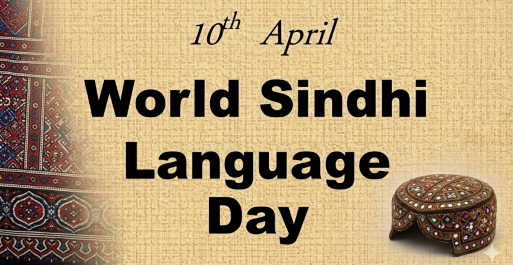
In this historical context, just as February 21 is celebrated globally as International Mother Language Day, April 10 should be recognized as World Sindhi Language Day, the day Sindhi received official recognition. Sindhis worldwide should unite to declare this day and renew their struggle for recognition of Sindhi as a national language in Pakistan also.
Language binds a nation beyond all divisions. If Sindhis across the world raise their voice together on April 10, demanding recognition of
“Sindhi Language as a National Language”, then achieving this goal is not impossible.
Today, the world is engulfed in violence, conflict, and crises. At such a time, ‘the Sindhu civilizational philosophy of world peace, unity of humanity, and collective progress’ (امن عالم اتحاد انساني ترقي بني آدم) propounded by G M Syed، the great, is not only essential for Sindh but for all humanity. No civilization can flourish without its language; thus, the growth of Sindhi and other Indus languages is vital for the welfare of all.
Let us begin this journey with the movement to recognize Sindhi as a national language, strengthening not only Sindhi but all languages rooted in the Indus/ Sindhu Civilization.
Let all Sindhis across the world declare April 10 as Global Sindhi Language Day and raise their voice:
“Sindhi Language is a National Language.”
Read: The Future of Sindhi Language
___________________
 Hailing from Larkana, Jagdeesh Ahuja is based in Karachi, Sindh. Politics, history, international relations, and philosophy are his areas of interest. He is a columnist and author of several books. Additionally, he is the founding president of the Sindhu Vas Foundation and a leader of the Sindh United Party. He played the lead role in the documentary film Still Standing (‘اڃان بہ قائم’), produced by the British company Pinch Media, which focuses on Sindh and the Sindhi community.