

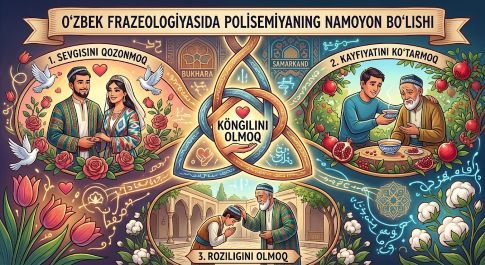
Analyzing the manifestation of polysemy in phraseological units, its role in the language system, and its functional possibilities.
Otaxonova Nodira Farxod qizi
Polysemy is the phenomenon in which one word or linguistic unit has several related meanings.
The term polysemy is derived from the Greek words poly (many) and sema (meaning), and refers to the property of a word having multiple meanings.
For example: The Uzbek word “oyoq”:
– “a body part belonging to a human being” — leg/foot;
– “the legs of furniture” — table legs.
All of these meanings originate from the same root, but they express different meanings depending on the context. This phenomenon makes language more concise and rich, because it is not necessary to create a separate word for every new object or concept. Polysemy often arises through metaphor or metonymy. It should not be confused with homonymy. Homonymy refers to words that have the same form but completely unrelated meanings. For example, in Uzbek, “olma” (fruit) and “olma” (the negative imperative form of the verb olmoq, “to take”) are homonymous words because their meanings are unrelated. Polysemy, however, is a phenomenon in which meanings are logically interconnected.
PHRASEOLOGY
Phraseology is one of the most interesting branches of linguistics, reflecting the worldview, way of life, and patterns of thinking of a people. In general, phraseology (from the Greek phrasis — “expression” and logos — “doctrine”) studies fixed expressions in a language and the characteristics of their formation. Expressions in every language consist of combinations of two or more words. However, the words in such expressions lose their direct meanings and, as a whole, acquire a figurative meaning. Such combinations are widely used in speech to increase its emotionality and expressiveness.
In linguistics, phraseological units are divided according to their semantic relationships into phraseological fusions, phraseological unities, and phraseological combinations. “In order to identify the patterns of manifestation of polysemy in Uzbek phraseology and draw conclusions about their linguistic nature, we analyze the semantic layers of several active idioms that are widespread in the speech of our people and possess multifaceted semantic characteristics from a semantic-pragmatic perspective.”
- “To raise someone to one’s head”
“The hosts warmly welcomed the unexpected guest and treated him with the greatest respect.” To raise someone to one’s head — to show a person extreme respect, honor and appreciation, to value them highly, and to demonstrate great esteem toward them. “As soon as the teacher left the room, the students raised the whole classroom to their heads.” To raise to one’s head — to make a great deal of noise, create a commotion, cause disorder, and disturb peace and order.
- “Invisible to the eye”
Before us lay an endless, boundless desert and green hills stretching as far as the eye could not see.” Invisible to the eye — very distant, endless, boundless, or an area whose end cannot be seen. “Dust and tiny particles that were invisible to the eye were floating in the air.” Invisible to the eye — extremely small or tiny, something that cannot be noticed or seen with the naked eye.
- “It was someone’s turn to speak”
“During the negotiations, it finally became the turn of the young specialists to speak as well.” It was someone’s turn to speak — to be given the opportunity, turn, and right to speak at a meeting or gathering. “Because he failed to complete the assignment on time, he was reprimanded at today’s meeting.” It was someone’s turn to speak — to receive a reprimand from elders or superiors, to be blamed or criticized because of a mistake or shortcoming, and to be put to shame.
- “To be struck dumb”
“After working hard all day, the farmer lay down and immediately fell into a very deep sleep.” To be struck dumb — to fall into a very deep sleep, becoming motionless and entering a deep sleep due to exhaustion or unconsciousness.
“Seeing such courage, everyone in the gathering was struck dumb.” To be struck dumb — to be extremely astonished by an unexpected event, piece of news, or scene, becoming speechless and stunned.
- “For one’s soul to leave”
“After a serious illness, the patient passed away in the hospital.” For one’s soul to leave — to die, pass away, depart from this world, close one’s eyes to life, or for the soul to leave the body. “Seeing his father’s inappropriate behavior, the father became extremely angry.” For one’s soul to leave — to become extremely angry, to lose one’s temper, or to become so furious that one can no longer control oneself.
CONCLUSION
In conclusion, polysemy in phraseological units, unlike lexical polysemy, is directly connected with human figurative thinking, the reinterpretation of situations, and cognitive abilities. The examples analyzed demonstrate that polysemy is mainly formed through the mechanisms of metaphor and metonymy, whereby secondary psychological, emotional, and social layers of meaning develop from primary physiological or action-related meanings. The fact that the meanings of a polysemantic phraseological unit are not completely separate from one another, but retain a common semantic root connecting them, is the main criterion distinguishing this phenomenon from homonymy. The speech situation and pragmatic factors, in turn, are the main factors determining which meaning of a phraseological unit becomes activated.
In general, phraseological polysemy demonstrates the rich and flexible linguistic potential of the Uzbek language and shows how the worldview of the Uzbek people is multifacetedly reflected in linguistic units.
REFERENCES
- Collection of Lectures on the Uzbek Language — Nargiza Erkaboyeva. Tashkent, 2021.
- Phraseological Units of the Uzbek Language — A. G‘ulomov.
- Theory and Practice of Phraseology — Sh. Rahmatullayev.
- Phraseological Dictionary of the Uzbek Language — N.G‘. Rahimov, S.S. Sirojiddinov.
- Phraseological Units and Their Meanings — H. Jumaboyev.
- Theory of Linguistics — Zulxumor Xolmanova. Tashkent, 2020.
Read: Culture’s Impact on Identity and Language
______________________
 Otaxonova Nodira Farkhod kizi, born in Shavat district, Khorezm region, is 2nd-year student at the Faculty of Uzbek Philology, Karakalpak State University.



The Uzbek words featured in your article are beautifully contextualized, and the accompanying explanations are remarkably clear. It is a highly educational and linguistically enriched piece. I deeply look forward to reading more articles like this from you in the future, as they represent a truly significant contribution to Sindhi linguistics. Kudos to Imdad Odho for the Sindh Courier platform for beautifully connecting continents through language.
Sindh Courier is not owned by Imdad Odho. It is run by Nasir Aijaz.
The Uzbek words featured in your article are beautifully contextualized, and the accompanying explanations are remarkably clear. It is a highly educational and linguistically enriched piece. I deeply look forward to reading more articles like this from you in the future, as they represent a truly significant contribution to Sindhi linguistics. Kudos Imdad Odho for the Sindh Courier platform for beautifully connecting continents through language.
Sindh Courier is not of Imdad Odho. It is of Nasir Aijaz. Sindh Courier is the first and only online media platform having the writers and readers from around the world.