Ancient Crafts Meet Modern Recognition
Uzbekistan turning its Bazaars into a National Strategy

Exploring Uzbekistan’s strategy of leveraging its rich artisan culture for modern economic development and regional inspiration.
Uzbekistan government has built a deliberate policy linking cultural tourism to the survival of traditional crafts — registering artisans along tourist routes, funding trade houses abroad to sell their work, and treating handmade heritage as an economic asset rather than mere scenery for visitors.
Amonboyeva Shahnoza | Uzbekistan
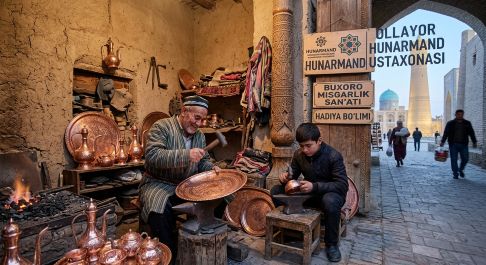
Walk through the old town of Bukhara in the early morning, before the tour groups arrive, and you’ll find the coppersmiths already at work. The hammering starts around seven. By nine, the alleys near Kalyan Minaret smell of hot metal and fresh chai, and the same families who have been shaping trays and ewers for generations are setting out their morning stock. What’s changed in the last few years isn’t the craft itself — it’s who’s paying attention to it.
Uzbekistan has quietly built one of the more interesting experiments in cultural policy in Central Asia: using tourism not just to bring in foreign currency, but as a deliberate lifeline for artisans who might otherwise have seen their trades die out with them.
The mechanics of it are less romantic than the result. A government decree created something called the “Hunarmand” association — essentially a registry of working craftspeople, from carpet weavers to woodcarvers to embroiderers, tied to specific tourist routes. If you run a workshop along a route that tourists actually walk, or if you sell through recognized galleries and craft centers, you can get onto that registry. Once you’re on it, doors open: the Chamber of Commerce, the Ministry of Culture, and the tourism committee start steering resources your way, and diplomatic missions abroad are tasked with helping showcase and sell your work in foreign markets.
It sounds bureaucratic, and it is. But the intent behind it is worth sitting with. For a long time, the handmade objects that define places like Bukhara, Samarkand, and Khiva were treated as backdrop — pretty things tourists photographed on their way to see a mosque or a madrasah. The newer approach treats them as the point. Trade houses are being set up abroad specifically to sell Uzbek craftwork. Embassies are asked to help artisans find buyers in the cities where they’re posted.
There’s a hard economic logic underneath the cultural sentiment, too. Researchers studying global tourism patterns have pointed out that a majority of the world’s most visited destinations build their appeal around heritage sites and traditional craft centers — people don’t just want to see old buildings, they want to bring something home that was made by a human hand in that place. A hand-knotted rug from Bukhara or a piece of suzani embroidery from the Fergana Valley carries a kind of authenticity that no souvenir shop trinket can fake. Uzbekistan’s tourism numbers have been climbing fast enough that the government set a target in 2025 to sharply increase visitor arrivals over the following two years, and craft tourism is one of the pillars they’re leaning on to get there.
What I find genuinely encouraging is who benefits. The stated aim isn’t abstract “cultural preservation” — it’s explicitly about pulling women, young people, and low-income families into paid craft work. In a region where unemployment among youth is a real and persistent problem, a policy that says “we will help you sell what you make” is a different kind of intervention than the usual subsidy or training program. It respects skills that already exist rather than trying to retrain people into something new.
There’s also a broader regional lesson here, one that might resonate with readers in Sindh and across Pakistan, where similar tensions exist between preserving traditional crafts — ajrak printing, truck art, Sindhi embroidery — and the pressures of modernization and mass production.
None of this is without friction. Mass tourism has a way of flattening whatever it touches — there’s always a risk that “craft for tourists” drifts into cheap reproduction, that the object stops being made for its own sake and starts being made only for the camera. Anyone who has walked through an overly commercialized tourist market anywhere in the world knows what that decline looks like. Uzbekistan’s planners seem aware of the risk, which is presumably why the registry system tries to keep the connection between a specific artisan, a specific workshop, and a specific piece of work — rather than letting craft tourism become anonymous and industrial.
There’s also a broader regional lesson here, one that might resonate with readers in Sindh and across Pakistan, where similar tensions exist between preserving traditional crafts — ajrak printing, truck art, Sindhi embroidery — and the pressures of modernization and mass production. The Uzbek model doesn’t solve that tension, but it does suggest a direction: treat the craftsperson as an economic actor worth investing in, not a museum piece to be photographed and left alone.
Samarkand hosted UNESCO’s General Conference last year, drawing thousands of delegates from nearly 190 countries — a fairly clear sign that the country is positioning its cultural heritage as a serious diplomatic and economic asset, not just a tourist attraction. Whether that translates into lasting income for the people actually making the carpets and the woodwork, rather than just better branding for the country as a whole, is the question worth watching over the next few years.
For now, though, the coppersmiths in Bukhara are still hammering every morning. The difference is that someone in Tashkent is finally counting how many of them there are, and trying to make sure there are more tomorrow than there were yesterday.
Read: The Architecture of Memory
________________
 Amonboyeva Shahnoza is student at the Urgench State University, faculty of computer engineering.