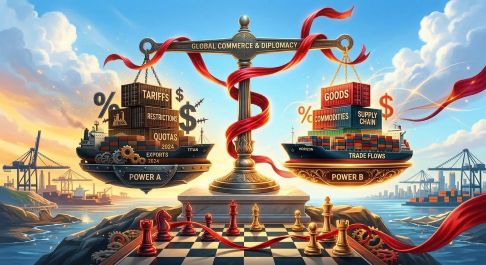
While the recent summit between Donald Trump and Xi Jinping yielded few concrete agreements, its true significance lay in the powerful diplomatic messages conveyed through protocol, optics, and underlying economic leverage.
By Tom Arms | London
Donald Trump met Xi Jinping this week. Little of substance was agreed. But the meeting itself was of considerable substance.
The symbols of protocol send powerful messages. Where people meet. The color of the carpet. The body language and the strength of the hand clasp and the sincerity of the smile can set a diplomatic agenda for years to come.
The Xi-Trump Summit was all about diplomatic signals. Trump’s messages were clear from the red carpet to the flyover to the state banquet, he was telling Xi: We respect you. We need you.
Xi, on the other hand, arrived knowing that several cards that Trump wanted were in his hand.
The fact is that Trump’s tariffs backfired. The International Monetary Fund (IMF) reported that since early 2025, Chinese imports from the US—especially the politically important agricultural products—have fallen by 15 percent. But the amount it has imported has remained relatively stable as China replaced American imports from elsewhere.
Read: Trump-Xi Summit Ends With Tea and Tour but Little Visible Policy Progress
Trump went into this week’s summit wanting China to buy more from America. Xi arrived having demonstrated that China could buy less from America without any bad consequences.
And the tale from the other side of the trade coin—exports—is even more lopsided. According to the World Trade Organization (WTO) the loss of the US market created by tariffs was more than offset by trade with other countries. Tariffs caused Chinese exports to the US to drop by $105 billion. Chinese exports to other parts of the world increased in 2025 to $301 billion.
Nor does the fall in direct Chinese exports necessarily mean that fewer Chinese-made products reached American consumers. Some Chinese manufacturers have responded by shifting production and intermediate-input trade to Vietnam, Mexico and other countries, allowing supply chains to be rerouted around the tariffs.
According to Reuters, more than half of the roughly 6,500 product categories that China sells to the US were actually showing higher imports in 2926 than in 2025.
Trump’s tariffs have accelerated a diversification of Chinese manufacturing and trade patterns that makes future American tariffs less threatening.
Trade is Trump’s favorite topic. He is the transactional president. But it was not the only item on the agenda. Iran, Ukraine and Taiwan also made an appearance. Once again, Xi held all the cards—except as regards Taiwan.
The Chinese leader has relationships with both Russia and Iran that Trump would like him to use. Trump asked him to do so. Xi was all smiles and made reassuring diplomatic noises, but offered no commitments.
Taiwan is the one issue where the US has the better hand. Xi wanted a commitment that the US would not support Taiwan declaring itself a separate independent nation. The obvious temptation for a transactional president would have been to trade something on Taiwan for Chinese help on Iran or Ukraine. He didn’t.
Diplomatic custom dictates that, at some point, President Xi will have to reciprocate with a state visit to China. When it happens, it will be worth watching the length of the red carpet—and the composition of the Chinese delegation waiting at the bottom of the aircraft steps.
Read: Observations of an Expat: Canada
_________________
 Tom Arms is foreign editor of Liberal Democrat Voice. He is also a regular contributor to “The New World” and lectures on world affairs. He is the author of two editions of “The Encyclopedia of the Cold War,” “World Elections on File,” “America Made in Britain” and “The Falklands Crisis.”