Hormuz to Bab el-Mandeb: A Burning Sea — The Middle East War and a Warning Bell for Pakistan
- Middle East war shows that in today’s world no country is safe from another’s fire.
- The spark from the seas of Hormuz and Bab el-Mandeb is reaching the farmer of Ghotki, the laborer of Karachi, and the Sindhi worker sitting in Riyadh.
Fida Hussain Malik
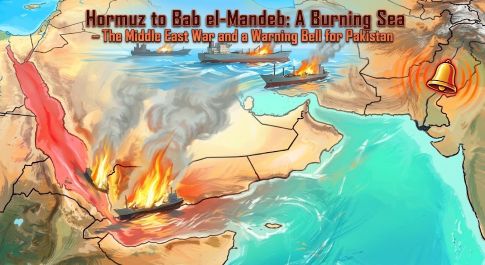
The Middle East is burning in a fire whose heat is already being felt from Karachi’s port to the petrol pumps of Ghotki. More than seven months have passed since the war that the United States and Israel launched against Iran on 28 February 2026, yet peace remains distant. On one side, Iran is not ready to loosen its grip on the Strait of Hormuz. On the other, Yemen’s Houthis have reached the shores of Bab el-Mandeb, and their war with Saudi Arabia has flared up again. The world’s two great energy gateways are standing on piles of gunpowder. This is not someone else’s quarrel in a far-off country. It is a question of our economy, of the livelihoods of our workers in the Gulf, and of the fire in our own kitchens.
The roots of this war are old. Distrust between the United States and Iran has run on since the Iranian Revolution of 1979. In the twelve-day war of June 2025, Israel badly damaged Iran’s air defences, and the United States also bombed the nuclear facilities at Fordow, Natanz and Isfahan. According to Encyclopedia Britannica, about 900 strikes were carried out in the first twelve hours on 28 February, in which Iran’s Supreme Leader, Ayatollah Ali Khamenei, was killed. Iran answered by targeting American bases and oil installations in Saudi Arabia, the United Arab Emirates, Qatar, Kuwait, Bahrain, Iraq, Oman and Jordan.
Pakistan’s role in this crisis has been distinctive. Through Pakistani mediation, a ceasefire was reached on 7 and 8 April, and on 11 and 12 April talks were held in Islamabad between US Vice President J. D. Vance and Mohammad Baqer Qalibaf, Speaker of the Iranian Parliament. When those talks failed, the United States imposed a naval blockade on Iranian ports. Then, on 17 June, President Trump, Iranian President Masoud Pezeshkian, and Prime Minister Shehbaz Sharif as mediator signed the fourteen-point Islamabad Memorandum. It promised a ceasefire on all fronts, the opening of Hormuz, and a final agreement within sixty days. But, according to Al Jazeera, vague wording allowed both sides to interpret the Hormuz clause in their own way. After the Islamic Revolutionary Guard Corps attacked commercial ships in July, Trump declared the agreement dead and the blockade was reimposed.
Iran’s internal condition is also severe. According to The New Arab, inflation in Iran reached 73 per cent in September, and the rial fell to 2.7 million against one dollar. Tehran’s tone, however, remains hard. On 4 October, Qalibaf said Hormuz would not open until Iran’s seven conditions, based on the Islamabad Memorandum, were met. The United States has sent its reply through Qatar.
At this moment, the Strait of Hormuz is the real center of the war. According to the US Energy Information Administration, an average of 20 million barrels of oil a day passed through it in 2024 — about 20 per cent of the world’s total oil use — and roughly a fifth of the world’s liquefied gas also moved through the same passage. After the war, commercial traffic there fell by more than 90 per cent. The International Energy Agency says that in August only 7.6 million barrels a day passed through Hormuz, about 13.1 million barrels below the pre-war level. The danger has not ended. According to the conflict monitor ACLED, Iranian attacks affected 21 ships in September, against 12 in August. In the week from 28 September to 4 October, ships transiting Hormuz fell from 203 to 157.
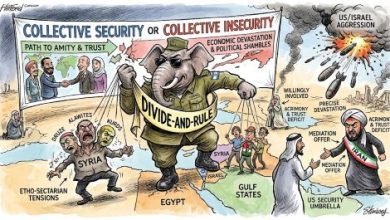
Israel and the United States started this war, but for Saudi Arabia and the Gulf states it is a severe test. A Reuters analysis says the Saudi–Iran reconciliation brokered by China in 2023 has all but collapsed in this war. After Hormuz closed, Saudi Arabia diverted its oil through the East–West pipeline to the Red Sea port of Yanbu, and daily exports from there rose from about 1 million barrels to 4.9 million. On 10 and 11 September, however, that pipeline was hit by drone attacks. Analysts say that after it restarted late in September, only 2.2 million barrels a day were coming out, against 5.5 million before the strikes.
Yemen’s tragedy is the most painful part of this war. The Houthis began attacking ships in the Red Sea in November 2023 and, according to the Africa Center for Strategic Studies, carried out about 530 attacks in two years. On 20 July 2026 they announced a naval blockade of Saudi Arabia, and the ceasefire in place since 2022 effectively broke. On 11 August, four crew members were killed in a ballistic-missile attack on the cargo ship Tahama in Bab el-Mandeb. On 10 September the Houthis seized Mocha and, according to reports, reached Perim Island in the middle of the strait the next day. On 4 October the Saudi-backed Yemeni government launched a major military campaign against the Houthis.
Ordinary Yemenis are paying the price. According to the UN agency OCHA, 22.3 million people in Yemen need humanitarian aid in 2026, including 5.2 million displaced people. Some 18.3 million face severe food insecurity, and more than 2.2 million children under five are acutely malnourished. Aid agencies have appealed for $2.16 billion.
Bab el-Mandeb is only 32 kilometers wide, yet about 30 per cent of the world’s container traffic and about 12 per cent of global trade used to pass through it. Before October 2023, an average of 80 ships a week transited the strait. After the fresh attacks of July 2026, that number fell to 25 a week. After the attacks of 2023 and 2024, insurance premiums rose from 0.1 per cent of a ship’s value to between 0.7 and 1 per cent. Revenue from Egypt’s Suez Canal was $10.2 billion in 2023 and fell to $3.9 billion in 2024.
On one side, the United States wants to bring Tehran to its knees through blockade and new sanctions. On the other, Iran has written a new chapter in its history of resistance. According to The New Arab, the Pentagon had spent more than $45 billion on this war by mid-September. China pressed Tehran for the April ceasefire. Russia condemned the attacks but did not enter the field to help Iran; instead, in March it earned about $150 million a day extra from higher oil prices. Israel reopened the war against Hezbollah in Lebanon, in which, according to Al Jazeera, at least 3,000 people were killed. Under the cover of global interests, every power is calculating its own advantage, and the loss is falling on ordinary people.
The oil market is the direct casualty of this war. Before the war, Brent crude was about $70 a barrel. On 31 March it reached $118.35, the high for the year. On 5 October Brent closed at $100.32, about 65 per cent above the start of the year.
For Pakistan these are not figures in a game. They go straight into the household budget. Our petroleum import bill from March to July 2026 was about $7.7 to $7.9 billion, roughly $1.3 billion higher than the same period last year. In April, Prime Minister Shehbaz Sharif said the weekly oil bill had been about $300 million before the war and had risen to $800 million. Petrol that cost Rs.266.17 a liter before the war was Rs.387.54 on 30 September — about 46 per cent dearer. For a Sindh farmer that means costlier diesel for the tractor and the tube well; for the transporter, higher freight; for the ordinary person, dearer flour, vegetables and medicine. In September, national inflation stood at 10.26 per cent.
Our other great link with the Gulf is remittances. According to the State Bank, Pakistan received a record $41.6 billion in remittances in 2025–26. Of the $3.66 billion that arrived in August 2026, Saudi Arabia sent $870 million and the UAE $750 million, first and second place — about 44 per cent of all remittances from those two countries alone. If attacks on Saudi cities and oil installations increase, the Gulf job market can shrink, and thousands of households across the country, including Sindh, whose kitchens burn on that money, will be hit directly.
The most delicate turn is that Pakistan is no longer only a mediator. On 7 August a defence pact was signed in Makkah among Pakistan, Saudi Arabia and Turkey, under which an attack on one will be treated as an attack on all three. On 5 October, an emergency meeting of that alliance in Riyadh decided that forces and capabilities would soon be stationed in Saudi Arabia. Defence Minister Khawaja Asif says Pakistan’s role is for now limited to support and monitoring, and that combat operations are being carried out only by the Saudi military. It should be remembered that in April 2015 our parliament, by a unanimous resolution, chose to stay neutral in the Yemen war so that Pakistan could play a diplomatic role for peace.
Three scenarios stand before us in the coming months. First, a new understanding on the basis of the Islamabad Memorandum, through the efforts of Qatar and Pakistan, with Hormuz opening in stages and oil becoming cheaper. Second, the present grinding war continues, with scattered attacks on tankers, expensive insurance, and oil around $100 becoming the world’s new normal. Third, and most dangerous, a larger war starts again and the war in Yemen closes Bab el-Mandeb as well. In my view the second is the most likely, because the United States cannot secure its aims by force alone, and Iran cannot endure a long war under blockade — yet the deficit of trust keeps both away from a settlement.
In this situation Pakistan urgently needs the following steps:
- Keep the mediating role alive, and meet the commitment to Saudi defence with diplomatic balance, so that Pakistan does not become a party to someone else’s war.
- Take any decision on a military role only after an open debate in parliament.
- Increase strategic oil reserves and look for alternative sources of import.
- Invest in local resources such as solar, wind and Thar coal, and reduce dependence on imported oil.
- Prepare an emergency plan for the protection of Pakistanis working in the Gulf, and for their return if needed.
- Strengthen targeted subsidies for farmers, transporters and the poor, and a system for monitoring freight charges.
- Start a flow of Pakistani humanitarian aid for Yemen’s famine-stricken people.
This Middle East war shows that in today’s world no country is safe from another’s fire. The spark from the seas of Hormuz and Bab el-Mandeb is reaching the farmer of Ghotki, the laborer of Karachi, and the Sindhi worker sitting in Riyadh. Pakistan’s real strength is not in collision, but in being a bridge. If we play our part with wisdom, Islamabad can become a center of peace. Otherwise, the burden of other people’s wars will have to be carried by our next generations.
Read: Flawed Policies Stifle Sindh’s Educators
_______________
 Fida Hussain Malik is MPhil Scholar, Primary School Teacher, and Defence & International Relations Analyst, based in Ghotki, Sindh. Email: fhmalik2004@gmail.com