A Serious Social Question…
Has the praise of women’s beauty overshadowed their other talents?

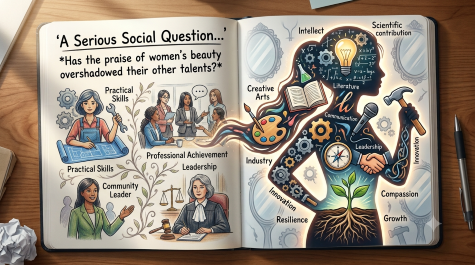
We must teach girls to inhabit something larger than the mirror. Tell her she is beautiful, but also tell her that she is capable. Tell her that her questions matter.
By: Ramesh Raja
For centuries, human civilization has been remarkably eloquent about the beauty of women and remarkably restrained about the depth of their being. We have written endlessly about her eyes, her hair, her lips, her complexion and the contours of her body. Poets have turned her face into metaphor, painters into an object of aesthetic contemplation, musicians into a song, and writers into a recurring symbol of desire, tenderness and perfection. Entire traditions of literature have been built around the woman as muse, beloved and beauty to be admired. Yet somewhere within this celebration lies a profound cultural omission: we have often praised the appearance of a woman more passionately than the qualities that make her a complete human being.
We have described the brightness of her eyes, but rarely the vision within those eyes. We have praised her lips, but seldom the courage with which she speaks. We have celebrated the softness of her body, but rarely the strength of her character. We have admired her beauty in youth, while giving far less attention to the wisdom, resilience and intellectual richness that experience can bring with age. When did we last write an ode to a woman’s courage with the same devotion with which we wrote about her beauty? When did we call her intellect beautiful, her independence beautiful, her moral courage beautiful, her capacity to survive failure beautiful? The absence of such praise is not merely a literary deficiency. It has gradually become a social education.
A child learns not only from what adults teach, but from what they repeatedly notice. If a girl is constantly told that she is beautiful, while her curiosity, intelligence, imagination, courage and judgment pass almost unnoticed, she may eventually come to understand herself through the same narrow mirror that society has placed before her. She learns that appearance is something to protect, improve and preserve, while her deeper capacities become secondary. The problem is not that we tell women they are beautiful. Beauty deserves appreciation. The problem is that we have too often allowed beauty to become a substitute for recognition. When one quality is praised disproportionately for generations, society should not be surprised when that quality becomes central to the identity of those being praised.
This is why the question is larger than beauty itself. It is about the power of recognition. Human beings tend to grow toward the qualities that are seen and valued in them. Praise a child for asking difficult questions and curiosity becomes a habit. Trust a young person with responsibility and responsibility develops into confidence. Honor courage and courage acquires social meaning. But if a woman is principally rewarded for being pleasing to the eye, society quietly teaches her that being looked at matters more than what she sees, thinks, creates or accomplishes. The limitation is therefore not imposed by beauty; it is imposed by reducing a person to beauty.
For generations, this pattern existed in other forms as well. A woman’s worth was often measured by her ability to maintain a household, prepare food, preserve family honor, obey expectations and sacrifice herself for others. The perfectly prepared meal could become a measure of virtue, while intellectual ambition was treated as an indulgence. The rolling pin was placed in a daughter’s hand long before a book, and domestic competence was often considered sufficient preparation for her future. Much has changed, but the deeper mechanism has not entirely disappeared. The object of admiration changes, yet the habit of defining women through a limited set of externally approved qualities can remain.
Beauty is particularly powerful because it is visible. It requires no explanation. A face can be seen in an instant, whereas intelligence must be encountered, courage must be witnessed, character must be tested, and wisdom often reveals itself only through time. Society therefore finds it easier to comment on a woman’s appearance than to understand the architecture of her mind. It takes only a moment to say that someone is beautiful. It takes attention to discover whether she is thoughtful, principled, imaginative, compassionate, courageous or intellectually formidable.
And perhaps this is where our cultural imagination needs to undergo its most important correction. We should not stop seeing women as beautiful; we should learn to see more of them. We should expand the vocabulary of admiration. A woman who speaks truth when silence would be easier possesses a form of beauty that no mirror can capture. A woman who continues her education despite obstacles possesses beauty in her determination. A woman who survives disappointment without surrendering her dignity possesses beauty in her resilience. A woman who stands beside someone weaker than herself possesses beauty in her compassion. A woman who thinks independently, makes difficult decisions, accepts responsibility for her mistakes and begins again possesses a beauty that does not depend upon youth, fashion or the approval of others.
This becomes especially important when we think about our daughters. The greatest gift we can give a girl is not the promise that she will remain beautiful forever. No one can make such a promise because time belongs to everyone. The greater gift is to make her understand that her value does not diminish when her appearance changes. A face is a temporary address. Age alters it, experience marks it and time inevitably transforms it. But courage can deepen with age, knowledge can expand, compassion can become more profound, and character can acquire a strength that youth alone cannot provide. If we attach a woman’s self-worth entirely to something that time is certain to change, we have given her a standard against which she is destined to feel inadequate.
We must therefore teach girls to inhabit something larger than the mirror. Tell her she is beautiful, but also tell her that she is capable. Tell her that her questions matter. Praise her when she thinks independently. Notice her persistence when she struggles. Respect her decisions even when they differ from yours. When she fails, do not make failure a judgment upon her worth. Teach her that falling is part of learning and that rising again is itself an achievement. Let her make mistakes, because a person who is never allowed to make mistakes may grow into someone who is afraid to make decisions. Let her dream even when her dreams are inconvenient. Let her acquire the confidence to stand on her own feet financially, intellectually, emotionally and morally. Independence does not mean rejecting others; it means having the freedom to choose relationships, responsibilities and companionship without making dependence the destiny of one’s life.
Our literature, cinema and popular culture have an important role in this transformation because culture does not merely reflect society; it also teaches society what deserves attention. If women continue to appear primarily as beautiful beloveds, suffering victims or decorative figures, we should not be surprised when the imagination of the next generation remains limited. We need stories in which women are thinkers, inventors, leaders, teachers, entrepreneurs, philosophers, scientists, artists, reformers and ordinary people confronting extraordinary difficulties. We need to see women not merely knocking at the door of fate, waiting to be admitted, but building doors of their own. The woman who thinks, chooses, questions, creates, fails, learns and begins again is not a departure from femininity. She is simply being allowed the full dignity of being human.
Perhaps, then, we need to redefine beauty itself. Beauty should not be confined to what pleases the eye. It can also describe the moral courage that refuses injustice, the intellect that searches for truth, the compassion that recognizes another person’s suffering, the discipline that turns an idea into achievement and the resilience that transforms hardship into wisdom. A beautiful face can attract attention, but character can inspire respect. A face may change with time, but character can deepen through it. Appearance may invite admiration for a moment; courage, creativity and integrity can leave an imprint long after appearance has faded from memory.
The real task is therefore not to take beauty away from women, but to give women back everything that beauty alone has been allowed to overshadow. We must learn to ask not only, “How beautiful is she?” but also, “What does she think? What has she created? What has she overcome? What does she stand for? What has she contributed? Whom has she helped? What difficult truth has she had the courage to speak?” These questions do not diminish beauty. They place it within a much larger understanding of the human being.
A civilization reveals its values through the things it chooses to celebrate. If we celebrate only a woman’s appearance, we should not be surprised when appearance occupies too much space in her understanding of herself. But if we celebrate her intelligence, courage, imagination, dignity, compassion and achievements with equal warmth, we create a different horizon for the generations that follow. Then a young woman will not spend her life asking whether she is beautiful enough to satisfy the gaze of the world. She will be free to ask the far more important question: what can I become, and what can I do with the life that has been given to me?
That is the deeper meaning behind the simple truth: beauty praise has overshadowed women’s other talents. The answer is not to reject beauty, but to enlarge our definition of it. A woman deserves to be admired for her face, perhaps, but respected for her mind, trusted for her judgment, valued for her work and remembered for her character. The beauty that merely pleases the eye has its moment; the beauty that thinks, chooses, struggles, creates and acts has the power to outlive the person who possesses it.
Read: Age of Artificial Companionship Begins
_______________
 Hailing from Gambat town of Sindh, Engr. Ramesh Raja, is a Civil Engineer, visionary planner, PMP certified and literary enthusiast with a passion for art and recreation. He can be reached at engineer.raja@gmail.com