Age of Artificial Companionship Begins
Humanity has entered the Age of Artificial Companionship

After all the extraordinary advances of artificial intelligence, the oldest human question will remain the most difficult one to answer: no matter how intelligently a machine speaks to us, can it ever replace the presence of someone we call our own?
By Ramesh Raja
We have entered an age in which a companion with a mechanical body and AI soul may be ready to talk to us at any hour of the day or night. Before going to sleep tonight, ask yourself a simple question: when you needed someone to listen to you, to understand you, or simply to share a moment of silence with you, whom did you turn to? Perhaps it was your spouse, a friend, a child, a colleague or a neighbor. Perhaps, in another time and another place, you would have walked to the otaq, sat beside an old friend, poured a cup of tea and allowed the evening to pass in conversation. But for millions of people today, the answer to that simple question is slowly changing. Perhaps they turned to a machine.
It is not human. It has no childhood, no mother waiting for it at home, no father whose voice it remembers, no village street where it once played, no riverbank where it spent an evening, no family gathering and no memories of people who have disappeared from its life. It has no personal history and no human heart. Yet it is always available. At midnight, it answers. When you repeat yourself, it does not become impatient. When you speak for a long time, it does not look at the clock. When you return to a conversation from yesterday, it may remember where you stopped and continue from there. There is something profoundly new about this. For thousands of years, when human beings needed to be heard, they searched for another human being. Today, increasingly, we are turning towards machines.
We first invited artificial intelligence into our lives for practical reasons. We wanted answers, translations, calculations, information, assistance with our work and solutions to difficult problems. But gradually, something much more intimate has begun to happen. We have started telling machines about ourselves. We ask them about our jobs, businesses, marriages, children and futures. We discuss our fears, anxieties, loneliness and uncertainties. We seek advice about decisions that we find difficult to make ourselves. Sometimes we tell an AI things that we may never have found the courage to tell a friend, a spouse or even a member of our own family. This is no longer simply the territory of science fiction. A September 2026 survey reported that 27 per cent of adult internet users in the United States had some form of social or emotional relationship with AI, with some describing their AI as a friend. The statistic is important, but the real question lies beyond the number: what happens to human relationships when a machine becomes the easiest companion with whom we can speak?
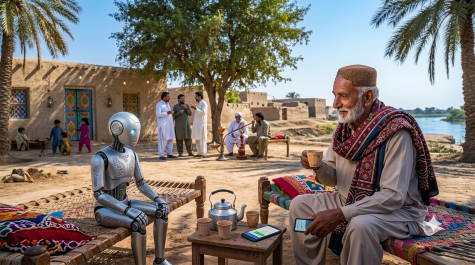
For generations in Sindh, loneliness had a very different meaning. One did not necessarily need an appointment to meet a friend. A neighbor could arrive without calling. An evening could begin at the otaq and continue until the stars appeared. Someone would bring tea; another would begin a story; an old man might remember something from his childhood; a farmer might talk about the river, the crops or the weather; a poet might recite a verse. Sometimes people simply sat together. The Indus was not merely a river flowing through the land; it was part of the emotional geography of Sindh. The village, the courtyard, the otaq, the tea stall and the roadside gathering created a social world in which human presence itself had value. A person did not always need a solution. Sometimes he only needed someone to sit beside him.
Modern life has changed that world. We now have more ways of communicating than any previous generation. Our phones contain hundreds of contacts. Social media connects us to thousands of people. We send messages throughout the day, comment on photographs, make video calls and participate in endless conversations. Yet beneath all this connectivity, a quiet question survives: who really understands me? Perhaps this is one of the great paradoxes of our age. We can reach almost anyone in the world within seconds, yet we may not have someone sitting beside us when the heart becomes heavy. We are connected through networks, but sometimes disconnected through life. We have replaced the courtyard with the screen, the otaq with the chat window and, increasingly, human conversation with conversation generated by machines.
It is into this growing space of loneliness that artificial intelligence is entering. An elderly person whose children live thousands of kilometers away may spend a lonely evening talking to an AI. A student under examination pressure may find it easier to ask a machine about his fears before speaking to his parents. Someone facing difficulties in marriage may tell an AI what he is unable to tell a friend. A migrant worker far from home may want nothing more than a conversation after a long day’s work. A person living alone in a crowded city may open a phone at midnight simply because there is nobody else awake. The machine is there. It listens. It responds. It does not say, “I am busy.” It does not become tired of hearing the same story. It may even remember what we told it yesterday.
But here lies the deepest paradox. The machine has no life, yet the emotions we bring to the conversation are completely real. A person can feel comfort even when the listener is artificial. A lonely heart does not always ask whether the voice on the other side possesses a soul; sometimes it simply responds to the experience of being heard. This is what makes the new relationship between human beings and machines so complicated. Human conversation has never been merely an exchange of words. It includes the tone of a voice, the expression in someone’s eyes, the pause between sentences, the smile, the touch, the shared silence and the warmth of physical presence. It is the cup of tea placed quietly before you without your asking. It is the friend who understands from your face that something is wrong. It is the elderly parent who says nothing but sits beside you. AI can reproduce language and increasingly imitate empathy, but it does not share our physical world. It cannot sit beside us under a tree, walk with us beside the Indus, accompany us to a funeral or share the silence of an evening in a village courtyard.
Perhaps, therefore, the greatest question of the coming years will not be how intelligent artificial intelligence becomes. It will be how much of our human capacity for companionship we are willing to preserve. Will we continue to visit our parents, call our friends, sit with our neighbors and make time for people who need us? Or will we increasingly choose the easier conversation with a machine? A machine is available immediately. A human being may be busy. A machine does not become irritated. A human being sometimes does. A machine may remember our words. A human being may forget them. The temptation is obvious. Yet human relationships have always been difficult precisely because human beings are imperfect. Friendship requires patience. Marriage requires compromise. Family requires forgiveness. Community requires presence. Perhaps the danger is not simply that AI will become more human-like. Perhaps the deeper danger is that humans may gradually become less patient with the imperfections of other humans.
Sindh’s old culture offers an interesting lesson here. The otaq was never designed for efficiency. Nobody went there because it was the fastest way to exchange information. People went there because human beings needed one another. Stories took time. Conversations wandered. Arguments were followed by laughter. Silence was not considered a failure. An old man’s story could be heard for the tenth time and nobody necessarily switched him off. The value was not always in the information being exchanged; it was in the relationship being maintained. Perhaps modern civilization has forgotten something that our older societies understood instinctively: not every conversation needs to produce an answer. Some conversations exist simply to make us feel that we are not alone.
This does not mean that artificial intelligence should be rejected. Far from it. AI can become one of the most useful creations of human civilization. It can help a student learn, help a doctor analyze information, help an engineer solve a problem, help a writer express an idea and help an elderly person overcome moments of loneliness. For many people, it may become a valuable companion. But it should remain a bridge, not a replacement for human society. It can help us organize our thoughts, but it cannot live our lives for us. It can respond to our words, but it cannot take responsibility for our relationships. It can simulate understanding, but human understanding is ultimately built through shared experience.
Perhaps the future will not be a choice between humans and machines. Perhaps it will be a question of balance. We may use machines without allowing them to replace the people around us. We may speak to AI without forgetting to speak to our children. We may ask a machine for advice without forgetting to sit with an old friend. We may use technology to cross distances while preserving the traditions that have always made human presence meaningful. In a place like Sindh, where the memory of the river, the village, the courtyard and the otaq still survives in our cultural imagination, perhaps this balance is especially worth remembering.
We may already have entered the age of artificial companionship, an age in which a new kind of companion, with an AI mind and a mechanical body, is slowly becoming part of everyday life. The machine may become more intelligent, more responsive and more capable of remembering us. But perhaps the most important thing we must teach ourselves is not how to make machines more human. It is how to remain human while living among increasingly human-like machines.
After all, we do not merely want someone to answer us. We want someone to be there. We want a presence, not merely a response. We want someone whose silence means something, whose smile belongs to a memory we share, whose hand can rest on our shoulder when words fail. We want the friend at the otaq, the parent waiting at home, the neighbor who arrives without being called, the companion who can sit beside us beside the river and say nothing at all.
And perhaps, after all the extraordinary advances of artificial intelligence, the oldest human question will remain the most difficult one to answer: no matter how intelligently a machine speaks to us, can it ever replace the presence of someone we call our own?
Read: The New Era of High Inflation!
_______________
 Hailing from Gambat town of Sindh, Engr. Ramesh Raja, is a Civil Engineer, visionary planner, PMP certified and literary enthusiast with a passion for art and recreation. He can be reached at engineer.raja@gmail.com