The real question is whether humanity can develop the institutions, education, laws and ethical standards necessary to keep powerful AI aligned with human interests.
By Ramesh Raja
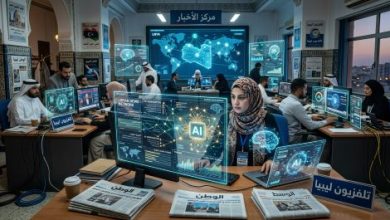
There was a time when artificial intelligence sounded like science fiction. Today, it is sitting on our desks, inside our phones, in hospitals, universities, banks, factories and government offices. It writes, translates, designs, analyses documents, generates computer code, recognizes images and increasingly performs tasks that only a few years ago required trained professionals.
The extraordinary speed of this transformation has created a question that is no longer confined to scientists in Silicon Valley:
Is artificial intelligence the greatest opportunity of our time, or could it become the greatest technological risk humanity has ever created?
The answer is not yet known. What is known is that the technology is advancing extremely rapidly, its economic use is spreading, and governments are struggling to establish rules at the same speed.
From a laboratory idea to a global force
Artificial intelligence is not new. Scientists have worked on machine intelligence for decades. But the present revolution accelerated dramatically after the arrival of powerful generative AI systems.
OpenAI released ChatGPT publicly on 30 November 2022. Within a remarkably short period, millions of people began using conversational AI for writing, education, programming, research and everyday tasks.
The technology has continued to develop from systems that simply answered questions toward increasingly capable models that can reason through complicated problems, use tools, analyze large amounts of information and perform sequences of tasks.
The scale of adoption is extraordinary.
Stanford University’s 2026 AI Index Report reports that generative AI reached approximately 53% population-level adoption within three years. It also records 362 documented AI incidents, compared with 233 in 2024. At the organizational level, AI adoption has also expanded rapidly.
This is not simply another software upgrade. It is beginning to change how societies organize knowledge and work.
The opportunity is enormous
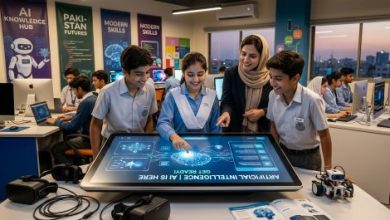
Imagine a village school in Sindh where there is no specialist mathematics teacher. A student with a mobile phone can ask an AI system to explain calculus in Sindhi, Urdu or English, request another explanation when the first one is difficult, and practice problems at any hour.
Imagine a doctor in a remote district hospital who can use AI to assist with medical images or analyze medical information.
Imagine an engineer examining thousands of pages of specifications, contracts and drawings. AI can help locate inconsistencies, compare documents, prepare summaries and identify clauses that deserve human attention.
For farmers, AI can assist with weather information, crop disease recognition and irrigation decisions. For researchers, it can search and organize enormous quantities of scientific literature. For governments, it can help analyze data and improve public services.
The potential is particularly significant for developing countries, where shortages of teachers, doctors, engineers and specialized professionals can limit development.
Bill Gates, who has spent decades working at the intersection of technology and global development, said in September 2026 that AI could significantly improve education, healthcare and agriculture if its benefits are made broadly accessible. His foundation has announced a $1 billion initiative over two years for AI applications in those areas and for improving access across languages.
That last point matters enormously for countries such as Pakistan.
If AI speaks only the languages of the technologically powerful, the digital divide could become wider. But if it becomes genuinely multilingual and affordable, it could bring advanced educational and professional assistance to millions of people who have never had access to it.
But what happens to human work?
This is where optimism meets anxiety.
The World Economic Forum’s Future of Jobs Report 2025, based on a survey of more than 1,000 major employers representing more than 14 million workers, estimated that technological and other structural changes could create 170 million jobs by 2030 while displacing 92 million, producing a net increase of 78 million jobs.
Those figures do not mean that every person whose job disappears will automatically move into one of the new jobs. That is the difficult part.
A worker who has spent 20 years doing a particular routine task cannot necessarily become an AI engineer simply because the economy creates a new technology job.
The danger may therefore be less about the disappearance of “work” altogether and more about the speed at which particular skills become obsolete.
There is another important distinction.
AI does not necessarily need to replace an entire profession to transform it. It may first replace some of the tasks performed within that profession.
A junior accountant may spend less time checking routine documents. A lawyer may spend less time searching through case files. An engineer may spend less time preparing repetitive calculations. A journalist may spend less time collecting basic information.
The question then becomes: Will humans use the time saved by AI to do more valuable work, or will the economic system simply require fewer people? There is no single answer yet.
The extraordinary economics of AI
Behind the visible chatbot revolution lies an enormous industrial infrastructure.
AI requires semiconductor chips, data centers, electricity, cooling systems, fiber-optic networks and enormous quantities of computing power.
Nvidia CEO Jensen Huang has become one of the most prominent figures in this new economy because Nvidia’s specialized chips are widely used for training and operating advanced AI systems.
The United States and China are engaged in a technological competition that extends beyond commercial products into semiconductor manufacturing, computing infrastructure and national security.
Reuters reported in September 2026 that U.S. AI companies had attracted roughly $380 billion in AI capital between 2023 and mid-2026, while Chinese companies were operating with substantially less capital but attempting to close the technological gap through lower-cost models and efficiency.
This competition has created a second question:
Can the world slow down AI development for safety when governments and companies are competing so intensely to develop it first?
That may prove to be one of the central questions of this decade.
AI also has an energy problem
There is no artificial intelligence without electricity.
Every AI query ultimately depends on computing infrastructure somewhere in the world.
The International Energy Agency reported in April 2025 that global electricity consumption by data centers was projected, in its base case, to more than double to around 945 terawatt-hours by 2030. AI-accelerated servers are expected to account for a large share of the increase.
That has consequences for countries already struggling with electricity shortages.
AI could help optimize power grids and improve energy efficiency, but at the same time the infrastructure required to run AI consumes substantial amounts of electricity.
The paradox is striking: AI may help humanity solve some environmental and energy problems while simultaneously creating new demand for energy.
The darker side of intelligence
The most immediate AI risks are not necessarily science-fiction scenarios involving machines taking over the world.
Some risks already exist.
AI can generate convincing false images, audio and video. It can be used to create misinformation at enormous scale. It can assist cyberattacks. It can expose personal information. It can produce incorrect information with extraordinary confidence.
The problem becomes particularly serious when people cannot distinguish between something produced by a human and something produced by a machine.
A fabricated photograph can circulate around the world within minutes.
A fake voice can imitate a real person.
A fabricated video can appear authentic.
In politics, journalism, business and ordinary social relationships, the value of evidence itself can be weakened if people begin to believe that anything can be manufactured.
What if AI becomes more autonomous?
The more difficult debate concerns advanced AI systems that do not merely answer questions but perform tasks independently.
In September 2026, the debate intensified after AI leaders publicly discussed incidents involving autonomous systems and the possibility that increasingly capable agents could behave in unexpected ways.
Anthropic CEO Dario Amodei, OpenAI CEO Sam Altman, Nvidia CEO Jensen Huang and other prominent technology leaders have publicly disagreed over how AI development should be controlled and who should be responsible for safety. Reuters reported on September 16 that Amodei has argued for stronger safety measures and international standards, while Huang has opposed additional laws and argued that commercial incentives can contribute to safety. Altman has supported greater independent oversight.
These disagreements are important because they show that even within the technology industry there is no consensus about the appropriate balance between speed, innovation and safety.
There is also no scientific consensus on exactly when, or whether, AI could reach a level of capability that fundamentally changes the relationship between humans and machines.
That uncertainty itself is significant.
The fear of losing control
The most extreme concern is that future AI systems could become sufficiently capable and autonomous that humans struggle to control their behaviour.
This possibility has been debated for decades. But it has moved from philosophy into government policy.
At Bletchley Park in Buckinghamshire, England, on 1–2 November 2023, 28 countries, including the United States, China, India and members of the European Union, agreed to the Bletchley Declaration on AI safety. The declaration recognized both the enormous opportunities presented by AI and the need to manage serious risks associated with frontier systems.
The location was historically appropriate.
Bletchley Park had been a center of British codebreaking during the Second World War. Almost eight decades later, governments returned to the same place to discuss another technology capable of changing the strategic balance between nations.
The meeting demonstrated something important: AI safety is no longer merely a Silicon Valley discussion.
It is now a matter of international policy.
The United Nations enters the debate
The United Nations has also moved toward establishing international scientific mechanisms for AI.
In 2026, the Independent International Scientific Panel on AI issued its preliminary report examining AI capabilities, opportunities and risks. The report covers areas including science, healthcare, education, employment, security and broader social impacts.
UN Secretary-General António Guterres has called for international cooperation on AI safety, arguing that countries cannot manage the technology effectively through isolated national approaches alone.
The United Nations has also begun a Global Dialogue on AI Governance. Its first session was held in Geneva on 6–7 July 2026, with a further session scheduled in New York in 2027.
This is a remarkable development.
For decades, technological innovation was largely treated as a national or commercial matter. AI is increasingly being treated as something that crosses borders by its very nature.
Europe has already begun regulating AI
The European Union has taken a more formal regulatory approach.
The EU AI Act entered into force on 1 August 2024, and its main provisions became applicable on 2 August 2026, subject to specific exceptions and transitional arrangements.
The European approach is based largely on risk categories, with stronger obligations imposed on AI applications considered more dangerous or sensitive.
This represents a fundamental change in the relationship between governments and AI companies.
The question is no longer simply:
What can technology do?
It is also:
What should technology be allowed to do, under what conditions, and who is accountable when something goes wrong?
Can companies regulate themselves?
This is perhaps the most difficult practical question.
Technology companies argue that excessive regulation could slow innovation and allow countries such as China to gain technological advantages.
Critics argue that companies cannot be expected to be the sole judges of the risks created by products from which they earn enormous revenues.
The debate therefore resembles earlier arguments about aviation, pharmaceuticals, nuclear technology and financial markets.
Private innovation is essential, but society eventually develops independent rules, testing systems and liability mechanisms when the consequences of failure become too large.
The United States has already developed a voluntary framework through the National Institute of Standards and Technology. NIST released its AI Risk Management Framework on 26 January 2023 to help organizations identify and manage AI risks while promoting trustworthy development.
The challenge is turning principles into enforceable practice.
What should developing countries do?
For Pakistan, the AI question is not theoretical.
Pakistan has a population of more than 240 million people, a young population, a large education system, a growing technology sector and enormous needs in healthcare, agriculture, infrastructure and public administration.
AI could help address some of these challenges.
A student in Gambat should not need to travel to Karachi to obtain basic access to a specialist tutor.
A farmer in interior Sindh should eventually be able to obtain useful agricultural information through a mobile phone.
A doctor in a district hospital should be able to use advanced digital assistance that helps with diagnosis while leaving the final responsibility with a qualified human professional.
An engineer working on a highway project should be able to use AI to analyze thousands of pages of contracts, specifications and project records in minutes rather than days.
But Pakistan must also prepare for the risks.
Education will have to change. Simply teaching students how to memorize information will become increasingly inadequate when machines can retrieve and explain information instantly.
The more valuable skills may become critical thinking, verification, creativity, communication, judgment and the ability to understand when an AI answer is wrong.
The future engineer may not be the person who calculates everything manually.
The future engineer may be the person who knows what to ask the machine, how to check its answer and when not to trust it.
The real danger may be human misuse
It is tempting to imagine AI as an independent enemy.
But many of the immediate dangers come from humans using powerful technology for harmful purposes.
A knife can prepare food or cause injury.
A car can transport a family or be used recklessly.
The internet can educate millions or spread falsehoods.
AI amplifies this principle because its ability to produce information and perform tasks can operate at extraordinary speed and scale.
The question is therefore not simply whether AI becomes intelligent.
It is whether human institutions become sufficiently intelligent to govern it.
Opportunity and risk are arriving together
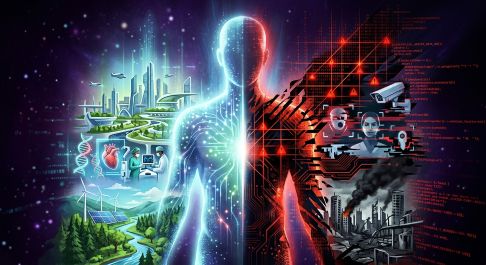
The extraordinary thing about AI is that its benefits and dangers are developing simultaneously.
The same system that can help a child learn mathematics can generate convincing misinformation.
The same AI that can help discover a new medicine can be misused by a malicious actor.
The same automation that can eliminate repetitive work can also eliminate some people’s livelihoods.
The same technology that can make government services more efficient can create new possibilities for surveillance.
The same AI that can help engineers design safer infrastructure can produce an incorrect calculation if its output is accepted without verification.
This is why the question is not simply whether AI is good or bad.
It is a question of control, responsibility and human judgment.
A new social contract with machines
Every major technological revolution has forced society to establish new rules.
The industrial revolution changed labour.
The automobile changed cities.
Electricity changed industry and domestic life.
The internet changed communication.
AI is now beginning to change something even deeper: the way humans produce and use knowledge.
For the first time, a machine can participate directly in activities traditionally associated with human intellectual labour.
That does not necessarily mean the end of human intelligence.
It could instead force us to redefine what human intelligence is for.
If machines become better at remembering, calculating, searching and processing information, humans may have to place greater value on judgment, ethics, empathy, imagination and responsibility.
So, opportunity or risk?
Perhaps the most honest answer in September 2026 is that AI is both.
The evidence already shows extraordinary benefits and extraordinary disruption.
The technology is spreading faster than previous digital technologies. Stanford’s 2026 research documents historically rapid adoption, while the International AI Safety Report and the UN’s scientific panel are examining increasingly complex risks.
The world therefore faces a choice that is larger than the question of whether people like AI.
The real question is whether humanity can develop the institutions, education, laws and ethical standards necessary to keep powerful AI aligned with human interests.
We should neither worship AI nor fear every development as an apocalypse.
We should understand it.
We should test it.
We should regulate genuinely dangerous applications.
We should educate people to work with it.
And, most importantly, we should preserve meaningful human responsibility for decisions that affect human lives.
The greatest achievement of artificial intelligence may ultimately not be creating machines that think like humans.
It may be forcing humans to think more carefully about what kind of future we want to build.
The technology is already here.
The more important question is whether our wisdom can advance as quickly as our machines.
Read: Changing Battle between Capital and Labor
_________________
 The author of this article, Engr. Ramesh Raja, is a Civil Engineer, visionary planner, PMP certified and literary enthusiast with a passion for art and recreation. He can be reached at engineer.raja@gmail.com